Research
Considering that both the EU and South Korea hope the Indo-Pacific region will remain free, open, and prosperous without being defined by US-China competition, both can cooperate to mitigate maritime challenges and protect the global commons.
However, South Korea’s hedge is less likely to transform into overt balancing against China over the short-term via multilateralizing cooperation with European partners. Neither South Korea nor their European partners want to antagonize China in the short-term; instead, they want to build a more inclusive regional order that is not defined by strategic competition between the US and China.
Both also share a vision that the Indo-Pacific region should be under liberal rules-based order, which has been undermined by China’s revisionist behaviors. Seoul needs to broaden its strategic outlook in the Indo-Pacific region and understand that its strategic relevance and economic development are mostly nested within the liberal rules-based order, of which decline cannot be defendable without multilateral effort, Kuyoun Chung (Kangwon National University) argues.
This is the fifth of seven papers in the HCSS Guarding the Commons series, edited by Paul van Hooft and Tim Sweijs, and is part of the new HCSS “Europe in the Indo-Pacific Hub (EIPH)”. More papers will follow in the coming weeks.
Read the complete paper series here:
- Thucydides Lives in Asia: Power Transition Traps Are Real, by Patrick Porter (University of Birmingham)
- Between AUKUS and the Quad: Scaling European Interest in the Indo-Pacific, by Jagannath Panda (Manohar Parrikar Institute for Defence Studies and Analyses)
- European Engagement in the Maritime Security in Indo-Pacific: a Japanese Perspective, by Yuki Tatsumi (The Stimson Center)
- Getting Real about the Indo-Pacific: Redefining European Approach to Maritime Security, by Frédéric Grare (European Council on Foreign Affairs – ECFR) and Mélissa Levaillant (Institute of Higher National Defence Studies)
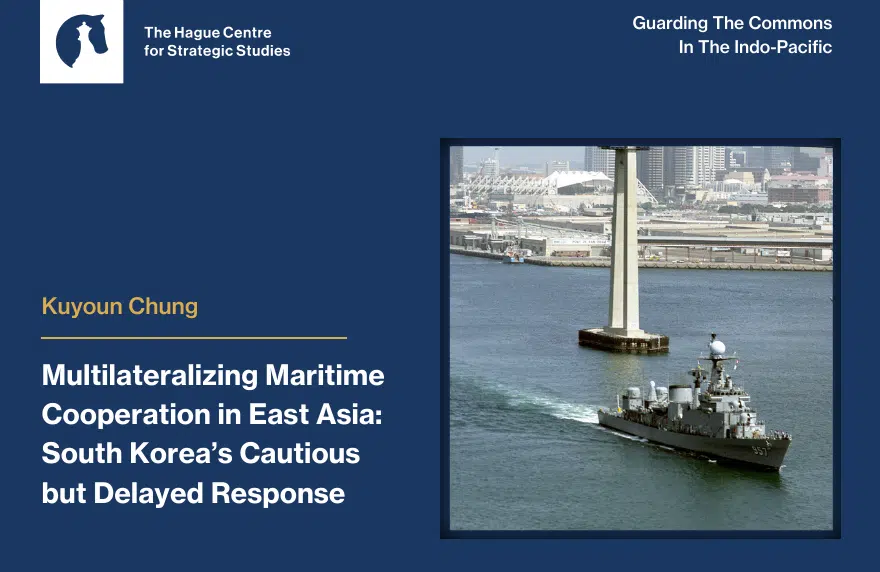
- Multilateralizing Maritime Cooperation in East Asia: South Korea’s Cautious but Delayed Response, by Kuyoun Chung (Kangwon National University)
- It started with a ship… What role for Germany in the Indo Pacific’s security architecture?, by Johannes Peters (Head of Center for Maritime Strategy & Security at the Institute for Security Policy at Kiel University (ISPK))
- Multilateralizing Maritime Security in the Indo-Pacific: How Europe can contribute to regional deterrence, by Stephan Frühling (Strategic and Defence Studies Centre, Australian National University)


Related Content