Indo-Dutch Cyber Security School 2026

Develop your career in Cyber Security

The Indo-Dutch Cyber Security School (IDCSS) is an annual event organized by Dutch and Indian organizations for students based in the Netherlands or India and young professionals interested in cyber security issues. The central goal of this school is to give students and young professionals the opportunity to grow professionally and academically, through lectures and online action learning, in the sphere of cyber security.
Attend the latest IDCSS

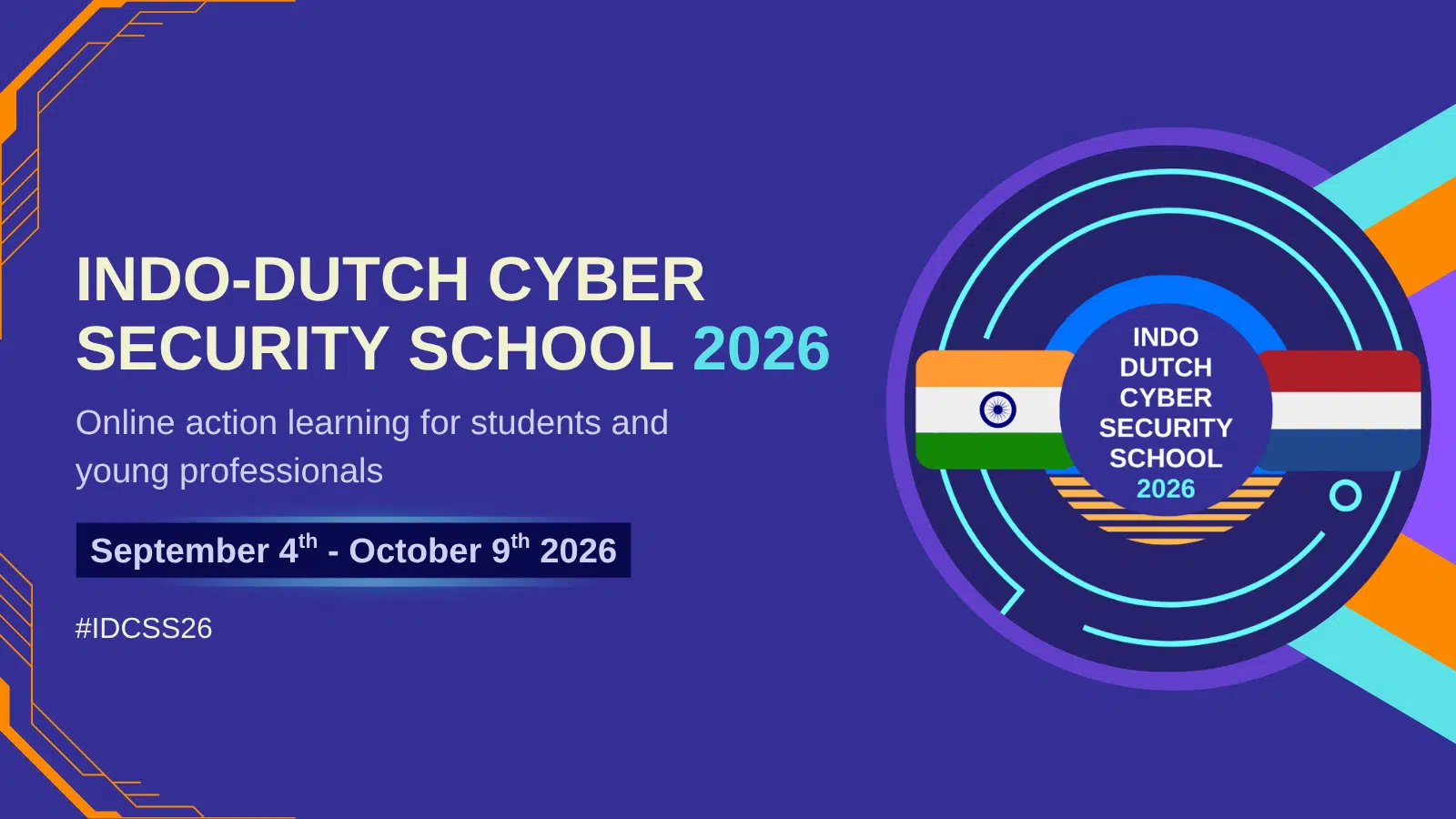
The need for ethical and highly educated young professionals in Cybersecurity is more pressing than ever. HCSS is proud to announce that IDCSS26 will be the ninth online course for young professionals in cyber security, held from 4th of September to the 9th October 2026. IDCSS26 offers a valuable opportunity for participants to gain further expertise in cybersecurity. Exemplary attendees may be rewarded with certificates in the specialties taught. Apart from a rich academic experience, participants have the chance to broaden their network and meet new people, including our expert speakers, our partner’s representatives, and fellow students. The school will be using the HCSS TEACH platform. To get access to the platform you first need to sign up via Eventbrite or Mera Events. Shortly before the schools starts you will be able to log in into the platform.

Programme and speakers

Over the years the Indo-Dutch Cyber Security School has held lectures on topics such as forensics in cybersecurity, data protection, blockchain, artificial intelligence, cyber arms watch and cloud computing. Our expert speakers come from a range of backgrounds in computer science, crisis and security management, law and industry. Previous speakers have included Christopher Painter – fmr. US Cyber Diplomat, and Venkatesh Murthy – Director of Data Security Council of India. In addition to the lectures, students will deepen their knowledge through action learning challenges, undertaken in multi-displinary groups and judged by the IDCSS partners. View the latest programme here.


HCSS TEACH.

HCSS TEACH is the main point of contact for participants of the Cyber Security Schools. Here you will find all the information needed to attend and participate in the school. Lecture schedules with Microsoft Teams links, the cyber resilience games sessions, partner challenges, announcements and all the information you need. Attendance for the school is tracked through the platform. Shortly before the school starts you will be able to log into the platform. To receive your login credentials, please complete the registration first via Eventbrite or Mera Events. When logging in for the first time, please click “Register” first and make sure to use the same email address you used to sign up via Mera Events or Eventbrite.

4100

Number of registrations

Participating organisations

Our partners in academia, government and industry

Since its inception the IDCSS has been supported by over twenty partners in industry, research and government. Our partners have included Governments of Karnataka and Telangana in India, The Hague Municipality, Embassy of India in The Netherlands, The Hague University of Applied Sciences, the Global Commission on the Stability of Cyberspace, TU Delft, Verizon and Symantec. As a result, students can partake in IDCSS for a nominal fee and distinguish themselves in front of their potential employers. Last year our partners included BlackPerl, Terra Eagle, Cynorsense and Globals Inc., Blockverse Institute and Cyber People B.V.

Previous Indo-Dutch Cyber Security Schools

The 2025 edition of IDCSS had over 8,000 participants from India and the Netherlands, who awarded the program a 7.8 out of 10 overall. Download the factsheet of the 2025 edition here.

The 2024 edition of IDCSS had over 2500 participants from India and the Netherlands, who awarded the program an 8.4 out of 10 overall. Download the factsheet of the 2024 edition here.

The 2023 edition of IDCSS had over 3300 participants from India and the Netherlands. Download the factsheet of the 2023 edition here.

In 2022 we had more than 2700 participants. Over 4 weeks in 2022 we held 20 specialist cyber security lectures and 5 multi-displinary challenges. In 2022, 95% of students were based in India and 5% based in the Netherlands. In 2021, 51% of participants were undergraduate students, 45% were graduate students and 4% PhD candidates. Since 2015, our cyber security schools have been held with the cooperation Municipality of The Hague and the Indian states of Telangana and Karnataka. Watch the 2020 IDCSS Inaugural Session here.

Strategic Cyber Resilience Game

The Strategic Cyber Resilience Game will also be a part of IDCSS26. In order to achieve your Certificate of Attendance, your will have to actively participate in the game as well as attend >75% of the lectures. More information on this will be shared when you register. 

In previous editions of IDCSS, students had the opportunity to play the Cyber Resilience Game as well. The intent of the game is to further educate the students on all different aspects of cyber resilience and challenge them to assess what capabilities are required to make India more cyber resilient. The game is played over a period of two weeks, guided by 3 online sessions, and played by more than 400 students. This component of the IDCSS curriculum gives the participants valuable insights about what lessons must be learned to make the Indo-Dutch cooperation and partnership more secure in our uncertain world. Based on the results of the 2023 game, a report was published on cyber resilience efforts in India, which can be downloaded here.

Find out more about HCSS serious gaming here. 

Hackathons

IDCSS participants can extend their learning further and take part in “The Great AppSec Hackathon 2026”, conducted by the Cybersecurity Centre of Excellence (CCoE).

The hackathon is open to students from all countries, aimed at nurturing talent in application security (AppSec), building cybersecurity skills and boosting global collaboration in securing the digital ecosystem. It brings together the brightest young minds across undergraduate and postgraduate backgrounds, in both tech and non-tech disciplines, to test their skills in real world scenarios through gamified challenges.

Registrations for the hackathon will be opening soon!

News

IDCSS25 partners with Cyber People and BlockVerse Institute!
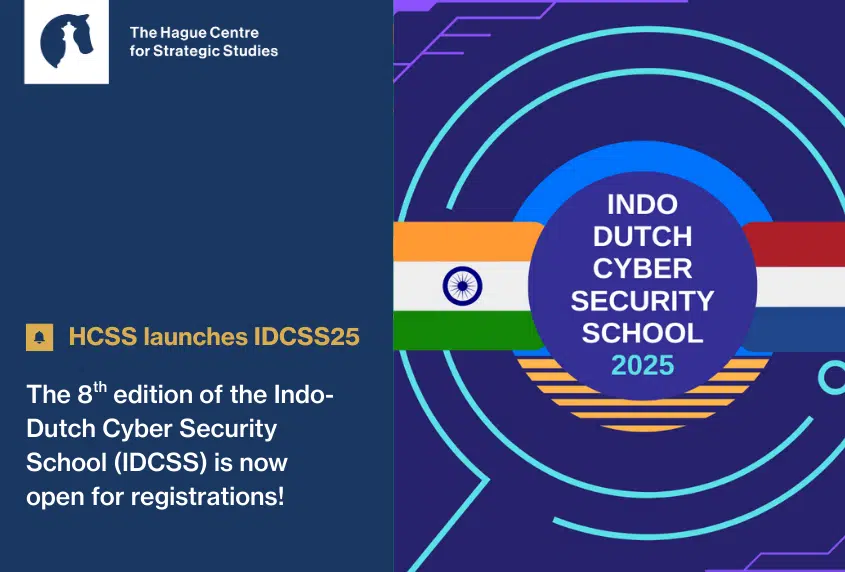
We are excited to announce a new collaboration between the Hague Centre for Strategic Studies (HCSS), organiser of the Indo-Dutch Cyber Security School (IDCSS), and Cyber People, a leading organisation in cyber talent recruitment and placement, and BlockVerse Institute, a future ready skilling and workforce transformation partner. Cyber People and BlockVerse Institute will support IDCSS in identifying top-performing students and skilling them based on industry demand. The skilling is to get them job ready and will be a self-paid, part-time, 3 months long program after IDCSS finishes. Students who perform well in this job readiness cohort will then be connected with relevant career opportunities within the cyber industry. You can already register your interest in the link!

The 8th edition of the Indo-Dutch Cyber Security School (IDCSS25) is open for registrations!
The 8th Edition of the Indo-Dutch Cyber Security School (IDCSS25) is now open for registrations! IDCSS25 will run from October 6th to November 7th, 2025. IDCSS is an annual online 5 week course for students and young to mid-career professionals who are interested in cybersecurity based in India or the Netherlands. Make sure to register now to secure your spot!

The Indo-Dutch Cyber Security School is back for 2023

The annual Indo-Dutch Cyber Security School, co-organised by The Hague Centre for Strategic Studies, Cybersecurity Center of Excellence (CCoE), the Data Security Council of India (DSCI) is back for another year! The Indo-Dutch Cyber Security School 2023 is supported by The Municipality of The Hague, Embassy of the Kingdom of The Netherlands in New Delhi, Embassy of India in The Hague, and Government of Telangana. Aimed at students and young professionals based in the Netherlands and India, IDCSS offers a unique platform to delve into the realm of cyber security. With a strong focus on professional and academic growth, this month long programme features engaging lectures, team working and interactive projects, empowering participants to excel in the field of cyber security.

Indo-Dutch Innovators: interview with Michel Rademaker on cybersecurity
For their Indo-Dutch Innovator series, the Netherlands Innovation Network India spoke to Michel Rademaker, Deputy Director at HCSS and one of the key persons behind the Indo-Dutch Cyber Security School 2022. Michel talked about cybersecurity, cyber diplomacy and the benefits of an Indo-Dutch collaboration in the cyber sector.

Launch of the 5th edition of the Indo-Dutch Cybersecurity School (IDCSS22)

We are delighted to announce the 5th edition of the Indo-Dutch Cybersecurity School (IDCSS22), an online programme, is launching today. This 4-week free course is a joint initiative of Hague Centre for Strategic Studies (HCSS), Data Security Council of India (DSCI), the Cybersecurity Centre of Excellence Telangana, the Municipality of The Hague, the Embassy of India in The Hague, and the Embassy of the Kingdom of the Netherlands in New Delhi, along with several partner organizations and sponsors.

Meet the lecturers

  • Michel Rademaker

    Michel Rademaker is one of the co-founders of HCSS and the Deputy Director. His fields of expertise include security strategy, policy, concepts and doctrines, technology assessments, geopolitical and economic security implications of climate change, raw materials and energy supply and serious gaming techniques.

    At IDCSS, he will host the ‘Cyber Resilience Game’, an online serious-game that allows students to practically engage with hypothetical cyber incidents. The game will be explained in 3 Phases and end with a results session.

    Michel Rademaker

    Deputy Director HCSS

  • Jeroen Prinse

    Jeroen Prinse is a seasoned cybersecurity leader with nearly two decades of experience bridging the gap between technical security measures and business objectives. As the Founder and Owner of Het Security Office, he specializes in translating complex information security concepts into actionable strategies that align with organizational goals. His expertise spans various industries, including government, finance, technology, and logistics.

    At IDCSS, he will provide a lecture on Building a Cyber Resilience Target Operating Model for the AI Era.

    Jeroen Prinse

    Founder and Owner of Het Security Office

  • Marijn van Schoote

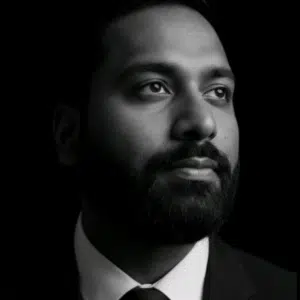
    Marijn van Schoote studied Computer Engineering and Business Information Systems in Twente. After working for several years as an IT auditor at Deloitte, he spent over a decade as Chief Information Security Officer (CISO), responsible for the digital resilience of the Port of Rotterdam Authority. Currently, Marijn is the Managing Director of Ferm-Seaports.

    At IDCSS, he will provide a lecture on Cyber Security in Ports and Critical Infrastructure.

    Marijn van Schoote

    Managing Director of Ferm-Seaports

  • Rutger Leukfeldt

    Rutger Leukfeldt holds the special chair of Governing Cybercrime, established and managed by the Netherlands Institute for the Study of Crime and Law Enforcement (NSCR). Rutger’s education and research focuses on the human factor in cybercrime. Who are the perpetrators, what are their crime scripts? What are risk profiles of victims? How can we tackle cybercrime?

    Rutger has more than 130 cybercrime publications to his name (including more than 70 peer-reviewed publications, 6 books and numerous professional publications and reports). Rutger is chair of the Cybercrime Working Group of the European Society of Criminology (ESC) and one of the founders of the annual Human Factors in Cybercrime Conference.

    At IDCSS, he will provide a lecture on Cybercriminology: the human factor in cybercrime.

    Rutger Leukfeldt

    Senior Researcher Cybercrime at NSCR

  • Thomas Attema

    Thomas Attema is a senior researcher in the Applied Cryptography and Quantum Applications department of TNO and the Cryptology group of CWI. He obtained his PhD at the Mathematical Institute of Leiden University. He focuses on the development and deployment of novel cryptographic techniques designed to withstand quantum attacks. Additionally, he explores advanced cryptographic functionalities that enable privacy-preserving data analysis.

    At IDCSS, he will provide a lecture on The Quantum Threat to Cryptography.

    Thomas Attema

    Senior Researcher at TNO

  • Godert Jan van Manen

    Godert Jan van Manen is a seasoned cyber security, technology risk and control specialist with over 25 years of hands-on experience, guiding organizations through complex challenges. His career has spanned critical areas such as technology design, large-scale implementations, migrations, and disaster recovery teams — all while keeping security, governance, and compliance at the forefront at diverse commercial companies and government institutions

    With a deep understanding of risk management frameworks and control principles, Godert Jan has helped businesses across diverse industries strengthen their defenses against evolving cyber threats. He is known not only for his technical expertise but also for his ability to translate complex security concepts into clear, actionable strategies that resonate with executives and teams alike.

    Calm under pressure and focused on alignment with business objectives, Godert Jan brings both strategic insight and practical experience to the table — making him a trusted voice on how organizations can thrive in an increasingly digital and risk-laden world.

    At IDCSS, he will provide a lecture on Cybersecurity in large educational institutions.

    Godert Jan van Manen

    Information Security Officer at Lucas Onderwijs

  • Allison Pytlak

    Allison Pytlak is the Senior Fellow and Director of the Cyber Program at the Stimson Center. Her research on cybersecurity has examined the interplay between cyber operations and international relations including state-centric cyber policy and multilateral governance structures, with a focus on United Nations (UN) processes and frameworks. In this context Pytlak has leveraged her significant experience in multilateral arms control and disarmament policy to identify opportunities for effectively advancing international law, norms and governance frameworks towards reducing cyber harm. Current projects focus on accountability and deterrence, multilateral policy and process, as well as cybercrime scam operations.

    In her prior role with the Women’s International League for Peace and Freedom (WILPF), Pytlak monitored and reported on the UN’s working group on state behavior on cyber space and played an important role as a liaison and advocate for civil society participation. She has researched, published, and provided numerous trainings about the gendered and human rights-based dimensions of cyber security and diplomacy.

    Prior to joining Stimson, Pytlak managed WILPF’s disarmament program where she contributed to its monitoring and analysis of UN disarmament processes including on cyber security and advanced feminist perspectives on international security topics through research and advocacy. Pytlak has worked within international civil society disarmament networks for more than 15 years, including as former staff of the Control Arms Coalition and on the governance body of the International Campaign to Abolish Nuclear Weapons, recipient of the 2017 Nobel Peace Prize.

    She holds an Honours B.A. in International Relations from the University of Toronto and an M.A., also in International Relations, from the City University of New York where her graduate research focused on inter-state cyber conflict.

    At IDCSS, she will provide a lecture on Pall Mall Process and Commercial Cyber Intrusion Capabilities.

    Allison Pytlak

    Senior Fellow and Director of the Cyber Program at the Stimson Center

  • Christopher Painter

    Chris Painter is a globally recognized leader and expert on cybersecurity and cyber policy, Cyber Diplomacy and combatting cybercrime. He has been on the vanguard of U.S. and international cyber issues for over twenty five years—first as a prosecutor of some of the most high-profile cybercrime cases in the country and then as a senior official at the Department of Justice, FBI, the National Security Council and finally the State Department. He has initiated, helped drive, or advised on virtually every major U.S. cyber policy for over a decade and has created innovative new organizations and approaches to deal with threats and take advantage of opportunities in cyberspace.

    In his most recent government role as the nation’s top cyber diplomat, Mr. Painter coordinated and led the United States’ diplomatic efforts to advance an open, interoperable, secure and reliable Internet and information infrastructure and advised the Secretary and Deputy Secretary of State on these emerging issues. The pioneering office that Mr. Painter established — the Office of the Coordinator for Cyber Issues — was the first high-level position and office dedicated to advancing the diplomatic aspects of cyber issues ranging from national security to human rights matters. These issues include promoting norms of responsible state behavior and cyber stability, preventing cyber conflict, enhancing deterrence, advancing cybersecurity, fighting cybercrime, promoting multi-stakeholder Internet governance and advancing Internet freedom.

    Among many other things, Mr. Painter was instrumental in negotiating a landmark agreement regarding the theft of intellectual property with China, negotiating a comprehensive cyber cooperation agreement with India, using diplomatic and other tools to combat high-profile cyber attacks and intrusions, and launching first of their kind “whole of government” cyber dialogues and capacity building programs with dozens of countries in Europe, Asia, the Americas, the Middle East and Africa. He and his team also spearheaded the promotion of an international framework of cyber stability that includes building a consensus around norms of acceptable behavior and getting agreement on transparency and confidence-building measures designed to reduce the risk of miscalculation that could inadvertently lead to conflict in cyberspace.

    Prior to joining the State Department, Mr. Painter served in the White House as Senior Director for Cyber Policy and Acting Cyber Coordinator in the National Security Council. He was a senior member of the team that conducted the President’s Cyberspace Policy Review in 2009 and he subsequently helped create and then structure a new directorate in the National Security Council devoted to these issues.

    Mr. Painter has been a frequent media spokesperson and presenter on cyber issues around the globe. He was named the Bartels World Affairs Fellow by Cornell University for 2017-2018 and chosen as a member of the Board of the Center for Internet Security. He is the recipient of the prestigious RSA Award for Excellence in the Field of Public Policy (2016), the Attorney General’s Award for Exceptional Service, the Intelligence Community Legal Award (2008) and has been named to the “Federal 100” list, among other honors. He is a graduate of Stanford Law School and Cornell University and clerked for US Circuit Judge Betty Fletcher. Currently Mr Painter serves as a Commissioner in the Global Commission on the Stability of Cyberspace.

    At IDCSS, he will provide a lecture on Ransomware.

    Christopher Painter

    Senior Fellow, Cyber security

  • Prof. Bruce W. Watson, Ph.D

    Bruce is Chief Advisor (Technical) at the National Security Centre-of-Excellence (Canada) and Emeritus Global Commissioner on Responsible AI in the Military Domain (GC-REAIM). He is also a Research Professor at the University of Waterloo, a Research Associate at Rhodes University, an Honorary Full Professor at the University of KwaZulu-Natal (UKZN), and leads Qorsa Labs’ research efforts – specializing in explainable AI, post-quantum cryptography, secure supply chains, and cybersecurity.
    He worked on compilers and programming languages (e.g., for Microsoft), followed by engineering and architecture work on pattern recognition for security (e.g., for Cisco), and optimization of chip designs (e.g., for ASML). Watson has been a presenter, participant and reviewer at several CyCons, including moderating various AI and Quantum Computing panels.
    Watson’s first Ph.D is in computing science and engineering from Eindhoven, after studying discrete mathematics and computer science in Waterloo (Canada). He later returned to Eindhoven as chair of Software Construction. Watson’s second Ph.D is from the University of Pretoria. He has published more than 100 papers and graduates several dozen Masters and Ph.D students, most of them cum laude.

    At IDCSS, he will provide a lecture on AI Implications in Cyber Security.

    Prof. Bruce W. Watson, Ph.D

    Chief Advisor at the National Security Centre-of-Excellence (Canada)

  • Dr. Lalit Mohan Sanagavarapu

    Dr. Lalit Mohan brings over 25 years of experience across IT and cybersecurity, most recently leading Product Management at Quick Heal Technologies and its enterprise arm, Seqrite, where he drove innovation across threat management, endpoint security and data privacy.
    Before Seqrite, he headed Product and Engineering for the Cyber Security Practice at Infosys, and led Innovation and R&D at Wells Fargo with a focus on FinTech and emerging technologies. He has played an active role in strengthening India’s banking cybersecurity ecosystem through engagements with RBI-affiliated institutions and national threat-intelligence platforms.
    He holds a Ph.D. in Computer Science and Engineering from IIIT-Hyderabad, with research specialising in threat intelligence. He writes and speaks widely on Zero Trust Network Access, privacy-by-design and data protection for regulated industries.

    At IDCSS, he will provide a lecture on From IOC to Intelligence: Turning Threat Data into Defensive Action.

    Dr. Lalit Mohan Sanagavarapu

    Cybersecurity Product Leader

  • Sai Krishna Singupuram

    Sai Krishna Singupuram is a seasoned Senior Cybersecurity Consultant with over a decade of diversified experience in the Cybersecurity & Privacy domain. His career reflects a steadfast commitment to protecting both enterprises and individuals in the digital landscape. He has worked across Enterprise Security & Security Operations, Incident Response, Digital Forensics, Risk Management, Penetration Testing, IoT Security, AI, Identity and Access Management (IAM), Threat Assessment, and creating robust security strategies. His experience includes running multiple Proof of Concepts on open-source technologies and contributing to cybersecurity policy development, currently exploring the emerging domains of privacy engineering, AI security and cyber diplomacy.

    In his current role as a Principal Cybersecurity Consultant, Saikrishna contributes significantly to fostering innovation, entrepreneurship, and capability-building in cybersecurity and privacy through Telangana State’s diverse initiatives.

    Beyond his technical expertise, Saikrishna is a dedicated thought leader and educator. He has conducted over 450 workshops on various cybersecurity and privacy topics, regularly engaging with audiences at industry events, webinars, and other platforms to share his extensive knowledge and insights. His contributions extend to writing, with authorship of numerous whitepapers and guidebooks, particularly in Incident Response, IoT Security, Privacy Engineering, Automotive Security, AI Security and insights into India’s cybersecurity landscape. Co authored law enforcement SOPs on digital forensic investigation. His efforts in this field have been recognized with Cyber Excellence awards for his achievements as a Cyber Author and for Excellence in Cybersecurity.

    In addition to his technical and educational efforts, Saikrishna actively promotes cybersecurity awareness and digital hygiene, empowering individuals to protect themselves against cyber threats, fraud, and scams. He is also an alumnus of the International Visitor Leadership Program (IVLP) - "Promoting Cybersecurity in the Quad Region."

    At IDCSS, he will provide a lecture on AI vs AI: The Future of Cyber Offence and Defence.

    Sai Krishna Singupuram

    Senior Cybersecurity Consultant, Cybersecurity Centre of Excellence (CCoE)

  • Srinivas Naik

    Srinivas Naik is a Security Researcher with Intel Corporation, based in Telangana, India, where his work centres on product and platform security — the discipline of finding and closing weaknesses in silicon, firmware and the software stack that sits on top of them.

    Deeply analytical and results-driven Senior Security Researcher with over a decade of expertise in Product Security, Confidential Computing, and Autonomous AI. Proven track record leading security research units at Intel Corporation, specializing in vulnerability research, trusted execution environments (Intel SGX). A recognized industry innovator holding 4 patents across US & EU regions, Srinivas is an accomplished speaker adept at translating complex threat vectors into robust enterprise-grade defenses across IoT and connected automotive landscapes.

    A recurring theme in his work is that the hardest problem in hardware security is not tooling but shared understanding — building a common vocabulary between hardware architects, firmware engineers and software security teams so that threats are reasoned about consistently across the whole stack.

    At IDCSS, he will provide a lecture on Web Application Security: From Vulnerabilities to Exploitation.

    Srinivas Naik

    Security Researcher, Intel Corporation

  • J. P. Mishra

    J. P. Mishra is the Founder and CEO of Deep Algorithms Solutions, a Hyderabad-headquartered cybersecurity company he co-founded in December 2021 to build AI-powered fraud prevention and threat detection for digital financial systems.

    He brings over 18 years of experience across artificial intelligence, data science, analytics and consulting with global technology organisations — background that shapes Deep Algorithms’ focus on enterprise-grade, standards-aligned products. Its flagship platform, adapID-AI, is an adaptive behavioural intelligence engine that continuously models identity behaviour across systems to surface compromised credentials, lateral movement, insider threats and anomalous access before they are exploited.

    Under his leadership the company has grown from a two-person team to roughly 60 employees, secured 10 patents, established a presence in the United States, and raised seed and pre-Series A funding led by Unicorn India Ventures. His stated mission is to make trust dynamic, invisible and resilient across every human and machine identity in the enterprise.

    At IDCSS, he will provide a lecture on Identity Is the New Perimeter: Understanding Human & Non-Human Identities and Behavioral Biometrics.

    J.P. Mishra

    Founder & Chief Executive Officer, Deep Algorithms Solutions Pvt. Ltd.

  • Venkat Melam

    Venkat Melam is an Executive Director at JPMorgan Chase, working within the firm’s Cybersecurity and Technology Controls organisation on technology governance, risk and controls, cybersecurity and information security.

    He brings more than two decades of experience in the field, with practitioner depth across information security, vulnerability management, third-party and vendor risk management, application support, and security automation using tooling such as Ansible and Jenkins.

    Beyond his day role he is active in the wider cybersecurity community — speaking at industry forums including the DSCI Financial Security Conclave (FINSEC) and contributing to JPMorgan Chase’s cybersecurity education and community-outreach initiatives. He holds a Master of Computer Applications (MCA) from Jawaharlal Nehru Technological University.

    At IDCSS, he will provide a lecture on Modern Vulnerability Management: From Risk Prioritization to Automated Remediation.

    Venkat Melam

    Executive Director – Technology Governance, Risk & Controls, Cybersecurity and Information Security, JPMorgan Chase

  • Arun Reddy

    Arun Reddy is Founder & Chief Executive Officer, Cynoresene Solutions Pvt. Ltd.

    At IDCSS, he will provide a lecture on Securing Agentic AI: Threat Models, Guardrails, and Risk Management.

    Arun Reddy

    Founder & Chief Executive Officer, Cynoresene Solutions Pvt. Ltd.

  • VVS A Trideep

    VVS A Tripdeep is Director-Cyber Security, Deloitte

    At IDCSS, he will provide a lecture on Cyber Risk Management & Resilience: Identifying, Quantifying, and Mitigating Digital Risk.

    VVS A Trideep

    Director-Cyber Security, Deloitte

  • Kshitij Tiwari

    Kshitij Tiwari is India Head and CoS at Project Karna Pvt. Ltd.

    At IDCSS, he will provide a lecture on AI-Powered Social Engineering, Deepfakes and Digital Fraud.

    Kshitij Tiwari

    India Head and CoS, Project Karna Pvt. Ltd.

Frequently Asked Questions

Q: When will the IDCSS26 take place? 

A: The IDCSS26 will take place between the 4th of September and the 9th of October 2026. Lectures will start on the 7th of September and run every day for the next three weeks. The last lecture will take place on the 21st of September. This will be followed by two weeks of challenges, during which students will work in groups to complete several target-oriented tasks. The results of the Strategic Cyber Resilience Game and the challenges will be announced on the final week of the IDCSS26, with the closing ceremony to be held on the 9th of October. Find the full programme here

Q: How much time should I reserve for IDCSS26 courses and assignments? 

A: Students are expected to be engaged part-time in the IDCSS26 programme, so as not to be hindered in fulfilling their academic obligations in their respective universities. More specifically, attendants will be required to spend approximately 20 hours on lectures and 10 hours on assignments, spread out over 4 weeks. 

Q: When will the final program details be released? 

A: The final programme details are expected in due time, including details about courses and lecturers. Details on the assignments will be released halfway through the courses, in which time the selection of participants among the pool of students will be made. 

Q: I do not have a background in Cybersecurity. Can I apply to IDCSS26?

A: Yes, you can! The lectures of the IDCSS26 are designed in such a way that they provide a mixture of content for both students who are new to the field as well as attendees that wish to build upon pre-existing knowledge.

Q: I don’t fulfill all the criteria. Can I apply to IDCSS26? 

A: Yes! Your motivation and acquired knowledge about cybersecurity also matters. Students who fulfill the criteria and are also highly motivated will be given priority. 

Q: Is there a participation fee? 

A: There is no fee for participants.

Q: How are courses going to be conducted? 

A: This year’s courses are going to be conducted online. Participants will need a digital device (desktop, laptop or smartphone) that uses enough bandwidth and has a stable connection in order to be able to attend the lectures, which are going to be livestreamed using Microsoft Teams and livestreamed on the IDCSS YouTube channel. 

Q: Will I receive credits? 

A: We are currently in discussion with various Colleges regarding a credit system for the IDCSS. More information will be published on the official IDCSS website. Apart from credits, participating students will receive an official certificate upon completion of the IDCSS26. 

Students who manage to successfully complete the school will receive up to two certificates by the end of the program. 

Indian students have the opportunity to do tests during the program, which will provide graded results.

Q: What kind of Certificate will I receive?

A: The IDCSS provides students with two types of certification. For attending >75% of lectures in the first part of the IDCSS program, and successfully completing the Strategic Cyber Resilience Game, students will receive a Certificate of Attendance. Upon completion of a Challenge in the second part of the IDCSS program, students will receive a Certification of Participation.

Q: What are the requirements for receiving a Certificate?

A: Students who have successfully participated in at least 75% of the IDCSS lectures AND have actively played the Strategic Cyber Resilience Game, were present at two out of three Game sessions and submitted their final deliverable, will receive an official Certificate of Attendance. Upon successful completion of a Challenge, students will receive a Certificate of Participation.

© The Hague Centre for Strategic Studies