
Latest Research

Stay up to date with our latest reports, papers, snapshots and alerts.

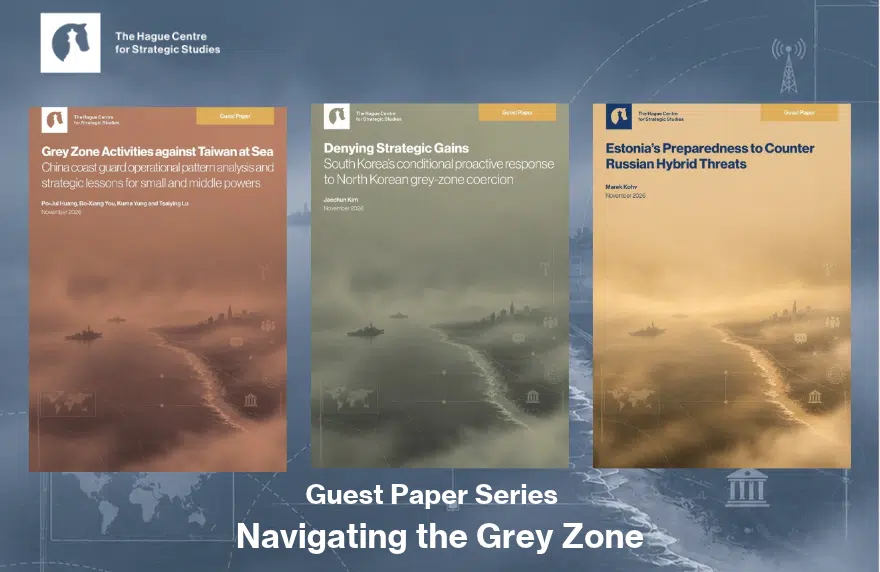
  • Grey Zone Guest Paper Series | Grey Zone Activities against Taiwan at Sea: China Coast Guard Operational Pattern Analysis and Strategic Lessons for Small and Middle Powers

    China Coast Guard operations around Taiwan show how persistent maritime presence can erode sovereignty below the threshold of armed conflict. This guest paper analyses three operational patterns: PLA-linked exercises, normalised law-enforcement patrols and civilian-vessel escorts. It argues that transparency, timely evidence and independent media access should form part of a routine response to maritime grey-zone coercion.

    Read more
  • Grey Zone Guest Paper Series | Denying Strategic Gains: South Korea’s Conditional Proactive Response to North Korean Grey-Zone Coercion

    What can Europe learn from South Korea’s management of North Korean grey-zone coercion? Professor Jaechun Kim examines how Seoul has responded to sustained maritime and political pressure under the shadow of North Korea’s nuclear capabilities. The paper highlights the importance of proportionate, conditional action that denies strategic gains while preventing escalation into wider conflict.

    Read more
  • Grey Zone Guest Paper Series | Estonia’s Preparedness to Counter Russian Hybrid Threats

    How does Estonia prepare for Russian hybrid threats? Marek Kohv’s paper examines Estonia’s whole-of-society approach, linking public awareness, security communication, criminal investigation, continuity planning and cyber defence. Its central lesson is that resilience depends on cooperation: hybrid attacks can simultaneously affect public order, essential services, infrastructure, and trust in government.

    Read more
  • Human Responsibility and Accountability – Compliance Challenges and the Industrial Impact of the GGE Framework

    Lethal autonomous weapon systems (LAWS) are changing the ways wars are being fought. Military decisions are now made by autonomous drones powered by AI instead of humans. The world grapples with effective guardrails to prevent an unchecked arms race. HCSS examines the guardrails in the UN CCW Group of Governmental Experts’ 2026 report and what their suggestions mean for defence manufacturers. Most importantly, the authors find that the framework places few direct obligations on the companies developing autonomous capabilities. They call for continuous legal review of materially modified systems, stronger technical standards and a structured route for industry and independent expertise to inform future international rules.

    Read more
  • Position Paper | Resilient SAF Supply Chains for Fuel Security

    How can sustainable aviation fuels strengthen Europe’s energy security and military readiness? In a new position paper, HCSS Strategic Analyst Irina Patrahau explores how resilient Sustainable Aviation Fuel (SAF) supply chains can support decarbonisation, industrial competitiveness and defence preparedness. Prepared ahead of a parliamentary roundtable in the Dutch House of Representatives, the paper sets out three priorities for the Netherlands and the EU:strengthen civil-military cooperation on fuel, build resilience into supply chains, and recognise fuel production facilities as strategic dual-use assets.

    Read more
  • Know Thy Enemy, Know Thyself: Simulations of Political Leaders’ Crisis Behaviour after a Ceasefire in Ukraine

    What happens when a fragile ceasefire in Ukraine breaks down, and a second international emergency hits before leaders can bring the situation under control? In a new report, HCSS uses 160 crisis simulations to examine how political leaders might respond to a ceasefire breakdown compounded by a second international emergency. From Trump and Putin to Zelensky and Macron, the findings highlight the importance of coalition cohesion, leader behaviour and preparing for escalation and de-escalation. The report sets out seven recommendations for NATO and European policymakers to strengthen crisis preparedness.

    Read more

Trending Topics

Find out what we are currently working on.

About The Hague Centre for Strategic Studies

HCSS conducts research on geopolitical, defence & security issues to governments, international institutions and businesses. We combine broad conceptual knowledge, qualitative and quantitative methods and present our findings in the form of recommendations, strategic explorations and scenario analyses.

News

Catch up with the latest HCSS media appearances, interviews, op-eds, webinars, columns and more.

Navigating The Grey Zone Guest Paper Series

Stay up to date with the HCSS Newsletter

Sign up to our biweekly newsletter to receive the latest news and analyses from HCSS.

© The Hague Centre for Strategic Studies