
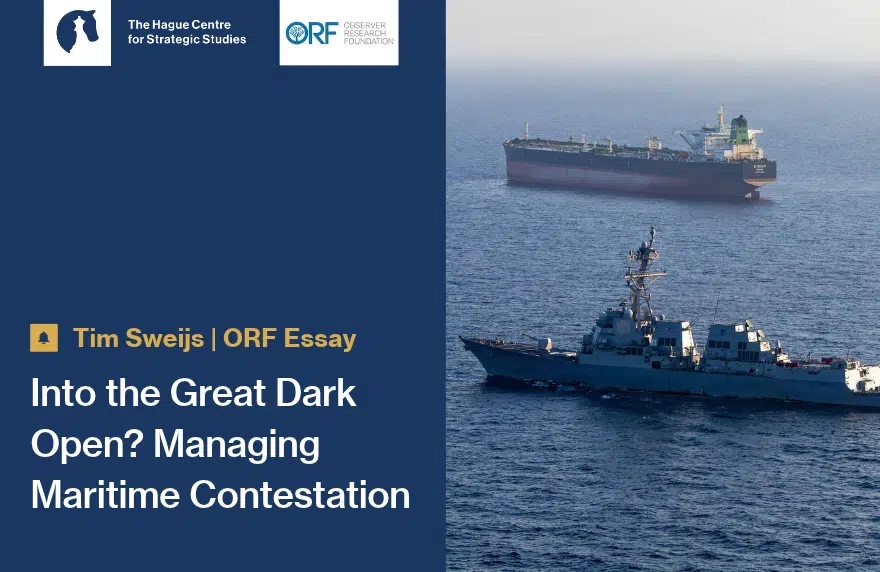
The world’s seas are becoming arenas of strategic confrontation. As states seek to control vital shipping routes, expand their naval fleets, and deploy new maritime technologies, the risk of escalation is growing. In this essay, originally published on September 28 by the Observer Research Foundation (ORF), HCSS Research Director Dr. Tim Sweijs examines how contestation over Sea Lines of Communication is reshaping global security, from the Strait of Hormuz to the Taiwan Strait. He argues that this trajectory is not inevitable: political leadership, military dialogue, and mechanisms for restraint are urgently needed to preserve freedom of the seas and prevent wider conflict.
This essay by HCSS research director Dr. Tim Sweijs was originally published on September 28 as part of the Sagarmanthan Edit 2026 essay series by the Observer Research Foundation (ORF).
Growing contestation of sea lines of communication and a global naval buildup are heightening the risk of escalation, underscoring the urgent need for mechanisms to manage maritime competition
This is an era of systemic confrontation. Revisionism is rife, competition is fierce, coercive statecraft is overtly prevalent, and subversion is widespread. A handful of states are engaged in large-scale conventional war in select regions, while numerous conflicts simmer beneath the surface worldwide. Military budgets are rising as powerful states increasingly relegate international law to a relic of the past.
Patterns that Persist
There are few certainties in international relations, but there are certainly recurring patterns. In some cases these translate into persistent patterns that recur across time and place. One such pattern is that, in times of confrontation, contestation over Sea Lines of Communication (SLOCs) tends to become a focal point of international statecraft. Major, and sometimes non-major, powers will seek to control, deny or disrupt the arteries that connect the world to gain an advantage over their opponents. In wartime, states use SLOCs to project military power into adversarial homelands, threaten ships carrying vital commodities, and cut off societies from the goods and supplies they depend on. The possibility that adversaries may act in a similar manner reinforces the pernicious logic of the security dilemma. This, in turn, can drive an upward spiral of maritime buildup that typically precedes systemic wars.
That point in time may be closer than anticipated. Contestation of SLOCs has been spreading for some time now. From the Panama Canal and the GIUK gap — the passages between Greenland, Iceland and the United Kingdom — to the Black Sea’s littorals, and from the Strait of Hormuz to the Taiwan Strait, major and minor powers engage in overt maritime coercion. In East Asia, maritime militias affiliated with the People’s Liberation Army (PLA) engage in slightly less overt attempts to intimidate opponents, to poach marine resources, and to bolster claims over disputed territories. In Europe, attempts to sabotage critical undersea infrastructure (CUI) are becoming increasingly common, through attacks on energy pipelines and the disruption of communication cables in the continent’s littoral seas.
Governments are also building strategic stockpiles of materials critical to their economies and militaries, shifting from just-in-time to just-in-case approaches. They are also forging new technology partnerships across the globe — such as the Pax Silica Alliance, led by the United States (US), in the field of artificial intelligence and semiconductors — to ensure the integrity of complex supply chain networks.
Changing Maritime Power
At the same time, as conflict dynamics in Europe and the Middle East show, unmanned systems in, on, above, and out of the water have reshaped the balance of power, giving smaller actors greater capacity to challenge more powerful adversaries. Ukraine, without a navy to speak of, has been able to deny Russia the ability to operate close to Ukraine’s shores. Iran poses a clear and present danger to any ship navigating the Strait of Hormuz. As maritime balances of power shift with new technologies, growing uncertainty over adversarial capabilities and intentions further ratchets up the security dilemma.
A Global Naval Military Buildup
Across the globe, growing maritime contestation is raising awareness of the importance of maritime security. It is also driving a naval buildup that may be on the cusp of evolving into a maritime arms race. China is embarking on an extensive modernisation and expansion of its naval fleet, which is estimated to include more than 370 commissioned ships. It is growing its fleet by an estimated 10 percent annually as it continues its military rise from a regional to a global power. The PLA Navy has already surpassed its American counterpart in sheer numbers, albeit not yet in tonnage.
The US has neglected its defence industrial base and is “decommissioning ships faster than it commissions new ones”. To reverse this trend, the Trump administration issued the Presidential Memorandum on Rebuilding the United States Navy and America’s Shipbuilding Base in the summer of 2026. India, meanwhile, has embarked on an ambitious programme to strengthen self-reliance and create an “indigenised naval force”. Adding approximately one ship every forty days, and with more than fifty warships under construction, India seeks to establish itself as a regional maritime player. Europe, unsurprisingly, lags. Decades of neglect of its naval forces, combined with severe industrial fragmentation, have left acute capability gaps that undermine its ability to project extra-regional power for an extended period. European governments, however, have begun to address these gaps following the resurgence of large-scale and protracted war in Europe. Over the past four years, they have invested heavily in military
Tim Sweijs
Source: Originally published by the Observer Research Foundation (ORF) on September 28, 2026, as part of the Sagarmanthan Edit 2026 essay series (link)
Dr. Tim Sweijs is the Director of Research at The Hague Centre for Strategic Studies (HCSS). His work is multidisciplinary in nature and straddles political science, science and technology, strategic studies, and war studies. He is the initiator, creator and author of numerous books, articles and studies including but not limited to strategic foresight, interstate coercion (compellence and deterrence), international norms and regimes, defence and national security planning for small and middle powers. He has advised international organisations, governments and defence departments across the globe such as the United Nations Security Council, the European Parliament, the Dutch Parliament, as well as to NATO’s Parliamentary Assembly. He regularly comments on international affairs in national and international media and guest-lectures at the Netherlands Defence Academy, Leiden University, and King’s College London.
Experts

Related Content


