Publications

Over the years, HCSS has built up an extensive archive of reports, monitors, papers and other publications. We disseminate the results of our research as broadly as possible to benefit the public good. Use the advanced search functions below to browse through our research library, most of which is available as free PDF downloads.

26 Jul 2023
This year HCSS launched The Socio-Political Instability Survey, inviting experts from around the world give their views on the short-term likelihood and location of volatility and conflict globally. This 'Observer' outlines the results of the first Socio-Political Instability Survey and provides analysis.
18 Jul 2023
The existing energy supply relationship between industrial consumers in North-Rhine Westphalia (NRW), Dutch seaports and other supply chain partners is an important basis for the acceleration of green hydrogen supply chains between the Netherlands and NRW. In June 2023, HCSS co-organised a workshop on cooperation between the Netherlands and North Rhine Westphalia. This factsheet outlines the main takeaways from that workshop.
13 Jul 2023
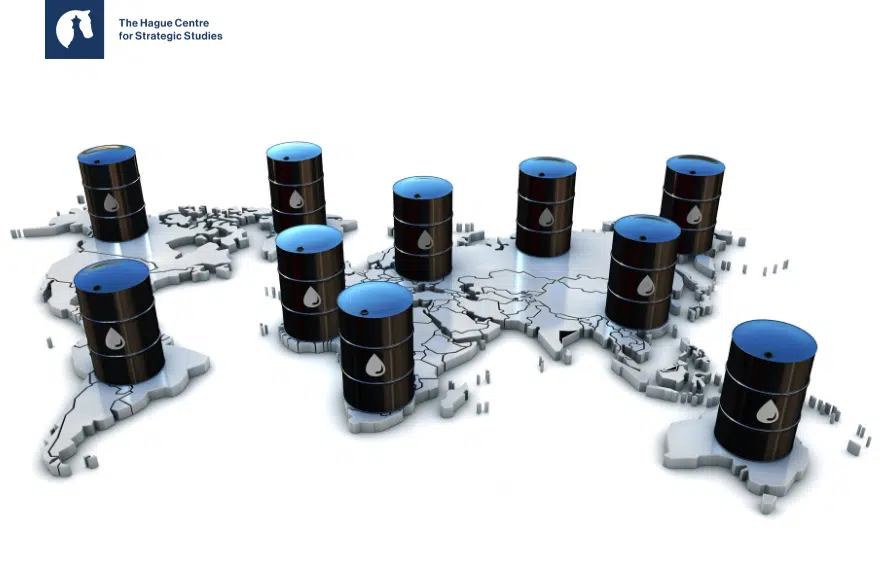
The world oil map is being redrawn. What does the global oil market look like a year after the invasion in Ukraine? What are the foreseen trends in the global oil market in the next 10-15 years? HCSS strategic analysts Irina Patrahau and Lucia van Geuns explore how these shifts and market volatility are affecting European industries and their competitiveness, in this article written for the Bulgarian Diplomatic Institute’s Foreign Affairs Research Paper on “Energy and Climate Diplomacy”.
26 Jun 2023
This paper by J.E. (Hans) Korteling, Beatrice Cadet and Tineke Hof begins by examining the neuro-evolutionary origins of cognitive biases and their subconscious effects on human thinking. The authors propose that information warfare can effectively exploit these cognitive biases to achieve desired outcomes.
22 Jun 2023
What are the implications of growing protectionism and strategic competition for Europe's energy security and decarbonization? In this paper, HCSS analysts Irina Patrahau, Lucia van Geuns and Michel Rademaker focus on the impact of the war in Ukraine on European energy security and decarbonization, with a specific focus on the tank storage sector.
19 Jun 2023
NATO recently revised its main doctrine, the Allied Joint Doctrine so that it now centres around influencing human behaviour. Apart from raising questions how this should be done, it also underlines the need to better understand the target audience. This paper by Yannick Smits (Leiden University and American University of Armenia) addresses ow to increase the success-potential of information-based behavioural influencing operations and how to better measure the effects of these operations in the post-campaign phase.
13 Jun 2023
Hoe gezond is de Nederlandse rechtsstaat? De Nederlandse rechtsstaat scoort consistent hoog in internationale metingen, maar het vertrouwen in onze rechtsstaat is historisch laag. In dit nieuwe HCSS rapport onderzoeken we de problematische trends achter dit verschijnsel en verkennen we scenario's voor de toekomst.
12 Jun 2023
This paper by Johan de Wit (Delft Technical University) presents brief summaries of four key studies that explore the factors that drive our intuitive or reasoned perceptions of risk. These studies are all conducted in the professional security domain to investigate real-life security risk decision making. The results of this paper identify some fundamental human traits that can be exploited to influence human decision behaviour.
6 Jun 2023
This paper by Robin Burda (Masaryk University) examines the experiences of Czechia and Ukraine in dealing with Cognitive Warfare (CW) and the implications for the European Union (EU) and the North Atlantic Treaty Organisation (NATO). It highlights the challenges faced by liberal democracies, which have their "hands tied" against CW threats.
25 May 2023
Judith T. van de Kuijt, Naomi Keja, Jacoline C. Slaager (TNO) explore four fundamental elements of Information Manoeuvre and identify three dilemmas concerning its scope and conceptual considerations. What should be the effects and what does it mean when information is used as a weapon? The question arises how the concept of Information maneuver can be defined. What is the essence of the concept, and of which elements does it consist of?
22 May 2023
This paper by Pontus Winther and Per-Erik Nilsson examines the implications of digital technology in modern warfare, focusing on the challenges it poses to International Humanitarian Law in the context of the Russian invasion of Ukraine. The study analyses the use of smartphone applications and chatbots by Ukrainian civilians to become advanced "spotters" of enemy movements.
16 May 2023
Cyberspace proved to be a catalyst to unlock the information environment, taking away restrictions of influence operations via Internet. Nowadays, the capabilities are near-limitless, but governance appears to be the (self-inflicted) limiting factor. While these limitations apply to the Netherlands they do not to others. Peter B.M.J. Pijpers and Paul A.L. Ducheine highlight whether the current cyberspace-induced manipulative influence operations truly differ from the old-school deceptive and misleading operations.  
15 May 2023
As organised crime groups play increasingly significant roles as agents of influence and political change, the subject should receive more attention from international relations, international security, and strategic studies, this new HCSS report warns.
9 May 2023
The risk of inadvertent nuclear escalation due to actions in the conventional domain is a serious, and underrated, feature of the current stand-off between NATO and Russia, following Russia’s 2022 invasion of Ukraine. This brief by HCSS analysts Paul van Hooft, Davis Ellison, and Tim Sweijs notes that NATO leaders and armed forces need to be conscious of unintended signals that can follow the placement of weapons, the movement of forces, and support to Ukraine, especially considering the deteriorating state of Russian armed forces.
2 May 2023
This brief by Jonathan D. Caverley (United States Naval War College) argues that even modest navies—almost uniquely among foreign policy tools— can effectively perform diplomacy when used thoughtfully and judiciously by civilian political leaders. Caverley explores how to analyse the diplomatic benefits of a naval vessel. The brief then discusses where to sink these costs.
1 May 2023
De verschuiving van politieke, economische en militaire macht naar de Indo-Pacific maakt deze regio van toenemend belang voor de Europese en Nederlandse welvaart en veiligheid. De toenemende assertiviteit van China en de militarisering van het Chinese buitenlands beleid zetten het vrije gebruik van de zee onder druk en hebben een destabiliserend effect op de gehele regio. Een meerderheid van de Indo-Pacific staten heeft behoefte aan meer Europese betrokkenheid in de regio om de multilaterale maritieme rechtsorde in stand te houden en ongehinderd maritiem verkeer tussen Azië en Europa te beschermen.
25 Apr 2023
What is the potential for European investments in advanced conventional weapons that could incentivise Russia back to the negotiating table? Competitive approaches to arms control are not without risk, and it is important to distinguish between “good fear” that is likely to incentivise an adversary to negotiate and “bad fear” that is likely to lead them to escalate with capability investments, posture changes, or procedural changes of their own.
25 Apr 2023
Veiligheid is en blijft een kerntaak van de overheid. Maar Pieter van Vollenhoven en Lodewijk Gunther Moor zetten in deze notitie grote vraagtekens bij de wijze waarop de overheid inhoud heeft gegeven aan deze kerntaak. De noodzaak van de komst van ‘onafhankelijk toezicht’ wordt hiermee nogmaals onderschreven om zo de samenleving tijdig te kunnen waarschuwen als de uitvoering van deze kerntaak door de overheid in het gedrang is.
18 Apr 2023
In this paper Dr. Chung Sam-man (KIMS) argues that in order to effectively target maritime challenges in the Indo-Pacific, including traditional security threats and newer challenges like climate change, a coalition of the willing that includes European navies and the navies of reliable and voluntary countries in the region needs to be forged.
17 Apr 2023
Deterring hybrid aggressors remains a difficult task. This new HCSS report by Mattia Bertolini, Raffaele Minicozzi and Tim Sweijs provides policymakers a set of practical non-technical guidelines for a counter-hybrid posture for small and middle powers, explaining how core good practices of cross-domain deterrence can be developed, applied and embedded into policies and practice.
12 Apr 2023
Nederland kan economisch worden ontwricht als geopolitieke competitie leidt tot exportverboden voor kritische grondstoffen en verstoring in de productie en aanvoer van halfgeleiders. Dit concluderen onderzoekers Joris Teer, Mattia Bertolini, en Benedetta Girardi in een nieuw rapport van het Den Haag Centrum voor Strategische Studies (HCSS).
3 Apr 2023
French presidential speeches in the Indo-Pacific from 2018 to 2021, structured a vision of France’s role in the region, as both a local actor – with territories in both the Indian Ocean and the Pacific Ocean – and a global power able to propose diplomatic, economic and military cooperation for the Indo-Pacific countries. This paper by Nicolas Mazzucchi (French Navy Centre for Strategic Studies (CESM)) highlights how France’s orientation in the Indo-Pacific region is consistent with its global strategy.
22 Mar 2023
Causality has been a burgeoning field, but for researchers it has been difficult to discern the assumptions they have to abide by in order to glean sound conclusions from causal concepts or methods. In an article published in the Journal of Artificial Intelligence Review, HCSS data scientists Maarten Vonk and Nino Malekovic, together with Thomas Bäck and Anna Kononova of the Leiden Institute of Advanced Computer Science (LIACS), aim to disambiguate the different causal concepts that have emerged in causal inference and causal discovery from observational data by attributing them to different levels of Pearl’s Causal Hierarchy.
21 Mar 2023
In southern Iraq, decades of water insecurity have influenced migration patterns by endangering agricultural output and the livelihoods of farmers. While a direct link between water insecurity and migration cannot be drawn, water insecurity may indirectly increase migration patterns by impacting individuals’ livelihoods, health, energy and food security. Learn more about what the Iraqi authorities and the private sector can do.

© The Hague Centre for Strategic Studies