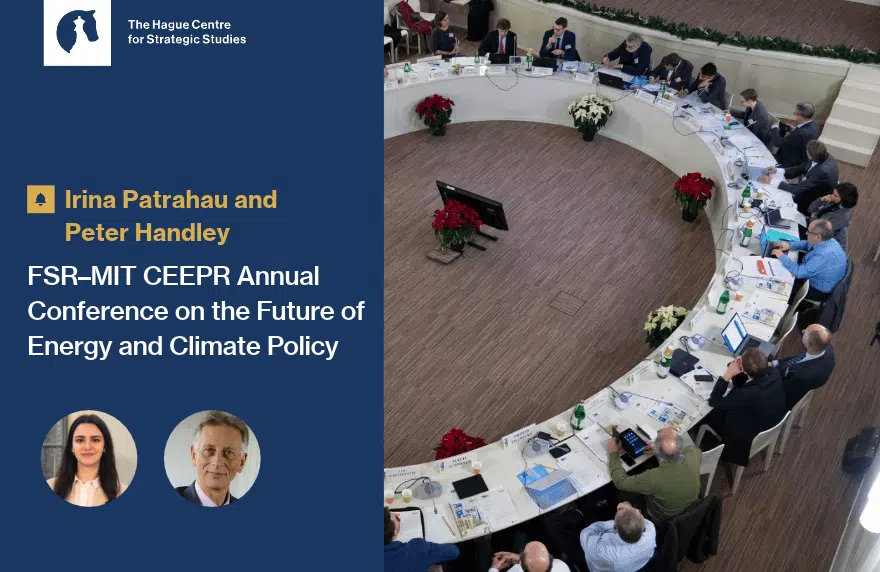
From 7-8 October, HCSS Strategic Analyst Irina Patrahau and Strategic Advisor Peter Handley participated in the first edition of the CEEPR-FSR Conference on the Future of Energy and Climate Policy in Florence, Italy.
Bringing together leading scholars, policymakers, regulators, and industry experts from both sides of the Atlantic, the inaugural conference on Energy and Climate Policy is organised by the European University Institute (EUI)’s Florence School of Regulation (FSR) and the Massachusetts Institute of Technology (MIT)’s Center for Energy and Environmental Policy Research (CEEPR).
‘Discussions here have been extremely interesting because you have a translatlantic viewpoint, you have the Florence School of Regulation on one side and MIT on the other. So it is very interesting to see the contrasts in the approach towards energy policy on the two sides of the Atlantic.’
Peter Handley, European Initiative for European Security and Strategic Advisor, Energy, Climate and Critical Raw Materials HCSS
Patrahau, Chair of the Energy Security and Critical Minerals initiatives at The Hague Centre for Strategic Studies (HCSS), joined the policy roundtable on “Securing Critical Mineral Supply Chains for the Energy Transition.” Chaired by Andris Piebalgs (EUI, FSR), the panel also included Richard Roth (MIT) and Marzia Sesini (EUI, FSR), as well as Peter Handley (European Initiative for European Security and strategic advisor on Energy, Climate and Critical Raw Materials for HCSS).
Looking back on the productive discussions, Patrahau stated:
‘The conference showed how important it is to maintain Transatlantic dialogue on energy and minerals, we can learn a lot from each other in how we are managing the energy transition.’
Reflecting on the value of transatlantic dialogue, the importance of bringing research and policymaking closer together, and the questions that will shape future cooperation, Patrahau adds:
‘We are moving from understanding the problems, to really concrete solutions. We need to continue challenging ourselves to come up with ideas of how to make our ambitions concrete, but also how to really bring those investments and the public-private cooperation to the next level.’


Related Content