HCSS
  • News
    • BNR | De Strateeg
    • Columns
    • Events
    • HCSS Newsletter
    • Podcasts
  • Publications
    • Publications
      • All Projects
      • All Publications
    • Geopolitics & Governance
      • Transatlantic Relations
      • Russia & Eurasia
      • Europe in the Indo-Pacific
      • AI in the Military Domain
      • PROGRESS / Strategic Monitor
    • Economics & Technology
      • Emerging Technologies
      • Critical Materials
      • Energy Security
    • Defence & Security
      • On Future War
      • Deterrence and Arms Control
      • Hybrid Threats
      • Cyber Security
    • Society & Resilience
      • Nationale Veiligheid en Weerbaarheid
      • Publieksmonitor Maatschappelijke Stabiliteit
      • Transnational Organised Crime
      • Strategic Monitor Dutch Police
    • Climate, Water & Food
      • Climate Security
      • Water, Peace & Security (WPS)
      • Food Security
  • Dashboards
    • Dashboards
      • All Tools
        • GINA
        • SARA
    • Geopolitics & Governance
      • DFRI
      • GINA | Diplomatic
      • GINA | Information
      • CLARIS
    • Economics & Technology
      • DOMINO
      • GATRI
      • GINA | Economic
      • Cyber Arms Watch
      • Cyber Comparator
      • Cyber Norms Observatory
      • Cyber Transparency
    • Defence & Security
      • GINA | Military
      • Nuclear Timeline
    • Society & Resilience
      • DAMON
    • Climate, Water & Food
      • Agrifood Monitor
      • CARMEN
      • CRM Dashboard
  • Leadership Practice
    • HCSS Leadership Practice
    • HCSS Boardroom
    • Strategic Negotiations Course
    • Serious Gaming
    • IDCSS | Indo-Dutch Cyber Security School
    • SANCS | Southern Africa-Netherlands Cyber Security School
  • About HCSS
    • Contact Us
    • HCSS Datalab
    • Our People
    • Funding & Transparency
    • Internship Programme
    • Press & Media Inquiries
    • Studio HCSS
    • Working at HCSS
    • Global Futures Foundation
  • Click to open the search input field Click to open the search input field Search
  • Menu Menu

News

HCSS at GLOBSEC | Europe’s Pivot: Converting Economic Weight into Geopolitical Clout

May 21, 2026

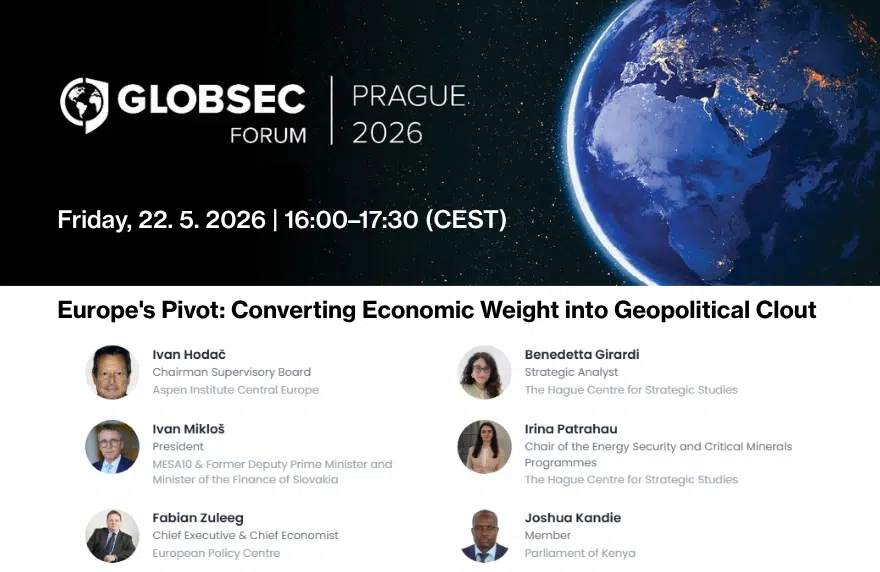
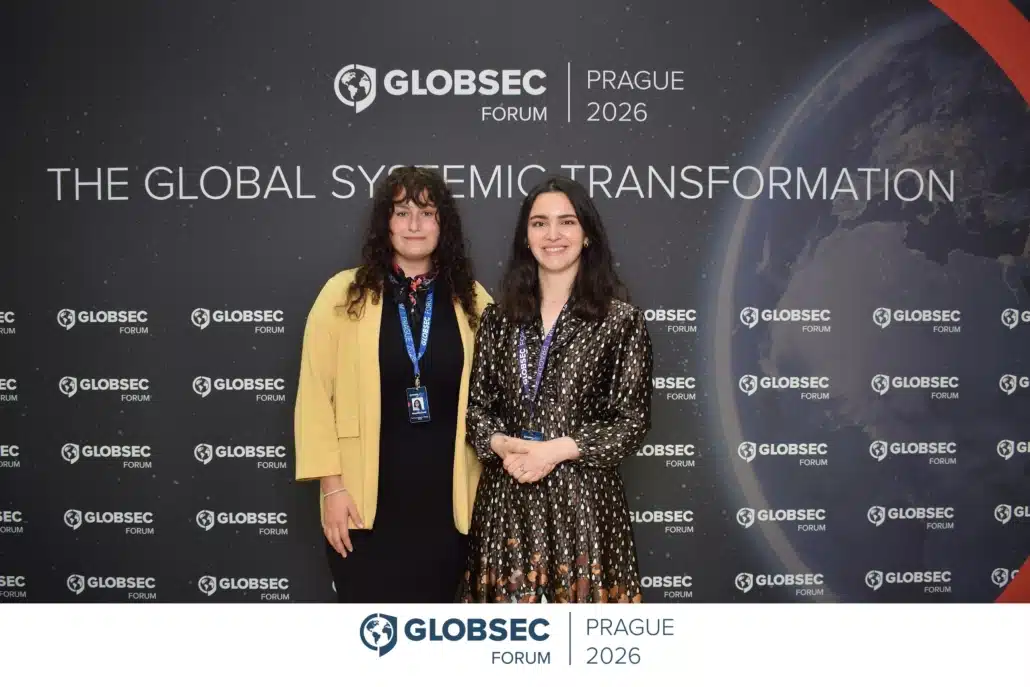
On Friday, May 22, HCSS strategic analysts Irina Patrahau and Benedetta Girardi will be co-hosting the GLOBSEC 2026 side-session ‘Europe’s Pivot: Converting Economic Weight into Geopolitical Clout’.

GLOBSEC Forum Side Session

Europe’s geoeconomic instruments have become integral to its security and global standing within an international environment characterised by systemic competition, economic coercion, and the heightened vulnerability of critical supply chains. The adoption of the Anti-Coercion Instrument (ACI), the successive sanctions packages against Russia and other actions illustrate a necessary change in approach. 

However, the EU has not always been able to effectively translate its economic power into geopolitical influence. From persistent internal coordination challenges and concerns over escalation to the need to manage key partnerships, especially transatlantic relations, the geoeconomic toolkit has not been used as effectively. This has direct consequences for European security: when economic instruments cannot be mobilised effectively, the Union’s ability to respond to coercion, reduce strategic dependencies, and shape the behaviour of external actors is weakened. These dilemmas are particularly acute for Central and Eastern European countries, where exposure to both economic pressure and hard security risks is especially pronounced. 

Europe now faces a series of strategic choices about whether and how to prioritise economic security over market openness, as well as how to clearly calibrate coercive and defensive instruments without undermining alliances. In this context, how can the EU translate its geoeconomic power into consistent geopolitical influence in a fragmented environment, characterised by trade conflicts, renewed industrial policy and protectionism. 

  • In an era of global fragmentation, can the EU successfully yield its economic weight to secure geopolitical influence? What are the opportunities and the threats? 
  • How can the EU prioritise its geoeconomic instruments while managing escalation risks and safeguarding transatlantic and other strategic partnerships?  
  • Which three actions should the EU prioritise over the next 12–18 months to strengthen the credibility and effectiveness of its geoeconomic statecraft? 
Details
  • Friday, 22. 5. 2026
  • 16:00–17:30 (CEST)
  • Palmovka 1
  • Link
Speakers
  • Ivan Hodač, Chairman Supervisory Board, Aspen Institute Central Europe
  • Benedetta Girardi, Strategic Analyst, The Hague Centre for Strategic Studies
  • Ivan Mikloš, President, MESA10 & Former Deputy Prime Minister and Minister of the Finance of Slovakia
  • Irina Patrahau, Chair of the Energy Security and Critical Minerals Programmes, The Hague Centre for Strategic Studies
  • Fabian Zuleeg, Chief Executive & Chief Economist, European Policy Centre
  • Joshua Kandie, Member, Parliament of Kenya
  • Share on Facebook
  • Share on X
  • Share on WhatsApp
  • Share on LinkedIn
  • Share by Mail

Experts

Irina Patrahau
Benedetta Girardi

Related News

Related Content

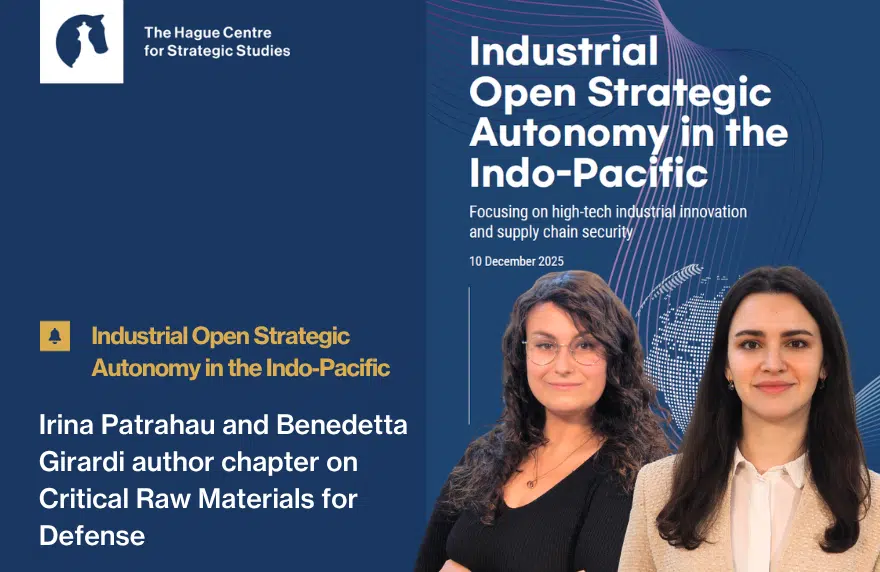
Irina Patrahau and Benedetta Girardi author chapter on Critical Raw Materials for Defense
IRTC Round Table | Irina Patrahau on critical raw material strategies and policies
Rewatch | Benedetta Girardi: Geopolitical tensions in the South China Sea

Office Address

  • The Hague Centre for Strategic Studies
  • Lange Voorhout 1
  • 2514 EA The Hague
  • The Netherlands

Contact Us

  • Telephone: +31(70) 318 48 40
  • E-mail: info@hcss.nl
  • IBAN NL10INGB0666328730
  • BIC INGBNL2A
  • VAT NL.8101.32.436.B01
  • Contact

Legal & Privacy

  • Disclaimer & Privacy
  • Algemene Voorwaarden 2024 (NL) 
  • Terms & Conditions 2024 (ENG) 
  • Algemene Voorwaarden 2026 (NL) 
  • Terns & Conditions 2026 (EN) 
  • Coordinated Vulnerability Disclosure
  • Ethical Standards
  • Manual for Responsible Use of AI

Follow us

© The Hague Centre for Strategic Studies
    Link to: Netherlands Food Partnership | Laura Birkman on the implications of the closure of the Strait of Hormuz for global food security Link to: Netherlands Food Partnership | Laura Birkman on the implications of the closure of the Strait of Hormuz for global food security Netherlands Food Partnership | Laura Birkman on the implications of the closure...
    Scroll to top Scroll to top Scroll to top

    GDPR Consent

    Your privacy is important to us. Here you can set which consent you are allowing us with regards to the collection of general information, the placing of cookies of the collection of personal information. You can click 'Forget my settings' at the bottom of this form to revoke all given consents.

    Privacy policy | Close
    Settings

    GDPR Consent Settings

    Your privacy is important to us. Here you can set which consent you are allowing us with regards to the collection of general information, the placing of cookies of the collection of personal information. You can click 'Forget my settings' at the bottom of this form to revoke all given consents.

    Website statistics collect anonymized information about how the site is used. This information is used to optimize the website and to ensure an optimal user experience.

    View details

    Functional cookies are used to ensure the website works properly and are neccessary to make the site function. These cookies do not collect any personal data.  

    View details
    Forget my settings Deleted!