HCSS
  • News
    • BNR | De Strateeg
    • Columns
    • Events
    • HCSS Newsletter
    • Podcasts
  • Publications
    • Publications
      • All Projects
      • All Publications
    • Geopolitics & Governance
      • Transatlantic Relations
      • Russia & Eurasia
      • Europe in the Indo-Pacific
      • AI in the Military Domain
      • PROGRESS / Strategic Monitor
      • Socio-Political Instability Survey
    • Economics & Technology
      • Emerging Technologies
      • Critical Materials
      • Energy Security
    • Defence & Security
      • On Future War
      • Deterrence and Arms Control
      • Hybrid Threats
      • Cyber Security
    • Society & Resilience
      • Nationale Veiligheid en Weerbaarheid
      • Publieksmonitor Maatschappelijke Stabiliteit
      • Transnational Organised Crime
      • Strategic Monitor Dutch Police
    • Climate, Water & Food
      • Climate Security
      • Water, Peace & Security (WPS)
      • Food Security
  • Dashboards
    • Dashboards
      • All Tools
        • GINA
        • SARA
    • Geopolitics & Governance
      • DFRI
      • GINA | Diplomatic
      • GINA | Information
      • CLARIS
    • Economics & Technology
      • DOMINO
      • GATRI
      • GINA | Economic
      • Cyber Arms Watch
      • Cyber Comparator
      • Cyber Norms Observatory
      • Cyber Transparency
    • Defence & Security
      • GINA | Military
      • Nuclear Timeline
    • Society & Resilience
      • DAMON
    • Climate, Water & Food
      • Agrifood Monitor
      • CARMEN
      • CRM Dashboard
  • Leadership Practice
    • HCSS Leadership Practice
    • HCSS Boardroom
    • Strategic Negotiations Course
    • Serious Gaming
    • IDCSS | Indo-Dutch Cyber Security School
    • SANCS | Southern Africa-Netherlands Cyber Security School
  • About HCSS
    • Contact Us
    • HCSS Datalab
    • Our People
    • Funding & Transparency
    • Internship Programme
    • Press & Media Inquiries
    • Studio HCSS
    • Working at HCSS
    • Global Futures Foundation
  • Click to open the search input field Click to open the search input field Search
  • Menu Menu

News

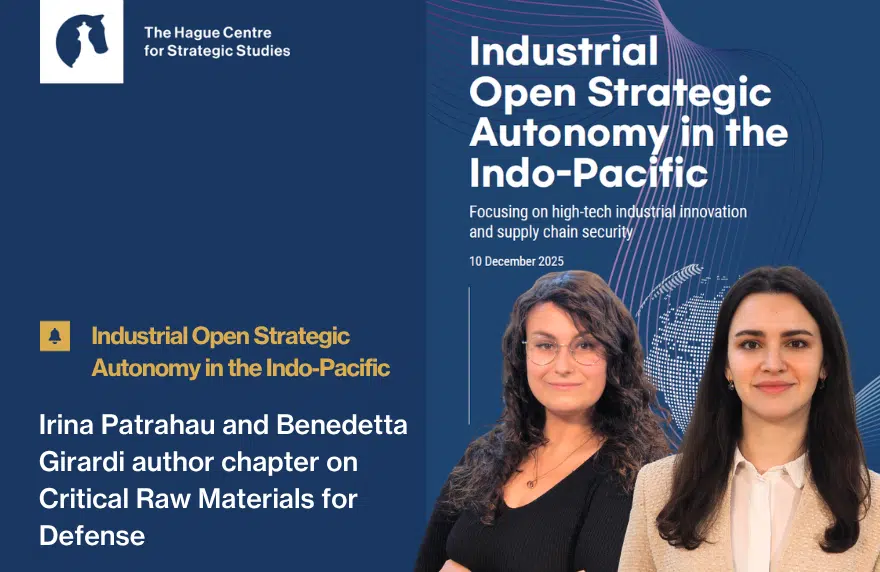
Irina Patrahau and Benedetta Girardi author chapter on Critical Raw Materials for Defense

April 2, 2026
Chapter Link

Chapter 4, Part 2 of the edited volume Industrial Open Strategic Autonomy in the Indo-Pacific offers a timely analysis of a challenge that sits at the very core of defence preparedness: secure access to critical raw materials (CRMs). 

Authored by Irina Patrahau and Benedetta Girardi, the chapter ‘Key technologies for Open Strategic Autonomy in Korea and the Netherlands: Critical Raw Materials for Defense’ makes clear that modern defence capabilities, from sensors and missile systems to space, cyber, and AI-enabled platforms,  are strongly dependent on a small set of materials characterised by high geographic concentration and growing geopolitical risk. For technologically advanced but resource-dependent countries such as the Netherlands and the Republic of Korea, this creates structural vulnerabilities that traditional defence-industrial planning often overlooks. 

The chapter highlights the explicit linkage between CRM dependency and defence readiness, situating raw and processed materials firmly within the concept of open strategic autonomy. Rather than advocating isolation or self-sufficiency, Patrahau and Girardi argue for managing dependencies through diversification, cooperation, and strategic coordination,  especially among like-minded partners in the Indo-Pacific and Europe. 

This perspective strongly aligns with earlier HCSS work on critical raw material for defence, which has consistently shown that the most acute defence bottlenecks increasingly lie far in the mining and especially processing of minerals, beyond prime contractors and Tier-1 suppliers. HCSS research has also underlined that these vulnerabilities tend to surface precisely when defence demand spikes during crises – when markets are least able to adjust. 

By bringing critical raw materials into the defence supply-chain debate, this chapter reinforces an important policy message: CRM governance is no longer a peripheral industrial or sustainability issue, it is a core defence policy concern. Integrating raw material strategies with defence planning is becoming essential for maintaining credible, resilient defence capabilities in an era of systemic competition. 

Chapter Link

Authors: Benedetta Girardi and Irina Patrahau

Partner institution: Korea Institute for International Economic Policy (KIEP)

  • Share on Facebook
  • Share on X
  • Share on WhatsApp
  • Share on LinkedIn
  • Share by Mail

Experts

Irina Patrahau
Benedetta Girardi

Related News

Related Content

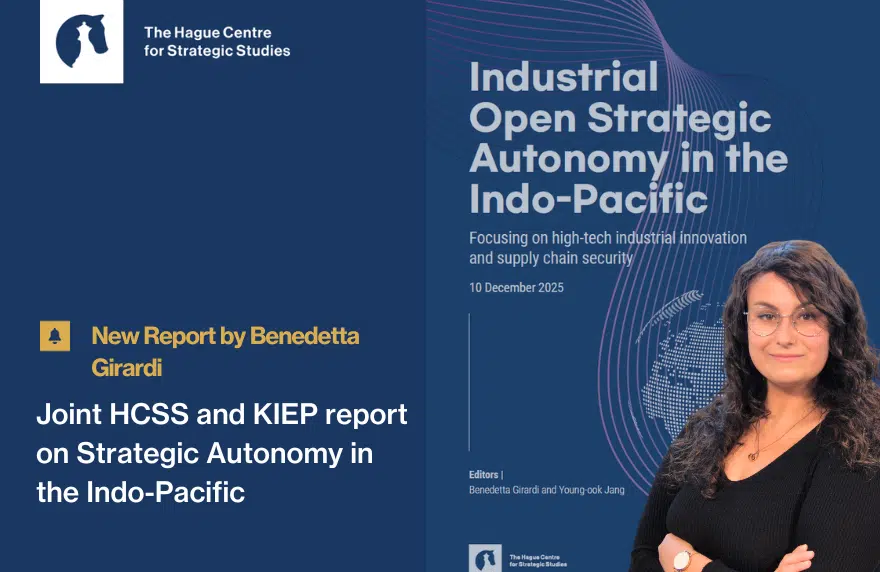
New Report: Industrial Open Strategic Autonomy in the Indo-Pacific: Focusing on high-tech industrial innovation and supply chain security
Industrial Open Strategic Autonomy in the Indo-Pacific: Focusing on high-tech industrial innovation and supply chain security
Climate security in the Indo-Pacific: How can Europe contribute? Dutch-French Dialogues on the Indo-Pacific.

Office Address

  • The Hague Centre for Strategic Studies
  • Lange Voorhout 1
  • 2514 EA The Hague
  • The Netherlands

Contact Us

  • Telephone: +31(70) 318 48 40
  • E-mail: info@hcss.nl
  • IBAN NL10INGB0666328730
  • BIC INGBNL2A
  • VAT NL.8101.32.436.B01
  • Contact

Legal & Privacy

  • Disclaimer & Privacy
  • Algemene Voorwaarden 2024 (NL) 
  • Terms & Conditions 2024 (ENG) 
  • Algemene Voorwaarden 2026 (NL) 
  • Terns & Conditions 2026 (EN) 
  • Coordinated Vulnerability Disclosure
  • Ethical Standards
  • Manual for Responsible Use of AI

Follow us

© The Hague Centre for Strategic Studies
    Link to: Expert Analysis | The ‘Liberation Day’ tariffs were supposed to revive US manufacturing. So far they have not. Link to: Expert Analysis | The ‘Liberation Day’ tariffs were supposed to revive US manufacturing. So far they have not. Expert Analysis | The ‘Liberation Day’ tariffs were supposed to revive US... Link to: De Ondernemer | Hans van der Louw: 41 miljard euro voor defensie, kans voor Nederlands mkb Link to: De Ondernemer | Hans van der Louw: 41 miljard euro voor defensie, kans voor Nederlands mkb De Ondernemer | Hans van der Louw: 41 miljard euro voor defensie, kans voor...
    Scroll to top Scroll to top Scroll to top

    GDPR Consent

    Your privacy is important to us. Here you can set which consent you are allowing us with regards to the collection of general information, the placing of cookies of the collection of personal information. You can click 'Forget my settings' at the bottom of this form to revoke all given consents.

    Privacy policy | Close
    Settings

    GDPR Consent Settings

    Your privacy is important to us. Here you can set which consent you are allowing us with regards to the collection of general information, the placing of cookies of the collection of personal information. You can click 'Forget my settings' at the bottom of this form to revoke all given consents.

    Website statistics collect anonymized information about how the site is used. This information is used to optimize the website and to ensure an optimal user experience.

    View details

    Functional cookies are used to ensure the website works properly and are neccessary to make the site function. These cookies do not collect any personal data.  

    View details
    Forget my settings Deleted!