Russia’s oil sector remains resilient, but its strategic foundations are weakening, HCSS energy specialists Jilles van den Beukel and Lucia van Geuns write in a new Expert Analysis. Sanctions have not stopped exports, yet they have increased costs, reduced efficiency and constrained access to technology and investment. Ukraine’s sustained strikes on refineries add direct pressure on the infrastructure converting crude into higher-value products. Maintaining effective sanctions enforcement, limiting access to critical technologies and sustaining pressure on Russia’s energy infrastructure can gradually reduce the profitability and fiscal capacity underpinning the war effort, the authors conclude.
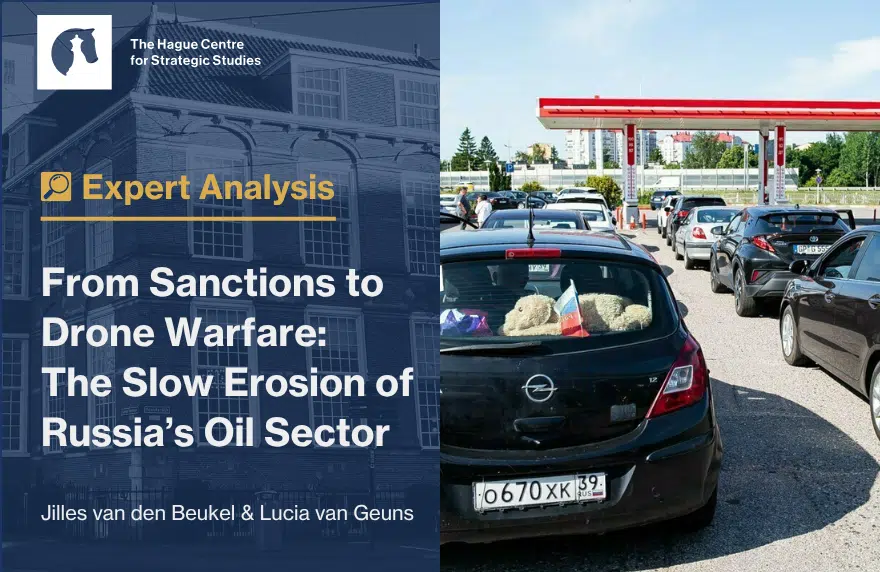
Photo credit: Klops.ru
Key takeaways
- For years, Russia’s oil sector has demonstrated remarkable resilience. Despite geological challenges in the major Siberian oil fields and increasingly severe Western sanctions, Moscow has maintained large-scale oil exports, redirected trade flows towards Asia and created alternative financial and logistical networks.
- The sanctions did not achieve their initial objective to sharply reduce Russia’s income from exporting oil. However, they have changed the economics of the sector. Higher transport costs, lower margins, restricted access to technology and increasing dependence on a limited number of buyers have gradually weakened the foundations of Russia’s energy model.
- Ukraine’s expanding campaign of drone attacks against Russian refineries has introduced a new dimension. For the first time since the beginning of the war, Russia’s oil sector is facing sustained pressure not only from restrictions on trade and technology, but also from direct attacks on the infrastructure that converts crude oil into oil products.
- The combination of decreasing oil production, continued sanctions and Ukrainian attacks on energy infrastructure result in a bleak outlook for Russia’s oil sector. Financing a prolonged war is gradually becoming more difficult.
Russia’s oil sector: increasing challenges to maintain production
Russia continues to rely on oil and gas production as its main business model. From a purely economic perspective, its sustained focus on fossil fuel production is understandable. The country possesses enormous hydrocarbon reserves and many existing fields can still produce oil at relatively low costs.
Natural gas is primarily the foundation of the domestic economy. It provides heating for households and supports energy-intensive industries. Within Russia, gas is being sold at a low, regulated price. Oil, by contrast, is the foundation of Russia’s external financial power. Oil exports have historically been the largest source of foreign currency earnings and government revenue.
For natural gas, Russia has the largest reserves in the world. The challenge is not so much maintaining production but rather transporting the gas to customers; if possible higher paying customers outside Russia. In contrast, Russia’s oil reserves are the ninth largest on a global basis and maintaining oil production levels is becoming more difficult.
The traditional backbone of Russian oil production, the mature fields of Western Siberia, is gradually declining. Many of these fields were developed during the final years of the Soviet Union, when maximizing short-term output was prioritized over long-term reservoir management.
Today, increasing water production, declining reservoir pressure and more complex extraction conditions are becoming growing challenges. Russia has responded mainly by drilling more production wells, but these measures deliver diminishing returns.
Western sanctions have made the challenge more difficult. Restrictions on technology transfers, equipment imports and international cooperation were first introduced after Russia’s annexation of Crimea in 2014 and expanded significantly after the full-scale invasion of Ukraine in 2022. These measures have reduced Russia’s ability to optimize reservoir management in existing fields and to develop new ones.
This is particularly important for more technologically demanding resources, such as shale oil. Russia has significant potential in this area, but large-scale development requires expertise and equipment that are now impossible to obtain for Russia. New conventional projects in remote regions, such as the Vostok projects in northern Siberia, require substantial investment and extensive new infrastructure. With sanctions, higher financing costs and uncertainty over future oil demand, many of these projects have been delayed.
Russia therefore remains a major oil producer, but the sector is increasingly focused on maintaining existing production rather than creating future growth. Production of crude oil has declined from 10,4 mb/d in 2019 to little over 9 mb/d at present, significantly below Russia’s OPEC+ quota of 9,7 mb/d (Fig.1).
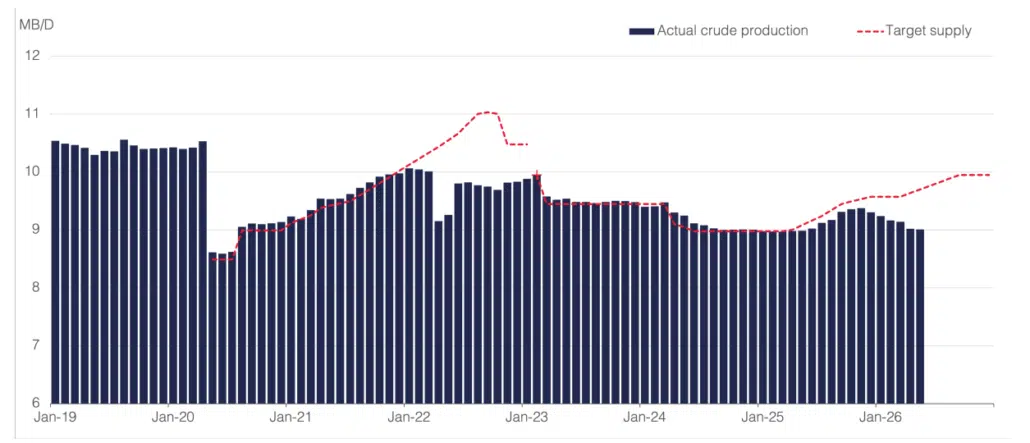
Fig. 1: Russia’s crude oil production, 2019-2026. Source: OIES
Sanctions: Russia adapted, but at a cost
After the invasion of Ukraine, Western sanctions were expanded to target Russia’s ability to profit from oil exports. The European Union and G7 introduced restrictions on Russian oil imports, while a price cap was introduced for Russian crude transported by Western-linked shipping services.
The impact was significant, but not as originally intended. Russia successfully redirected much of its oil exports toward China, India and other buyers. It created a so-called “shadow fleet” of older tankers and developed alternative insurance and trading arrangements.
The result was not the collapse of Russian oil exports, but a more expensive and less efficient system. Russia has had to sell crude at discounts, pay higher transportation costs and rely increasingly on opaque networks. According to analyses by organisations such as the Centre for Research on Energy and Clean Air (CREA), Russian fossil fuel revenues have remained substantial but have become increasingly vulnerable to lower prices, tighter enforcement and rising logistical costs. Discounts and costs for building a shadow fleet have reduced Russia’s income from oil exports with roughly 25%.
The key lesson is that sanctions have not removed Russia from global energy markets. Instead, they have weakened the foundations of the energy model that finances the Kremlin.
Ukrainian drone attacks: a new vulnerability
Since 2025, Ukraine has significantly expanded its attacks on Russian energy infrastructure, particularly through long-range drone operations. These strikes have mostly focused on refineries rather than storage facilities and pipelines (Fig.2).
This is strategically important. Refineries contain complex equipment such as catalytic crackers and desulphurization units. These components are difficult to replace and can take months to repair. A refinery does not need to be completely destroyed to become a problem; repeated attacks can keep facilities operating way below capacity and create a permanent maintenance burden.
As highlighted by the Oxford Institute for Energy Studies, the impact of these attacks should be understood as a war of attrition rather than a search for a single decisive strike. The objective is not necessarily to destroy Russia’s refining system, but to force it into a continuous cycle of repair, adaptation and resource allocation.
Ukraine’s expanding drone production has changed the equation. Large numbers of relatively inexpensive drones can overwhelm air defence systems. Even when most drones are intercepted, a limited number reaching their targets can create significant economic disruption.
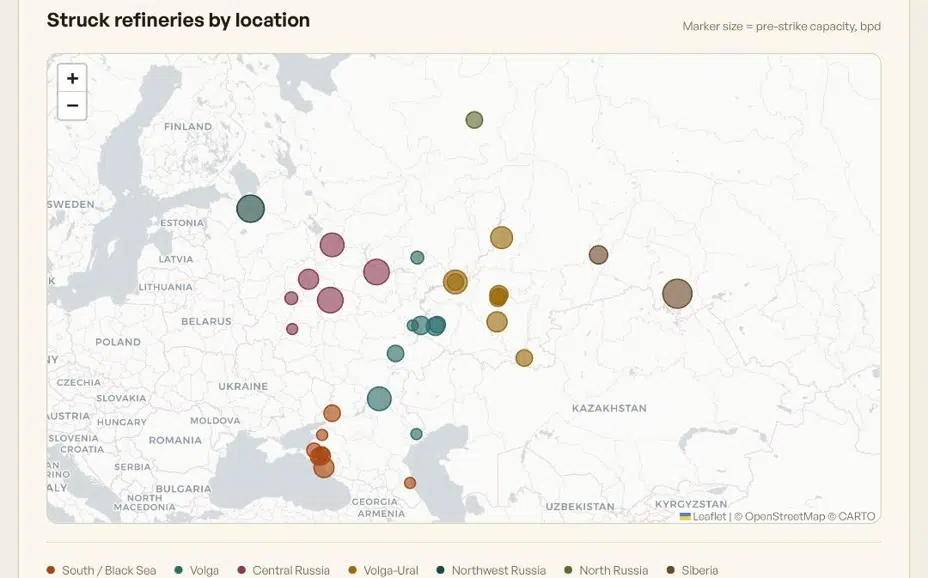
Fig. 2. Struck refineries per location (Version August 3, 2026). Source: The Refinery Ledger
The economic impact: refining suffers, crude exports continue
The effects of the attacks should not be overstated. Damage to refineries does not automatically translate into an equivalent loss of oil revenue for the Russian state.
When refining capacity is reduced, Russia can export more crude oil instead of processing it domestically. This means crude exports have remained relatively resilient despite refinery disruptions (Fig. 3).
However, the economic damage is real. Russia earns more value from refined products such as diesel and gasoline than from crude oil. Lower refinery output therefore reduces profit margins, increases logistical costs and forces the government to intervene more heavily in the domestic fuel market.
Recent attacks have temporarily removed a significant share of Russian refining capacity from operation. Estimates vary depending on whether nominal or operational capacity is measured, but disruptions in the range of 20–30 percent have been reported at different points.
Russia has responded by banning or restricting exports of gasoline and diesel, redirecting supplies internally and increasing state intervention. These measures prevent immediate shortages but further reduce market efficiency.
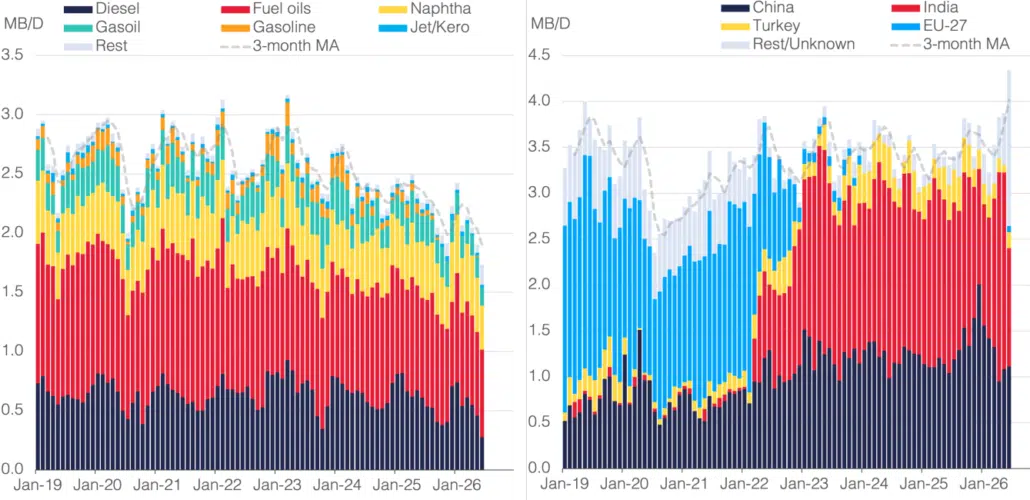
Fig. 3: Russia’s oil product exports (by product) and Russia’s crude oil exports (by destination), 2019-2026. Source: OIES
The current pressure on Russia’s oil sector is cumulative rather than catastrophic. The industry is not collapsing, and Russia still exports millions of barrels of oil per day. However, the system is becoming less efficient, more dependent on government intervention and more vulnerable to external shocks. The reprieve from the current high prices is likely to be temporary only.
This conclusion is consistent with recent assessments from organisations such as CREA and the Kiel Institute. Their analyses suggest that Russia’s economy remains resilient but increasingly dependent on continued energy revenues. The issue is not whether Russia can sell oil, but whether it can continue doing so at sufficient profitability to sustain both the state budget and the war effort.
The Ukrainian drone campaign adds a new dimension to the pressure. Sanctions weakened Russia’s access to technology, finance and markets. Drone attacks are now targeting the physical infrastructure that turns oil resources into economic power.
Ukraine’s own energy vulnerability
Ukraine itself remains highly exposed to energy attacks. Its domestic refining capacity was largely destroyed or disabled early in the war, forcing the country to rely on imports, mainly from European neighbours such as Poland and Romania by means of road transport. That is a robust system, be it at relatively high cost.
Throughout the war, Russia has focused primarily on Ukraine’s electricity infrastructure, targeting transformers, power plants and transmission systems. Despite extensive damage, Ukraine’s energy system has survived due to rapid repairs, European grid integration, spare equipment and improved air defence.
The contrast between the two countries is important. Russia has greater physical resources, but Ukraine has demonstrated greater adaptability and social resilience after years of attacks.
Conclusion
Russia’s oil sector is entering a more difficult phase. The decline of mature fields, limited access to Western technology, and delayed investment in new projects are gradually weakening the foundations of future production.
Western sanctions have not stopped Russian oil exports, but they have increased costs and reduced efficiency. Ukraine’s drone campaign introduces a new vulnerability by directly targeting the infrastructure that converts crude oil into higher-value products.
The likely outcome is not a sudden collapse of Russia’s energy sector. Instead, the country faces a slow erosion: lower efficiency, higher costs, greater state control and increasing pressure on the revenues that sustain the war economy.
The strategic question is therefore not whether Russia’s oil sector can survive. It can. The question is how much economic strain the Kremlin is willing and able to absorb as increasing costs are gradually decreasing its ability to continue the war.
Jilles van den Beukel and Lucia van Geuns
References
- Baker Institute for Public Policy. 2026. Quantifying Ukraine’s Strikes on Russian Energy Infrastructure. Houston: Rice University, March 2. https://www.bakerinstitute.org/research/quantifying-ukraines-strikes-russian-energy-infrastructure.
- Centre for Research on Energy and Clean Air (CREA). 2026. Monthly Analysis of Russian Fossil Fuel Exports and Sanctions. Helsinki: CREA. https://energyandcleanair.org/june-2026-monthly-analysis-of-russian-fossil-fuel-exports-and-sanctions/. (For recent revenue and export data.)
- Financial Times. 2026. “How Vladimir Putin’s Refinery Dream Became Ukraine’s Target.” July 30. https://www.ft.com/content/3990cbf0-e783-4445-a32f-19a345c0cc6f.
- Financial Times. 2026. “Ukraine Adapts Strikes on Russian Energy Industry to Hit Critical Components.” July 29. https://www.ft.com/content/5ca782bd-5c4a-45f8-9a7a-5793d800321d.
- Kiel Institute for the World Economy. 2026. Endgame: The State of the Russian Economy. Kiel Report No. 9. Kiel: IfW Kiel. https://www.kielinstitut.de/publications/endgame-the-state-of-the-russian-economy-19855/.
- Oxford Institute for Energy Studies. 2026. The Domestic and Global Impact of Ukraine’s Attacks on Russian Oil Infrastructure. Oxford: OIES, July 1. https://www.oxfordenergy.org/publications/the-domestic-and-global-impact-of-ukraines-attacks-on-russian-oil-infrastructure/.
- Reuters. 2026. “Ukraine Attacks Russian Energy Sites: What Has Been Hit?” July 27. https://www.reuters.com/business/energy/ukraine-attacks-russian-energy-sites-what-has-been-hit-2026-07-27/.
- Reuters. 2026. “Russia’s Western Oil Exports Set to Hold Steady in June.” June 2026. (Industry-source data on refinery outages and export flows.)
- The Hague Centre for Strategic Studies (HCSS). 2021. “Russia’s Unsustainable Business Model: Going All In on Oil and Gas” January 2021. https://hcss.nl/report/russias-unsustainable-business-model/
- The Hague Centre for Strategic Studies (HCSS). 2024. “Het effect van sancties op de Russische olie inkomsten” February 2024. https://hcss.nl/news/jilles-van-den-beukel-het-effect-van-sancties-op-de-russische-olie-inkomsten/
- The Refinery Ledger. 2026. Database for strikes on Russian refineries. https://ukrdronecampaign.pplx.app/


Related Content