Research
In 2019, the Netherlands let an export licence for an ASML machine lapse after pressure from Washington. In 2026, it pushed back against a US bill, the MATCH Act, that would have made that kind of alignment automatic. Same ally, same technology, two very different responses.
In their new snapshot, Isis Ketelaar and Benedetta Girardi argue that neither the story of US pressure nor the story of growing European autonomy explains this shift on its own. Dutch semiconductor policy is better understood as a balancing act: the Netherlands works with the US on export controls but wants to maintain decisional power over how this takes shape.
The reason it can do this is ASML. It is world’s leading manufacturer of extreme ultraviolet (EUV) lithography machines, which are needed to print the most advanced chips, the ones behind AI and modern weapons systems. Without ASML, leading-edge chip production is effectively impossible, and the Dutch government has decision capacity over which of its most advanced machines may be exported, and to whom.
This makes the Netherlands a crucial link in the technological rivalry between the US and China. Yet the same position that gives the Netherlands this leverage, also ties it down. The authors identify four constraints that set the limits of Dutch room for manoeuvre: (1) commercial dependence on China, (2) security dependence on the US, (3) the reach of US export control law, and (4) the EU regulatory framework. Tracing them across three phases between 2019 and 2026, the authors find that the constraints don’t go away. What changed is how well the Netherlands has learned to work within them.
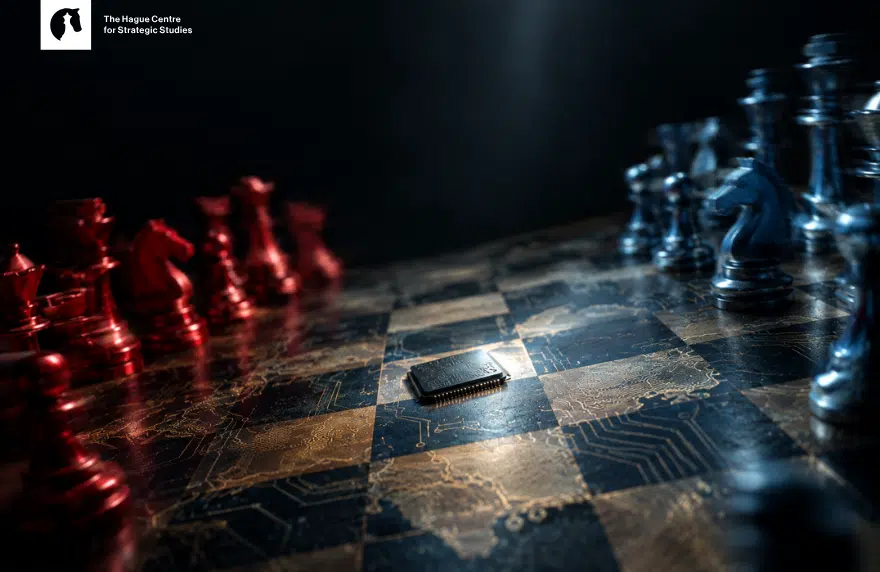
As Ketelaar concludes: ‘The Netherlands demonstrates that even states that control indispensable technologies remain bound by the relationships and institutions within which they operate.’ This snapshot therefore shows that whilst strategic bottlenecks do exert influence, they do not confer independence and offers broader lessons on how small and middle powers can navigate geopolitical games of chess between larger players.
Authors: Isis Ketelaar and Benedetta Girardi
Cover image: AI-generated


Related Content