
New Report: Responding to China’s Hybrid Threats: Strategic Postures for Small and Middle Powers
The new HCSS report ‘Responding to China’s Hybrid Threats: Strategic Postures for Small and Middle Powers’ analyses how the People’s Republic of China deploys hybrid threats against small and middle powers in Europe and the Asia-Pacific. Based on an original database, it shows why ad-hoc responses are insufficient and introduces a framework to help states develop more coherent strategic postures towards Chinese hybrid pressure.
Responding to China’s Hybrid Threats: Strategic Postures for Small and Middle Powers
The new HCSS report ‘Responding to China’s Hybrid Threats: Strategic Postures for Small and Middle Powers’ analyses how the People’s Republic of China deploys hybrid threats against small and middle powers in Europe and the Asia-Pacific. Based on an original database, it shows why ad-hoc responses are insufficient and introduces a framework to help states develop more coherent strategic postures towards Chinese hybrid pressure.
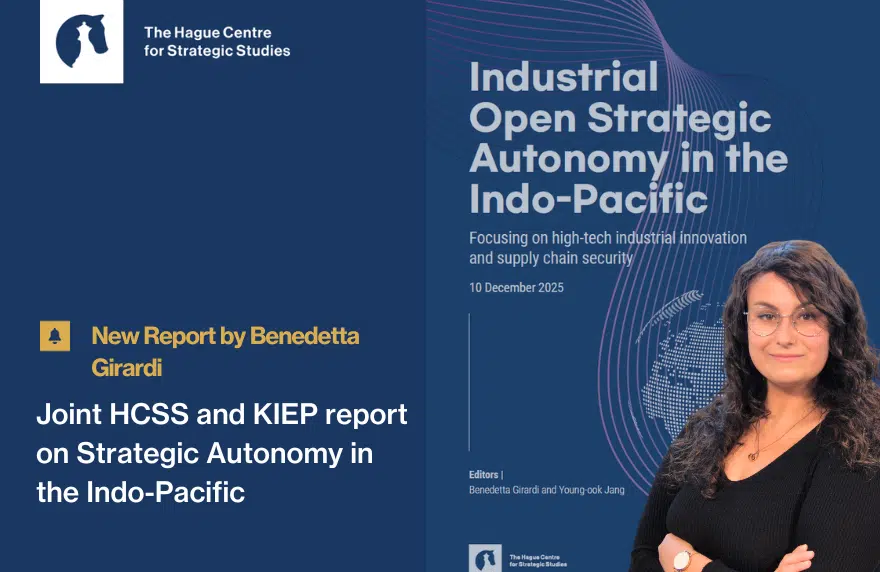
Industrial Open Strategic Autonomy in the Indo-Pacific: Focusing on high-tech industrial innovation and supply chain security
How can countries strengthen economic security without sacrificing openness? This new HCSS–KIEP edited volume by Benedetta Girardi and Young-ook Jang examines how South Korea and the Netherlands can advance open strategic autonomy through cooperation in high-tech innovation and supply-chain security. Focusing on semiconductors, quantum technology, energy, and critical raw materials, the edited volume shows how middle powers can build resilience through partnership—not decoupling.