The Hague Centre for Strategic Studies (HCSS) has launched the Chinese Latent Activity and Related Interference Scanner (CLARIS), a new public dashboard that systematically maps verified instances of Chinese hybrid threat activity targeting small and middle powers (SMPs) in Europe and the Asia-Pacific.
Developed by Jesse Kommandeur, Benedetta Girardi, Laura Jasper and Maria-Antigone Rumpf, CLARIS translates extensive open-source research into an accessible, data-driven tool. It documents Chinese hybrid activities since 2010 across five domains: digital and information warfare, economic statecraft, paramilitary operations, physical sabotage and violence, and legal and political manoeuvres.
The dashboard builds directly on the analytical insights of the HCSS report Responding to China’s Hybrid Threats: Strategic Postures for Small and Middle Powers, which showed that Chinese hybrid threats are structural rather than incidental and that many SMPs still respond in ad-hoc ways. CLARIS provides the empirical backbone to this argument by enabling users to observe patterns over time, compare countries and regions, and examine individual incidents in detail.
Key findings from the dataset confirm the predominance of digital and information warfare as China’s most frequently used hybrid tool, alongside sustained use of economic coercion and legal-political pressure. The data also reveal clear regional variation: while Europe is primarily exposed to cyber, economic, and political influence operations, the Asia-Pacific experiences more frequent paramilitary and military-adjacent pressure.
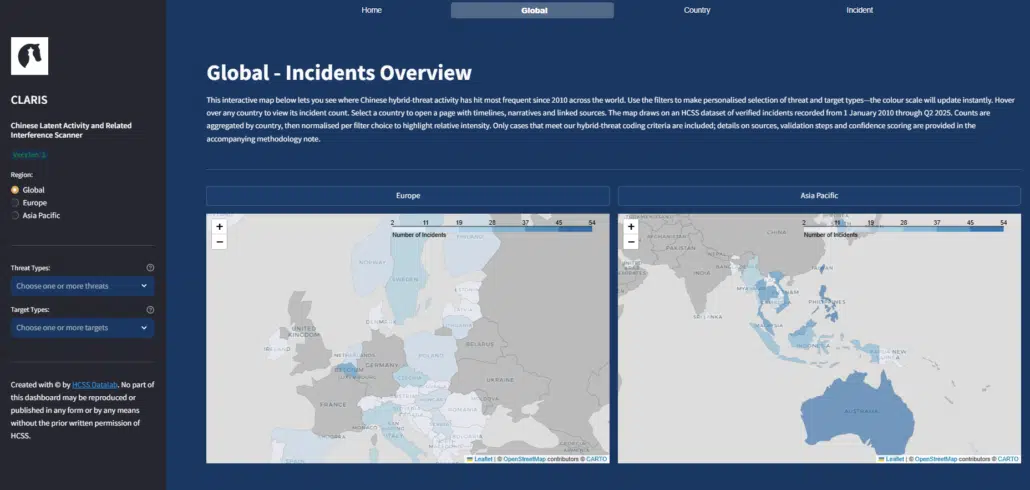
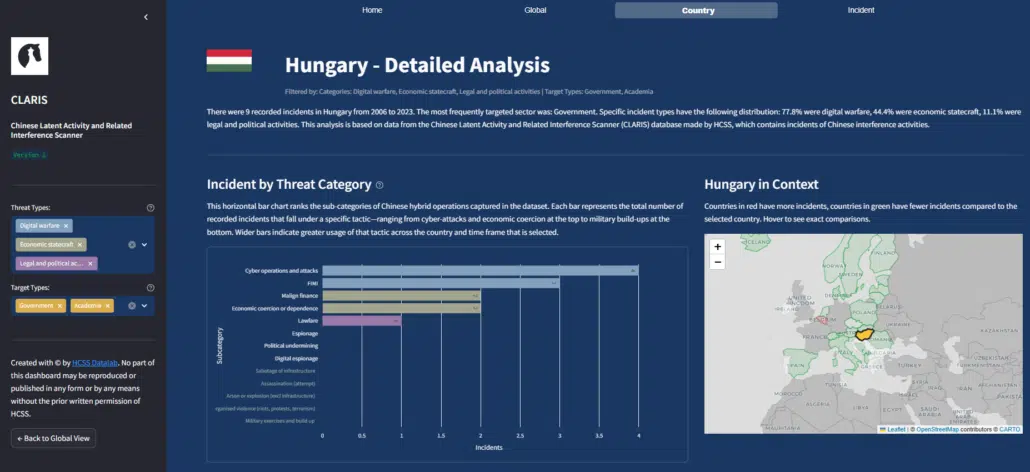
CLARIS is organised around three analytical lenses. The Global Lens offers a macro-level overview of trends and regional concentration. The National Lens allows country-specific analysis of tactics, targets, and timelines. The Incident Lens provides detailed case files, including sources and links to related events.
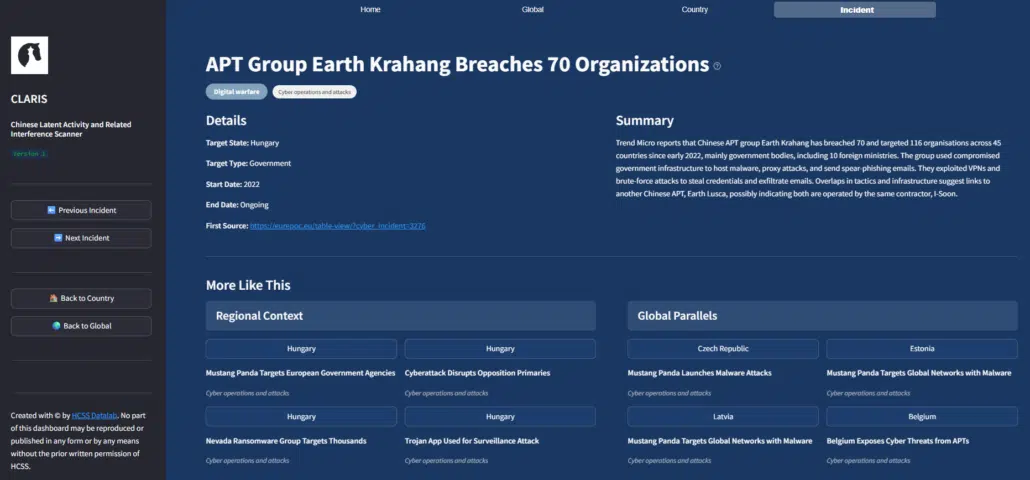
The dashboard does not predict future behaviour, nor does it claim exhaustive coverage. Instead, it offers a conservative and transparent baseline for analysis, explicitly acknowledging challenges related to attribution, source bias, and data completeness. Watch the explainer video below, or go directly to the CLARIS landing page.



Related Content