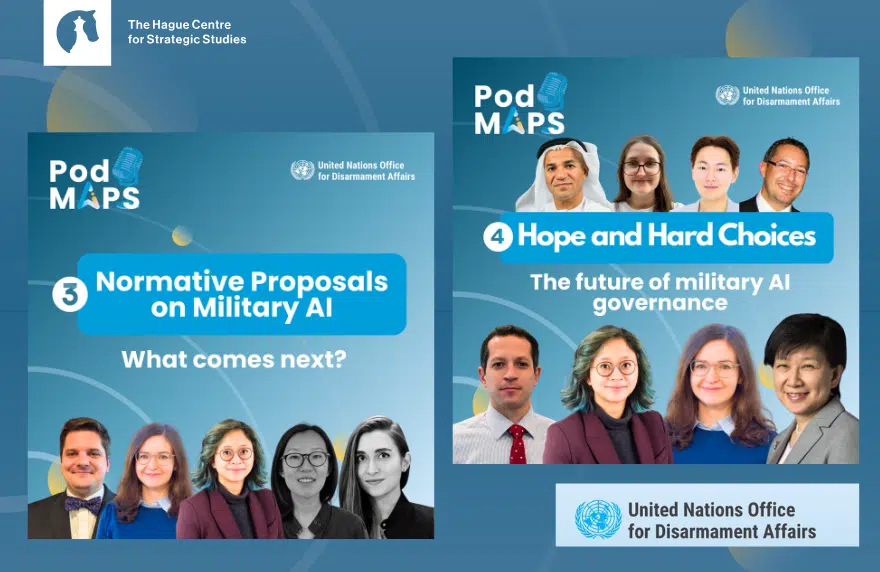
Artificial intelligence is transforming the military domain, presenting new opportunities, risks, and ethical dilemmas. The PodMAPS podcast series by the UN Office for Disarmament Affairs (UNODA) brings together UN officials, military officers, researchers, civil society advocates, and young professionals to discuss these challenges in real time. Hosted by Ulysse Richard, PodMAPS is part of the Military AI, Peace & Security (MAPS) Dialogues, funded by the Republic of Korea.
HCSS strategic analyst Sofia Romansky features in Episodes 3 and 4, bringing her expertise to discussions on military AI governance and normative proposals.
For the past two years, HCSS has served as the secretariat for the Global Commission on Responsible AI in the Military Domain (GC REAIM), with Sofia Romansky as the Project Coordinator, supporting the commission’s work to define norms and guidance for responsible military AI. This work culminated in the presentation of the commission’s Strategic Guidance Report at the UN, delivered by Prime Minister Dick Schoof, marking a major milestone in global efforts to govern AI in the military domain.
Episode 1 – Opportunities and risks of military AI
This episode explores the promises and pitfalls of AI in the military, from enhanced decision-making and operational effectiveness to concerns around accountability, unpredictability, and the erosion of human judgment. Guests also examine the role of humans in human-machine interaction and its implications for legal obligations under international humanitarian law.
Featuring Ambassador Ernst Noorman (Netherlands Ministry of Foreign Affairs), Dr. Michael C. Horowitz (Perry World House, University of Pennsylvania), Dr. Bruce Watson (GC REAIM Commissioner), Georgia Hinds (ICRC), Gaurav Keerthi (RSIS, NTU), Dr. Saeed Aldhaheri (University of Dubai), and Kerstin Vignard (Johns Hopkins University Applied Physics Laboratory).
Episode 2 – Bridging the AI divide
This episode addresses the growing divide between states developing military AI and those that lack capacity. Guests from the Global South discuss trust deficits, the need to break silos between technical and policy communities, and examples of effective national AI policy. The conversation also covers inclusion and pathways for meaningful international cooperation.
Featuring Dr. Yasmin Afina (UNIDIR), Sumaya Nur Adan (Oxford Martin AI Governance Initiative), Major Jamal Hassan (Ministry of Defense, Kenya), Valeria Chiappini (Ministry of Foreign Affairs, Chile), and Dr. Saeed Aldhaheri (University of Dubai).
Episode 3 – Normative proposals on military AI: What comes next?
Romansky joins Dr. Yasmin Afina (UNIDIR), René Holbach (UNODA), Juliana Helou van der Berg (UNODA), and Fei Su (SIPRI) to examine the evolving landscape of norms for military AI. Topics include recommendations from the Global Commission on Responsible AI in the Military Domain and UNIDIR, lessons from lethal autonomous weapons systems (LAWS), and risks linked to AI in nuclear command and control.
Episode 4 – Hope and hard choices: The future of military AI governance
This episode asks what a successful future for military AI governance might look like. Romansky joins a diverse panel including Izumi Nakamitsu (UN), Isabelle Jones (Stop Killer Robots), Dr. Michael Horowitz (University of Pennsylvania), and others to discuss inclusivity, verification, and bridging the gap between technical and policy communities.
🎧 Listen to the series and hear experts, including Sofia Romansky, explore how AI is shaping global security:
- Spotify: https://lnkd.in/e3GWswbR
- Apple Podcasts: https://lnkd.in/eX3WNUMr
Experts

Related Content