HCSS
  • News
    • BNR | De Strateeg
    • Columns
    • De Tafel van Mars
    • Events
    • HCSS Newsletter
    • Podcasts
  • Publications
    • Publications
      • All Projects
      • All Publications
    • Geopolitics & Governance
      • Transatlantic Relations
      • Russia & Eurasia
      • Europe in the Indo-Pacific
      • AI in the Military Domain
      • PROGRESS / Strategic Monitor
      • Socio-Political Instability Survey
    • Economics & Technology
      • Emerging Technologies
      • Critical Materials
      • Energy Security
    • Defence & Security
      • On Future War
      • Deterrence and Arms Control
      • Hybrid Threats
      • Cyber Security
    • Society & Resilience
      • Nationale Veiligheid en Weerbaarheid
      • Publieksmonitor Maatschappelijke Stabiliteit
      • Transnational Organised Crime
      • Strategic Monitor Dutch Police
    • Climate, Water & Food
      • Climate Security
      • Water, Peace & Security (WPS)
      • Food Security
  • Dashboards
    • Dashboards
      • All Tools
        • GINA
        • SARA
    • Geopolitics & Governance
      • DFRI
      • GINA | Diplomatic
      • GINA | Information
      • CLARIS
    • Economics & Technology
      • DOMINO
      • GATRI
      • GINA | Economic
      • Cyber Arms Watch
      • Cyber Comparator
      • Cyber Norms Observatory
      • Cyber Transparency
    • Defence & Security
      • GINA | Military
      • Nuclear Timeline
    • Society & Resilience
      • DAMON
    • Climate, Water & Food
      • Agrifood Monitor
      • CARMEN
      • CRM Dashboard
  • Leadership Practice
    • HCSS Leadership Practice
    • HCSS Boardroom
    • Strategic Negotiations Course
    • Serious Gaming
    • IDCSS | Indo-Dutch Cyber Security School
    • SANCS | Southern Africa-Netherlands Cyber Security School
  • About HCSS
    • Contact Us
    • HCSS Datalab
    • Our People
    • Funding & Transparency
    • Internship Programme
    • Press & Media Inquiries
    • Studio HCSS
    • Working at HCSS
    • Global Futures Foundation
  • Click to open the search input field Click to open the search input field Search
  • Menu Menu

News

New Snapshot | Saudi Arabia’s Mineral Gambit: What the EU Can Learn from Vision 2030

February 20, 2026
Download Snapshot (PDF)

New HCSS report warns: The EU must act now to secure Europe’s competitiveness in the global minerals value chain

In 2016, Saudi Arabia launched Vision 2030, an ambitious reform agenda to diversify its economy away from oil. Guided by this new strategy, the Kingdom became a global mineral player in under a decade, with its state-owned mining company emerging as the largest multicommodity player in the Middle East and the 15th largest globally. This new HCSS snapshot analyses how Saudi Arabia developed its domestic capabilities, streamlined its licensing procedures, leveraged its financial resources, and deployed various diplomatic tools to secure a place in the mining sector.

More importantly, Assistant Analyst Laurence Krakow and Strategic Analyst Irina Patrahau examine how the EU can learn from Saudi Arabia’s reform agenda to strengthen its own mineral strategy. As Europe struggles to capture a significant share of the minerals value chain, Saudi Arabia can serve as an example of proactive and effective policymaking.

The key findings are:

  1. The EU should be more proactive in identifying the strategic projects that align with its ambitions, moving away from the passive approach currently embedded in the “strategic project” scheme, which is both costly and risky for potential investors.
  2. The EU should provide targeted financial support to improve the effectiveness of strategic project designation. Although a step in this direction has been taken with the adoption of the RESourceEU Action Plan, timely implementation is essential to compete with faster-moving actors.
  3. The EU should target its international engagement more strategically by identifying European strengths and acting in a coordinated manner. While structural constraints limit the EU’s ability to fast-track the development of its mining sector, its commitment to sustainable value chains and mutually beneficial partnerships can give it an advantage in bilateral engagements, positioning it as a reliable and responsible partner

Lead author Laurence Krakow notes:

“By upholding its commitment to sustainable supply chains and mutually beneficial partnerships, the EU can position itself as an attractive and reliable partner that brings added value.”

Author: Laurence Krakow

Editor: Irina Patrahau

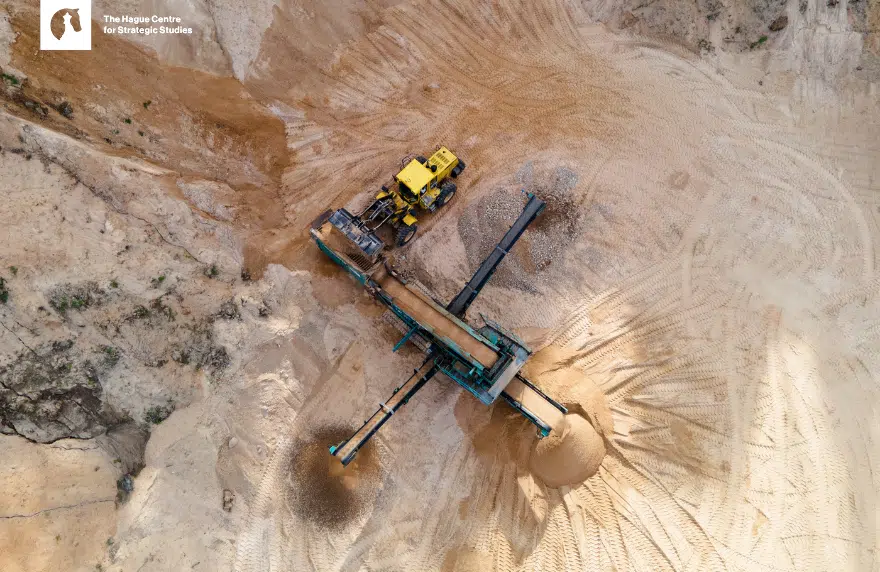
Cover photo: Canva

Download Snapshot (PDF)
  • Share on Facebook
  • Share on X
  • Share on WhatsApp
  • Share on LinkedIn
  • Share by Mail

Experts

Irina Patrahau

Related News

Related Content

New report | Shields and Spears: Nuclear-Conventional Force Balancing and the European Deterrence Architecture
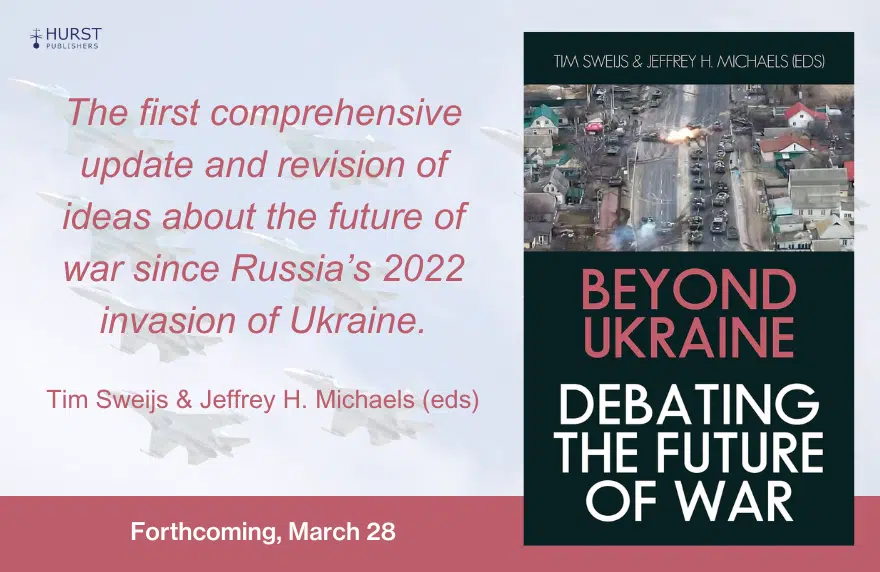
Book launch | Beyond Ukraine: Debating the Future of War
Guest paper series | Lessons Learned for Taiwan from the Russo-Ukrainian War

Office Address

  • The Hague Centre for Strategic Studies
  • Lange Voorhout 1
  • 2514 EA The Hague
  • The Netherlands

Contact Us

  • Telephone: +31(70) 318 48 40
  • E-mail: info@hcss.nl
  • IBAN NL10INGB0666328730
  • BIC INGBNL2A
  • VAT NL.8101.32.436.B01
  • Contact

Legal & Privacy

  • Disclaimer & Privacy
  • Algemene Voorwaarden 2024 (NL) 
  • Terms & Conditions 2024 (ENG) 
  • Algemene Voorwaarden 2026 (NL) 
  • Terns & Conditions 2026 (EN) 
  • Coordinated Vulnerability Disclosure
  • Ethical Standards
  • Manual for Responsible Use of AI

Follow us

© The Hague Centre for Strategic Studies
    Link to: Persbericht | Nieuw HCSS–Deloitte-onderzoek: Verbod woonlandbeginsel bedreigt helft tot tweederde van Nederlandse vloot Link to: Persbericht | Nieuw HCSS–Deloitte-onderzoek: Verbod woonlandbeginsel bedreigt helft tot tweederde van Nederlandse vloot Persbericht | Nieuw HCSS–Deloitte-onderzoek: Verbod woonlandbeginsel bedreigt... Link to: HCSS in the media | Week 8 Link to: HCSS in the media | Week 8 HCSS in the media | Week 8
    Scroll to top Scroll to top Scroll to top

    GDPR Consent

    Your privacy is important to us. Here you can set which consent you are allowing us with regards to the collection of general information, the placing of cookies of the collection of personal information. You can click 'Forget my settings' at the bottom of this form to revoke all given consents.

    Privacy policy | Close
    Settings

    GDPR Consent Settings

    Your privacy is important to us. Here you can set which consent you are allowing us with regards to the collection of general information, the placing of cookies of the collection of personal information. You can click 'Forget my settings' at the bottom of this form to revoke all given consents.

    Website statistics collect anonymized information about how the site is used. This information is used to optimize the website and to ensure an optimal user experience.

    View details

    Functional cookies are used to ensure the website works properly and are neccessary to make the site function. These cookies do not collect any personal data.  

    View details
    Forget my settings Deleted!