HCSS
  • News
    • BNR | De Strateeg
    • Columns
    • Events
    • HCSS Newsletter
    • Podcasts
  • Publications
    • Publications
      • All Projects
      • All Publications
    • Geopolitics & Governance
      • Transatlantic Relations
      • Russia & Eurasia
      • Europe in the Indo-Pacific
      • GC REAIM
      • PROGRESS / Strategic Monitor
    • Economics & Technology
      • Emerging Technologies
      • Critical Materials
      • Energy Security
    • Defence & Security
      • On Future War
      • Deterrence and Arms Control
      • Hybrid Threats
      • Cyber Security
    • Society & Resilience
      • Nationale Veiligheid en Weerbaarheid
      • Transnational Organised Crime
      • Strategic Monitor Dutch Police
    • Climate, Water & Food
      • Climate Security
      • Water, Peace & Security (WPS)
      • Food Security
  • Dashboards
    • Dashboards
      • All Tools
        • GINA
        • SARA
    • Defence & Security
      • DAMON
      • GINA | Military
      • Nuclear Timeline
    • Geopolitics & Geo-economics
      • DFRI
      • GATRI
      • GINA | Diplomatic
      • GINA | Economic
      • GINA | Information
    • Climate, Energy, Materials & Food
      • Agrifood Monitor
      • CARMEN
      • DOMINO
      • CRM Dashboard
    • Strategic Technologies
      • Cyber Arms Watch
      • Cyber Comparator
      • Cyber Norms Observatory
      • Cyber Transparency
  • Services
    • HCSS Boardroom
    • HCSS Datalab
    • HCSS Socio-Political Instability Survey
    • NATO Summit
    • Strategic Capability Gaming
    • Studio HCSS
    • Southern Africa-Netherlands Cyber Security School 2026
    • Indo-Dutch Cyber Security School 2025
  • GC REAIM
    • GC REAIM | Members
    • GC REAIM | Publications
    • GC REAIM | Conferences
    • GC REAIM | Partners, Sponsors, Supporters
  • About HCSS
    • Contact Us
    • Our People
    • Funding & Transparency
    • Partners & Clients
    • Internship Programme
    • Press & Media Inquiries
    • Working at HCSS
    • Global Futures Foundation
  • Click to open the search input field Click to open the search input field Search
  • Menu Menu

News

New Report: Responding to China’s Hybrid Threats: Strategic Postures for Small and Middle Powers 

January 13, 2026
Report Link

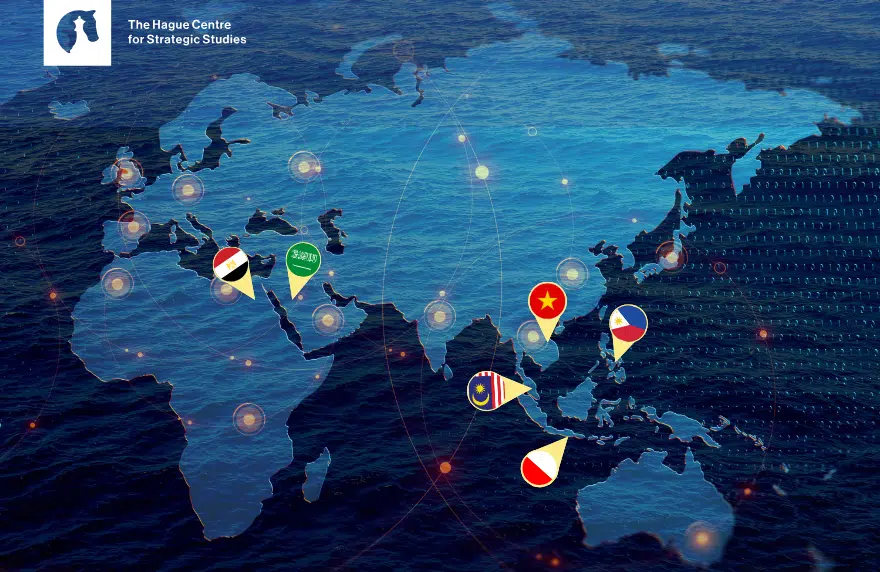
Hybrid threats have become a structural feature of today’s security environment, allowing states to pursue strategic objectives below the threshold of armed conflict. While European debates have largely centred on Russia, this new HCSS report demonstrates that the People’s Republic of China (PRC) has developed a broad and adaptive hybrid toolkit that increasingly affects small and middle powers (SMPs) in Europe and the Asia-Pacific. 

Drawing on an original HCSS database of confirmed Chinese hybrid threat incidents targeting 50 SMPs, the report maps activity across five domains: digital and information warfare, economic statecraft, paramilitary operations, physical disruption, and legal and political activities. The findings show that Chinese hybrid activity is systematic rather than incidental, with cyber operations, disinformation, and economic leverage forming the core of Beijing’s approach across both regions. While tactics vary by geography, they are consistently tailored to exploit national dependencies and institutional vulnerabilities. 

A central finding is that most SMPs still respond to Chinese hybrid threats in an ad-hoc and reactive manner. Such responses may address individual incidents but fail to build long-term resilience. The report argues that hybrid threats should instead be understood as a structural element of the PRC’s foreign policy, requiring coherent strategic posturing rather than isolated countermeasures. 

To support this shift, the report introduces a framework that distinguishes four strategic approaches adopted by SMPs: bandwagoning, hedging, balancing, and countering. Through comparative analysis and case studies, it demonstrates how each posture entails distinct trade-offs in terms of sovereignty, economic exposure, and retaliation risks. Importantly, even accommodating strategies rely on detection and preparedness, while more assertive approaches demand higher institutional capacity and political resolve. 

The report concludes with tailored recommendations for each strategic posture. These include strengthening early-warning and attribution capabilities, mapping and stress-testing economic dependencies, improving cross-government coordination, and aligning domestic resilience measures with foreign-policy positioning.

As lead author Benedetta Girardi notes: 

“Hybrid threats are not isolated disruptions but part of a long-term strategy. Small and middle powers cannot afford to respond incident by incident; they need to position themselves consciously and coherently in relation to China.”

Report Link

Authors: Benedetta Girardi, Noemie Jacq, Fiona De Cuyper and Laura Jasper

Contributors: Sofia Romansky, Elton Hogklint and Emma Genovesi

Quality Assurance: Tim Sweijs

The research was made possible through a financial contribution from the Taipei Representative Office in the Netherlands to the Hague Centre for Strategic Studies (HCSS).


  • Share on Facebook
  • Share on X
  • Share on WhatsApp
  • Share on LinkedIn
  • Share by Mail

Experts

Benedetta Girardi
Fiona De Cuyper
Laura Jasper
Sofia Romansky
Tim Sweijs

Related News

Related Content

Maritime Security for resilient global Supply Chains in the wider Indo-Pacific
What the Indo-Pacific means to Europe: trade value, chokepoints, and security risks
Bridging Waters: Strengthening Europe’s Maritime Security Engagement Through Partnerships with Rising Middle Powers 

Office Address

  • The Hague Centre for Strategic Studies
  • Lange Voorhout 1
  • 2514 EA The Hague
  • The Netherlands

Contact Us

  • Telephone: +31(70) 318 48 40
  • E-mail: info@hcss.nl
  • IBAN NL10INGB0666328730
  • BIC INGBNL2A
  • VAT NL.8101.32.436.B01
  • Contact

Legal & Privacy

  • Disclaimer & Privacy
  • Algemene Voorwaarden (NL) 
  • Terms & Conditions (ENG) 
  • Coordinated Vulnerability Disclosure
  • Ethical Standards
  • Manual for Responsible Use of AI

Follow us

© The Hague Centre for Strategic Studies
    Link to: De Strateeg | Wat zijn de gevolgen van Trumps aanval op Venezuela? Link to: De Strateeg | Wat zijn de gevolgen van Trumps aanval op Venezuela? De Strateeg | Wat zijn de gevolgen van Trumps aanval op Venezuela? Link to: Essay | Orbis Americana: De strelende diplomatie van Europa spoort keizer Trump aan tot roekeloosheid Link to: Essay | Orbis Americana: De strelende diplomatie van Europa spoort keizer Trump aan tot roekeloosheid Essay | Orbis Americana: De strelende diplomatie van Europa spoort keizer Trump...
    Scroll to top Scroll to top Scroll to top

    GDPR Consent

    Your privacy is important to us. Here you can set which consent you are allowing us with regards to the collection of general information, the placing of cookies of the collection of personal information. You can click 'Forget my settings' at the bottom of this form to revoke all given consents.

    Privacy policy | Close
    Settings

    GDPR Consent Settings

    Your privacy is important to us. Here you can set which consent you are allowing us with regards to the collection of general information, the placing of cookies of the collection of personal information. You can click 'Forget my settings' at the bottom of this form to revoke all given consents.

    Website statistics collect anonymized information about how the site is used. This information is used to optimize the website and to ensure an optimal user experience.

    View details

    Functional cookies are used to ensure the website works properly and are neccessary to make the site function. These cookies do not collect any personal data.  

    View details
    Forget my settings Deleted!