
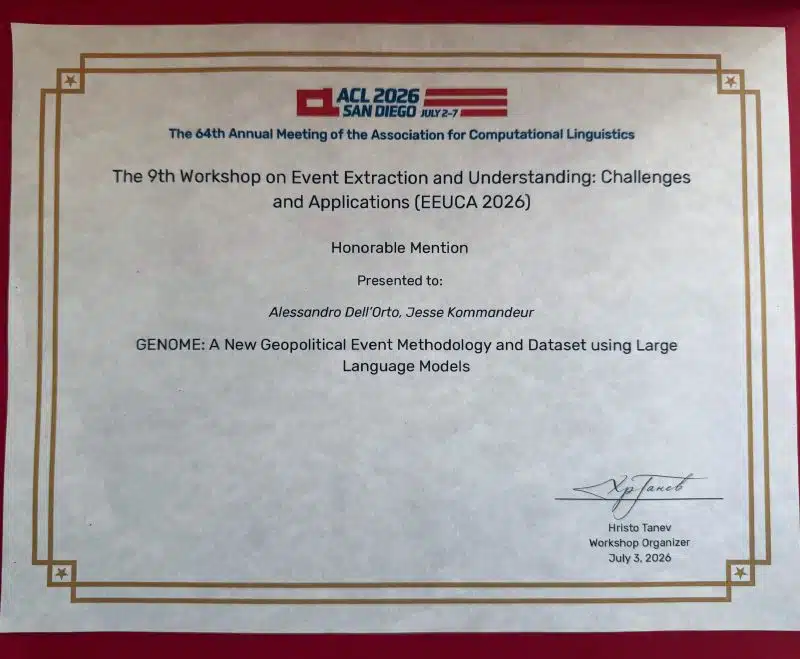
The HCSS Datalab has been awarded an Honorable Mention at ACL 2026, the 64th Annual Meeting of the Association for Computational Linguistics, held in San Diego from 2–7 July 2026. ACL is the world’s flagship venue for computational linguistics and natural language processing. The award recognizes the paper GENOME: A New Geopolitical Event Methodology and Dataset using Large Language Models, by HCSS Datalab researchers Alessandro Dell’Orto and Jesse Kommandeur, presented at the 9th Workshop on Event Extraction and Understanding.
Quantitative research into international relations depends on structured event data, machine-readable records of who did what to whom, and when. Yet existing automated datasets are largely conflict-focused, and the most prominent one, POLECAT, stopped receiving updates in 2024, leaving a gap in up-to-date coverage of both conflictual and cooperative interactions.
GENOME (Geopolitical Event News Observatory, Mapping, and Extraction) fills that gap. It uses Large Language Models to extract geopolitical events from newswire data, classifying them with an adapted version of the PLOVER ontology and extending the traditional Actor–Recipient structure with a new “Third Party” role to capture multilateral relations.
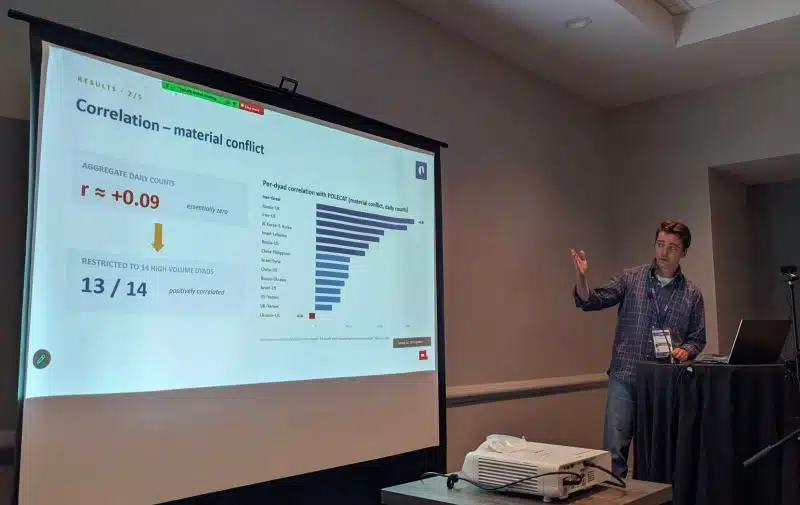
Benchmarked against POLECAT over a five-month overlap, GENOME aligns closely on conflict events while capturing a far more balanced picture of cooperation, especially the low-intensity, verbal diplomacy that is often invisible in existing data but carries early-warning value. GENOME also dates events by when they actually happened rather than when they were reported, and resolves international bodies such as NATO, the IMF and the UN with greater precision.
But the award-winning method is only the beginning. GENOME is not an endpoint but a foundation. Later this year, HCSS will roll out the GENOME platform: a new public interface that turns the world’s news into a living, continuously updated map of how states clash and cooperate. Policymakers will be able to track how a relationship heats up or cools down week by week; analysts will be able to spot the signals that precede a crisis; and researchers will gain an open, up-to-date alternative to the datasets that have gone dark.
Sign up to receive updates and get early access
Authors: Alessandro Dell’Orto, Jesse Kommandeur
Publisher: Association for Computational Linguistics
This is a core HCSS Datalab output. The Datalab designed the full GENOME pipeline (LLM-based event extraction, PLOVER-based ontology classification, entity normalization, and deduplication), built and validated the dataset against POLECAT, and will operationalize it in the forthcoming public platform.
Experts

Related Content