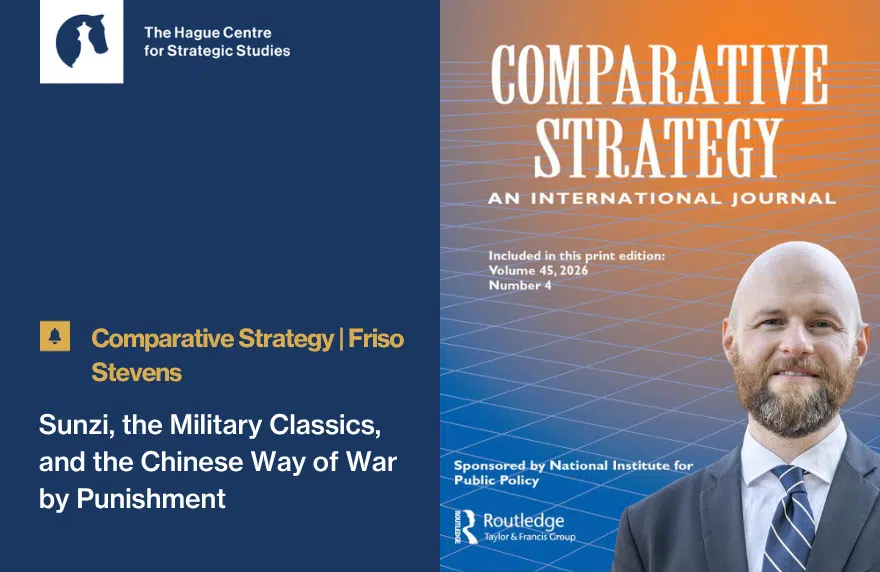
HCSS Strategic Analyst Friso Stevens has published a new peer-reviewed article in Comparative Strategy titled “Sunzi, the Military Classics, and the Chinese Way of War by Punishment: A Strategically Defensive and Tactically Offensive Strategic Culture.”
The article revisits the foundational texts of Chinese strategic thought — Sunzi’s Art of War together with the other six Military Classics that make up the core corpus of China’s ancient strategic canon — to reassess what they actually reveal about how China uses force.
Stevens pushes back against Beijing’s framing of China as a uniquely pacific, defensively minded power. Nuancing the familiar dictums of Sunzi and reading across the classics as a whole, he distils the core concepts they contain and sets them against the People’s Republic’s strategic behaviour under the Chinese Communist Party (CCP). What emerges is a consistent pattern: a tactical preference for delivering the enemy a surprise first blow with overwhelming force.
This is warfare as punishment. Rather than seeking to occupy or hold, China retains a flexible, low-cost posture — striking hard to teach the adversary a shocking lesson, then withdrawing once the point has been made. The result is a strategic culture that is defensive in its self-presentation but decidedly offensive in its execution, with clear implications for how Beijing’s signalling, deterrence, and escalation choices should be read today.
Dr. Friso Stevens is a Strategic Analyst at HCSS, working at the intersection of IR theory, military strategy, and foreign and defence policy analysis. His research spans the changing character of war — from hybrid and grey-zone tactics below the threshold of armed conflict to the future of land, air, and naval warfare — with a broad regional focus across Europe, Asia, and North America.
Read the full article here.
Experts

Related Content