HCSS
  • News
    • BNR | De Strateeg
    • Columns
    • Events
    • HCSS Newsletter
    • Podcasts
  • Publications
    • Publications
      • All Projects
      • All Publications
    • Geopolitics & Governance
      • Transatlantic Relations
      • Russia & Eurasia
      • Europe in the Indo-Pacific
      • GC REAIM
      • PROGRESS / Strategic Monitor
    • Economics & Technology
      • Emerging Technologies
      • Critical Materials
      • Energy Security
    • Defence & Security
      • On Future War
      • Deterrence and Arms Control
      • Hybrid Threats
      • Cyber Security
    • Society & Resilience
      • Nationale Veiligheid en Weerbaarheid
      • Transnational Organised Crime
      • Strategic Monitor Dutch Police
    • Climate, Water & Food
      • Climate Security
      • Water, Peace & Security (WPS)
      • Food Security
  • Dashboards
    • Dashboards
      • All Tools
        • GINA
        • SARA
    • Geopolitics & Governance
      • DFRI
      • GINA | Diplomatic
      • GINA | Information
      • CLARIS
    • Economics & Technology
      • DOMINO
      • GATRI
      • GINA | Economic
      • Cyber Arms Watch
      • Cyber Comparator
      • Cyber Norms Observatory
      • Cyber Transparency
    • Defence & Security
      • GINA | Military
      • Nuclear Timeline
    • Society & Resilience
      • DAMON
    • Climate, Water & Food
      • Agrifood Monitor
      • CARMEN
      • CRM Dashboard
  • Services
    • HCSS Boardroom
    • HCSS Datalab
    • Socio-Political Instability Survey
    • Strategic Capability Gaming
    • Strategic Negotiations Course
    • Studio HCSS
    • Southern Africa-Netherlands Cyber Security School 2026
    • Indo-Dutch Cyber Security School 2025
  • GC REAIM
    • GC REAIM | Former Members
    • GC REAIM | Publications
    • GC REAIM | Conferences
    • GC REAIM | Partners, Sponsors, Supporters
  • About HCSS
    • Contact Us
    • Our People
    • Funding & Transparency
    • Partners & Clients
    • Internship Programme
    • Press & Media Inquiries
    • Working at HCSS
    • Global Futures Foundation
  • Click to open the search input field Click to open the search input field Search
  • Menu Menu

News

New policy brief: realigning deterrence and arms control in a European quest for strategic stability

December 6, 2022

Neither arms control nor deterrence can be considered without the other. In a new HCSS policy brief, Lotje Boswinkel and Paul van Hooft underline that, however counterintuitive it may seem to Europeans, investments in robust deterrence also provide powerful bargaining leverage to engage on arms control.

Russia’s invasion of Ukraine has caused a strategic awakening in Europe, but long before the war, relations between Washington and Moscow had already deteriorated and competition with Beijing had grown. Today’s global missile landscape is more dense, diverse, advanced, and volatile – as well as more contested and less regulated.

Meanwhile, the future of the arms control regime is hanging by a thread. Key bilateral arms control treaties have either collapsed or become increasingly outdated, or are suffering from a lack of enforcement mechanisms, contestation and non-compliance from outside and from within.

Arms control and its demise are often framed as an issue pertaining predominantly to the US, Russia, and increasingly also China, as these three are driving most of the technological and military-strategic developments. Even so, the security implications stretch beyond today’s major military powers – not least to Europe. For small and middle powers, the already limited manoeuvre space in the field of arms control is shrinking even further.

In today’s tense geopolitical environment, Europe will need to understand arms control as serving three potential and competing purposes: to promote disarmament, to create stability, and to lock in competitive advantages – all with the ultimate aim to prevent war.

This entails investing in both deterrence and arms control, simultaneously: the two are typically separated yet two sides of the same coin, Boswinkel and Van Hooft state. The Ukraine war has put deterrence-by-denial and deterrence-by-punishment firmly back on the agenda, and it is key to seek the right mix of deterrence, arms control, and non-proliferation measures.

In addition to the more technical takeaways and recommendations for Europe, this policy brief warrants three higher-level policy recommendations for small and middle powers:

  • Doubling down on instruments of economic statecraft
  • Revamping the dual-track approach: treating arms control and deterrence holistically
  • Invest in expert and public knowledge
Policy Brief Link

Authors: Lotje Boswinkel and Paul van Hooft, with contributions from Michal Gorecki.

The research for and production of this report has been conducted within the PROGRESS research framework agreement. Responsibility for the contents and for the opinions expressed, rests solely with the authors and does not constitute, nor should it be construed as, an endorsement by the Netherlands Ministries of Foreign Affairs and Defence.

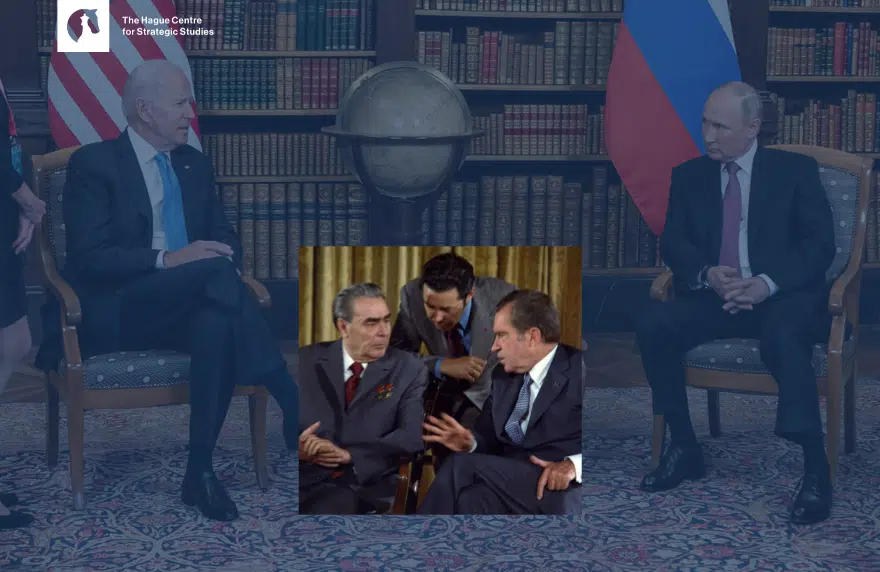
Cover image source: Wikimedia Commons, Brezhnev and Nixon (1973) / Biden and Putin (2021)

  • Share on Facebook
  • Share on X
  • Share on WhatsApp
  • Share on LinkedIn
  • Share by Mail

Experts

Lotje Boswinkel
Paul van Hooft

Related News

Related Content

De Strateeg: Wapenbeheersing in het nauw, nieuwe aanpak noodzakelijk
Militaire Courant | Oorlog in Oekraïne: kansen en uitdagingen voor wapenbeheersing
Poetin over kernwapens is strategische afschrikking onder kernparaplu

Office Address

  • The Hague Centre for Strategic Studies
  • Lange Voorhout 1
  • 2514 EA The Hague
  • The Netherlands

Contact Us

  • Telephone: +31(70) 318 48 40
  • E-mail: info@hcss.nl
  • IBAN NL10INGB0666328730
  • BIC INGBNL2A
  • VAT NL.8101.32.436.B01
  • Contact

Legal & Privacy

  • Disclaimer & Privacy
  • Algemene Voorwaarden (NL) 
  • Terms & Conditions (ENG) 
  • Coordinated Vulnerability Disclosure
  • Ethical Standards
  • Manual for Responsible Use of AI

Follow us

© The Hague Centre for Strategic Studies
    Link to: De Strateeg: Hoe Nederland andere landen helpt in de strijd tegen klimaatverandering Link to: De Strateeg: Hoe Nederland andere landen helpt in de strijd tegen klimaatverandering De Strateeg: Hoe Nederland andere landen helpt in de strijd tegen klimaatve... Link to: Joris Teer | Nieuwsuur: Chinese magneten als machtsmiddel Link to: Joris Teer | Nieuwsuur: Chinese magneten als machtsmiddel Joris Teer | Nieuwsuur: Chinese magneten als machtsmiddel
    Scroll to top Scroll to top Scroll to top

    GDPR Consent

    Your privacy is important to us. Here you can set which consent you are allowing us with regards to the collection of general information, the placing of cookies of the collection of personal information. You can click 'Forget my settings' at the bottom of this form to revoke all given consents.

    Privacy policy | Close
    Settings

    GDPR Consent Settings

    Your privacy is important to us. Here you can set which consent you are allowing us with regards to the collection of general information, the placing of cookies of the collection of personal information. You can click 'Forget my settings' at the bottom of this form to revoke all given consents.

    Website statistics collect anonymized information about how the site is used. This information is used to optimize the website and to ensure an optimal user experience.

    View details

    Functional cookies are used to ensure the website works properly and are neccessary to make the site function. These cookies do not collect any personal data.  

    View details
    Forget my settings Deleted!