Publications

Over the years, HCSS has built up an extensive archive of reports, monitors, papers and other publications. We disseminate the results of our research as broadly as possible to benefit the public good. Use the advanced search functions below to browse through our research library, most of which is available as free PDF downloads.

21 Mar 2023
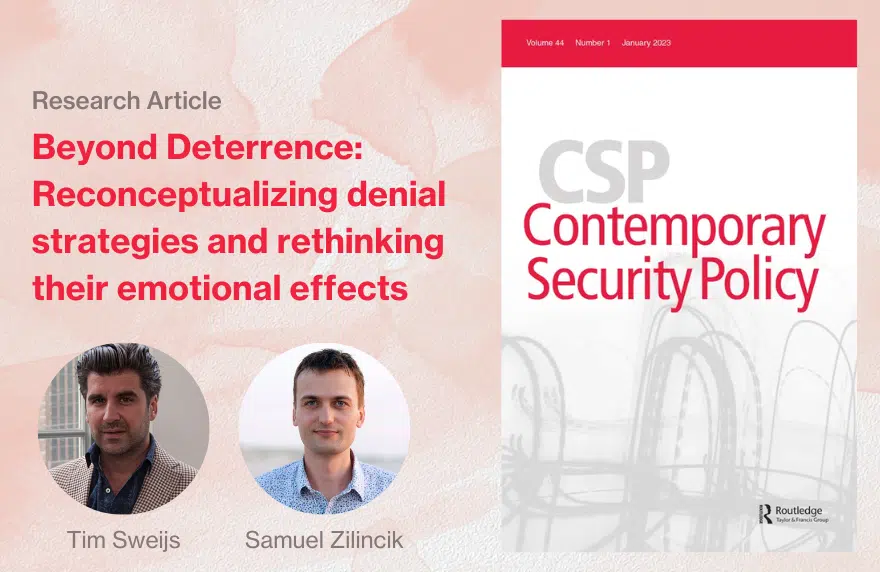
Western strategic thought about denial strategies and their effects is conceptually muddled. In a new article in Contemporary Security Policy (CSP), Tim Sweijs and Samuel Zilincik try to reconceptualize denial and rethink its emotional effects. The authors argue that the expansion of military domains and the renewed emphasis on multi-domain coercion requires us to reconsider the utility of denial strategies with a pair of fresh eyes.
20 Mar 2023
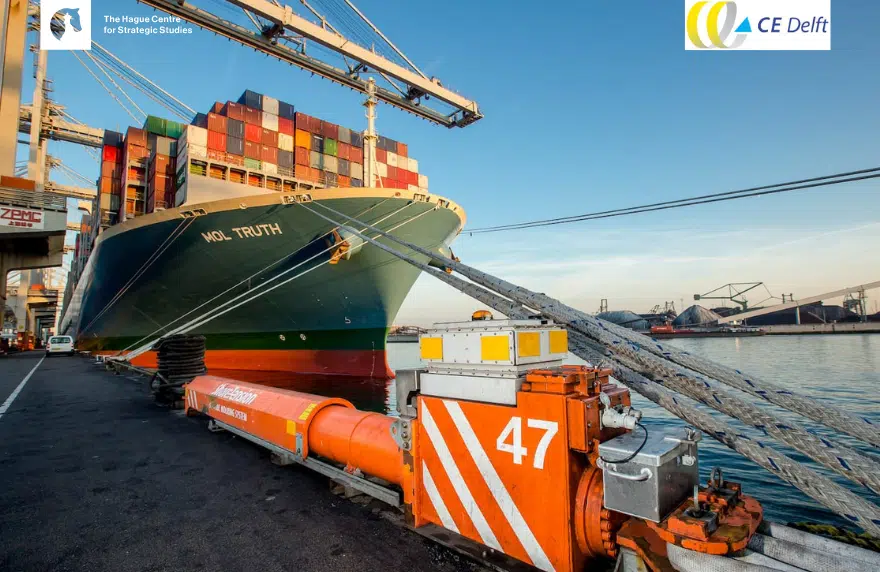
How can the European boycott on Russian oil affect maritime bunkering in the Netherlands? And how do these sanctions interact with ambitions to decarbonize shipping under Fit-for-55? This new report by HCSS and CE Delft develops three storylines of how bunkering in Dutch ports will be affected by sanctions on Russian oil.
16 Mar 2023
Do NATO’s deterrence policies really have an impact on Russian behaviour? Deterrence policies have gained renewed interest amongst policymakers and military strategists alike, driving the need for robust assessments and evaluation of deterrence strategies. This new study by Tim Sweijs and Mattia Bertolini identifies seven sins of deterrence assessments and offers clear guidelines on how to address them.
13 Mar 2023
This paper by Eva Pejsova (The Brussels School of Governance) asks what has been the scope and focus of the European (EU) naval presence in the Indo-Pacific and what has been its effect? This paper looks at the rationales and specificities of the naval deployments of France, Germany and the Netherlands in the Indo-Pacific.
9 Mar 2023
Wat is er nodig om een energiehandelshub te zijn? De ARA-regio – Amsterdam, Rotterdam en Antwerpen – is een van de grootste handelsknooppunten van vloeibare bulkgoederen ter wereld. Toch zal de energiekaart de komende decennia aanzienlijk veranderen: een handelscentrum zijn voor nieuwe energiebronnen is daarbij geenszins een gegeven. Met behulp van openbaar beschikbare gegevens werpt dit rapport licht op enkele van de fijne kneepjes van de energiehandel, met name gericht op de rol van Nederland als internationale hub. Het kijkt terug op de ontwikkeling van het land als een internationaal centrum van olie en aardgas, en vooruit op de belangrijkste kenmerken van opkomende grondstoffenmarkten.
8 Mar 2023
This policy brief by Collin Koh (S. Rajaratnam School of International Studies) examines, prospects and challenges facing the viability of future European naval presence in the Indo-Pacific. It argues that notwithstanding varying perceptions within Southeast Asia, the region remains generally receptive of European naval presence.
7 Mar 2023
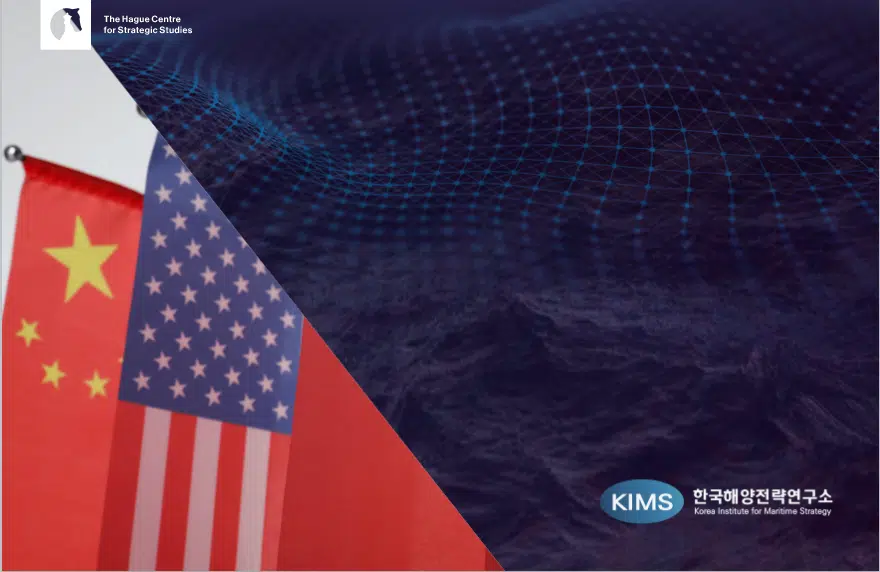
What could trigger a conflict in the East China Sea between China on one side and Japan and the United States on the other, and what would that conflict look like? This chapter by Paul van Hooft, Tim Sweijs and Stella Kim imagines conflict and escalation scenarios in the East China Sea, by analyzing structural drivers of China, the US, Japan, South Korea, and other regional states’ maritime strategies, territorial disputes, and geographic constraints.
6 Mar 2023
In NATO’s most recent Strategic Concept, Western allies touted arms control, disarmament, and non-proliferation as central to strategic stability alongside “effective deterrence and defence” and “meaningful and reciprocal political dialogue.” This paper by Susan Colburn (Duke University) argues that looking to the past can help us consider the advantages and potential risks resulting from this broad approach. Colburn takes the case of NATO'S Euromissiles struggle to argue that there are not neat lessons to be drawn from history nor are there any easy frameworks that can be exported and applied to the problems of the present.
2 Mar 2023
Artificial Intelligence – or AI – applications are affecting the character of war and international security more broadly in a variety of ways. Our human history of war features a long succession of new technologies that have affected how wars were fought. Read Tim Sweijs' remarks at The Summit on Responsible Artificial Intelligence in the Military Domain: REAIM, The Hague, held on the 15 and 16 February 2023.
1 Mar 2023
Strategic stability refers to the ability of states to interact during crises without escalating diplomatic and conventional military disputes to the use of nuclear weapons. This essay by Giles David Arceneaux evaluates the effects of nuclear command and control systems on strategic stability in crisis scenarios. This study defines the concept of nuclear command and control, details the challenges that command and control systems pose for strategic stability, identifies challenges to strategic stability emanating from Russia, China and North Korea, and discusses opportunities for policymakers to reinforce strategic stability in those regions.
28 Feb 2023
The war in Ukraine has raised fresh doubts over the will and ability of European states to play a meaningful role in the Indo-Pacific. In the United Kingdom, there is a lively debate over the utility of its ‘tilt’ to the region. This paper by William D. James explores the rationale and efficacy of small or token defence deployments – with a specific focus on the defence component of the Indo-Pacific tilt. Its arguments challenge the assumption that tokenistic deployments are always a strategically unsound idea.
27 Feb 2023
Increasing violence by revisionist regimes is breaking the current arms control regime. In this paper John D. Maurer argues that for Europe today, then, the single most important contribution to the future of arms control is to choose to compete. European countries can best respond by leaning into military technical competition in the short term to produce better arms control results over the longer term.
27 Feb 2023
De aanwezigheid van een sterke en welvarende middenklasse is essentieel voor de sociale en politieke stabiliteit van democratische samenlevingen. Maar deze middenklasse staat onder druk, waarschuwt HCSS in een nieuw rapport. Een toenemend aantal mensen, ook uit traditioneel gezagsgetrouwe groepen, wijst de rechtsorde en het huidige democratische staatsbestel in zijn geheel af.
23 Feb 2023
In this snapshot, strategic analyst Frederik Mertens gives his view on Ukraine's call for fighter aircraft and the role of air defence systems in the war. While tanks are being introduced, Kyiv is clamouring for fighter aircraft. The Ukrainian request to be reinforced in the air is fully understandable. Although they have been able to keep the Russian air force at bay for a full year, the Russian missile campaign is still ongoing and Russia seems to prepare its airpower to support its Spring offensive. But fighters are not tanks.
22 Feb 2023
As Russia’s war of aggression enters its 2nd year, the Western definition of success must remain the re-establishment of Ukraine as a secure and sovereign European democracy with all the rights and responsibilities that entails. This Ukraine Strategy by The Alphen Group (TAG) addresses the scope and extent of Western support required to reinforce that goal across the diplomatic, informational, military and economic domains.
20 Feb 2023
What preliminary lessons can we learn after one year of war in Ukraine? After the Russian invasion, a large-scale and even nuclear war in Europe is no longer unthinkable, but European countries are only at the beginning of a period of rearmament and reconstruction of their defence apparatus. HCSS has focused on the land combat in this first analysis. Because the Ukraine war obviously has many dimensions, but it is still mainly about defending, conquering and reconquering territory in which the Russian and Ukrainian armies play the leading role. In this first study, wemake a number of important observations.
16 Feb 2023
Hoe zal de toekomstige invulling van de nationale inzet van de krijgsmacht er waarschijnlijk uit zien? En welke (aanvullende) capaciteiten heeft Defensie daarvoor nodig zodat zij tegelijk kan blijven voldoen aan internationale verplichtingen? Het klassieke beeld van verdediging van ‘het nationale territoir’ is volstrekt achterhaald. De mogelijke dreigingen die op ons land afkomen, vereisen een gelaagde aanpak waarin verschillende overheidsinstanties, bedrijven, maatschappelijke organisaties en burgers allen een rol spelen. De krijgsmacht vormt daarbij een structurele partner in de veiligheidsketen.
15 Feb 2023
As the largest and most diverse democracy on earth the struggle to keep the India secure within cyberspace and all other domains is significant. India is currently undergoing efforts to digitise its economy and infrastructure. Consequently, the number of users to be safeguarded by securitisation of the cyber domain is rising rapidly. To become an economically developed digital nation, India must therefore also adopt a holistic approach in tackling challenges to its cybersecurity.
15 Feb 2023
Since the Ukraine war, there has been a growing recognition of the importance of climate proofing the armed forces as a precondition for operational effectiveness, rather than as a positive side effect. Energy security is now a priority of NATO and the EU. This HCSS report shows how new technologies can help armed forces reduce their carbon and logistical footprint, while maintaining - or even strengthening - their operational effectiveness. Better incentives for green innovation can help to reduce costs and improve operational capability at the same time.
10 Feb 2023
The use of information technology not only changes the way people communicate but also how they fight. This makes it necessary to more effectively integrate so-called information activities into military operations. This paper provides advice on how to adapt military command structures, using the German-Dutch Division 2025 project as a case study, to use communication capabilities and specialised staff as a military tool.
26 Jan 2023
Deterring aggression is a constant challenge for both small states and their larger allies and partners. This paper asserts that traditional concepts for small states’ defence and deterrence, such as “deterrence by insurgency” and non-offensive defence, are insufficient, and that instead, small states should be encouraged and supported to build up sufficient military capability that allows them to hold adversaries at greater risk. The paper ends with some policy considerations tailored for small states in Southeast Asia, like the Philippines, facing particular deterrence challenges.
19 Jan 2023
Welke voorlopige lessen kunnen we leren na één jaar oorlog in Oekraïne? Na de Russische inval is een grootschalige en zelfs nucleaire oorlog in Europa niet meer ondenkbaar, maar Europese landen staan aan het begin van een periode van herbewapening en wederopbouw van hun defensieapparaat. In deze eerste analyse, met een focus op het landgevecht, komen we tot een aantal belangrijke observaties.
19 Jan 2023
How can a middle power strategy in the Indo-Pacific enable the EU to pursue greater strategic autonomy? This snapshot by assistant analyst Stella Kim and senior strategic analyst Paul van Hooft argues that by analysing the strategies of prevailing middle powers in the region, the EU can improve its own approach in the Indo-Pacific and settle on one better suited for its capabilities.
17 Jan 2023
What does it take to be an energy trade hub? Using publicly available data, this HCSS report sheds light on the role of the Netherlands as an international energy trade hub. It looks back at the country’s development as an hub for oil and natural gas, and forward at the main characteristics of emerging commodity markets.

© The Hague Centre for Strategic Studies