
Research
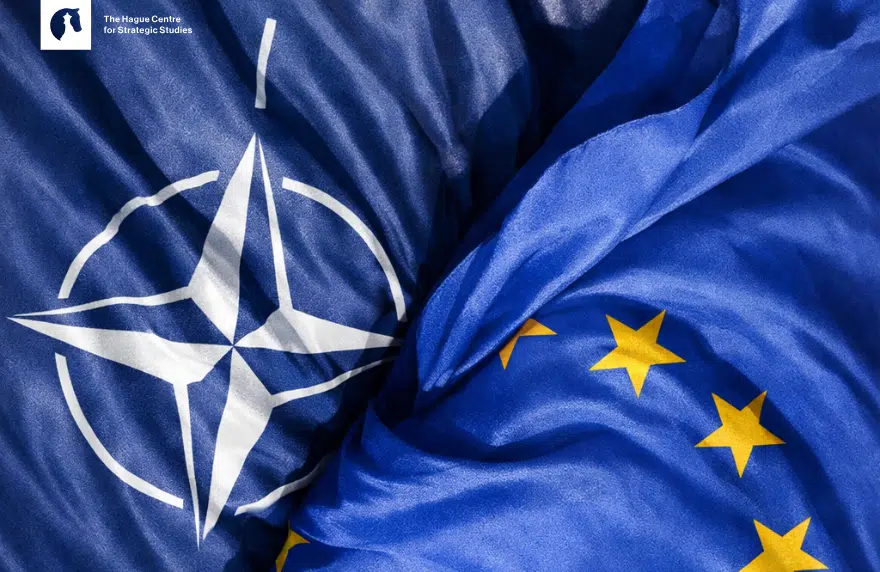
Europe’s defence landscape is complex, and the relationship between the European Union and NATO is a prime example. Though only five kilometres apart in Brussels, the EU and NATO often appear worlds apart in practice. This new HCSS report by Davis Ellison and Daniel Fiott offers a clear-eyed assessment of this relationship and a roadmap for improvement.
Persistent political tensions, overlapping memberships, and entrenched institutional suspicion have historically constrained cooperation between these core European security actors. The second Trump presidency, Brexit, and ongoing regional disputes – most notably involving Türkiye and Cyprus – have compounded these challenges.
Yet, European states continue to invest heavily in both organisations. Lead author Davis Ellision notes:
“Despite tensions, EU and NATO remain the indispensable frameworks for European security. Cooperation and competition coexist, but neither can be replaced.”
The report identifies key areas for strengthening EU-NATO cooperation:
- Reform of the Berlin Plus Agreement to streamline EU access to NATO assets.
- Closer political coordination in Brussels, particularly between the EU’s Political and Security Committee and NATO’s North Atlantic Council.
- Reconceptualising European defence scenarios to better align strategic planning across institutions.
- Greater alignment of defence planning to reduce duplication and enhance operational readiness.
Crucially, improving institutional cooperation also requires addressing Europe’s dependence on the United States. While some capitals aim to reduce reliance on American forces and defence industry, this will require careful coordination and at least tacit approval from Washington.
The study highlights that European security is inherently regional: both NATO and the EU operate in service of European stability. Germany and France, in particular, play leading roles in navigating the complex web of institutional relationships, with other states such as the Netherlands actively supporting reforms.
Daniel Fiott, co-author, emphasises:
“The moment is ripe for reform. European capitals must seize this opportunity to build a more self-sufficient, resilient, and credible security architecture within and alongside NATO.”
The report provides a provisional menu of reforms for policymakers seeking to strengthen the EU’s role within NATO, improve institutional cooperation, and foster European strategic autonomy without jeopardising the transatlantic bond.
Authors: Davis Ellison and Daniel Fiott (Assistant Professor at the Centre for Security, Diplomacy and Strategy (CSDS) at the Vrije Universiteit Brussel (VUB), where he heads the Defence and Statecraft Programme)
Contributor: Noemie Jacq
Quality assurance: Paul Sinning
Cover image: AI-generated with OpenAI’s ChatGPT.
The research for and production of this report has been conducted within the PROGRESS research framework agreement. Responsibility for the contents and for the opinions expressed, rests solely with the lead authors and does not constitute, nor should be construed as, an endorsement by the Netherlands Ministries of Foreign Affairs and Defence.
Experts

Related Content