Research
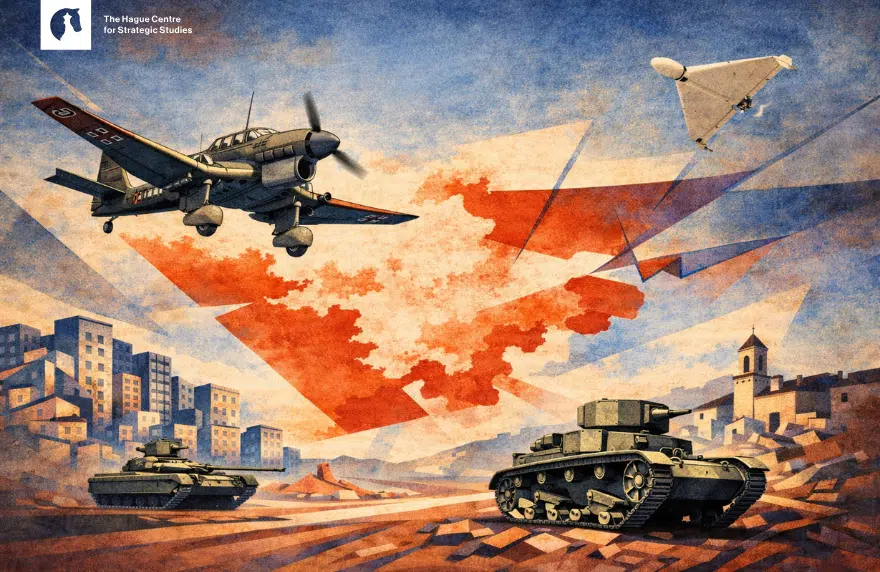
A “Little World War”: What Spain’s Civil War reveals about Ukraine and today’s strategic choices
The war in Ukraine is often framed as a regional conflict. A new HCSS paper by Dr. Iskander Rehman argues this is a dangerous misreading. Drawing on the history of the Spanish Civil War, the author shows how proxy wars often become global laboratories for military innovation, and how democracies risk falling behind when they fail to learn and act decisively.
The paper demonstrates that both Spain in the 1930s and Ukraine today function as arenas where external powers test weapons, refine tactics, and gain combat experience. Authoritarian regimes, from Nazi Germany then to Russia, China, and North Korea now, have shown a greater willingness to intervene directly, absorbing lessons that shape future conflicts.
“Ukraine is not just a battlefield,” says Dr. Rehman. “It is a laboratory of military adaptation, and the powers that have intervened – whether directly or indirectly – are already preparing for the next war.”
Key findings:
- Proxy wars accelerate military learning: In Spain, Germany refined airpower and combined-arms warfare; in Ukraine, drones, electronic warfare, and industrial-scale attrition are reshaping modern conflict.
- Authoritarian regimes are gaining invaluable battlefield experience: Direct involvement allows for rapid experimentation and feedback, from North Korean troop deployments to Russian drone innovation.
- Democracies risk mislearning, or not learning at all: During the Spanish Civil War, Western powers observed but often misinterpreted key developments, sometimes reinforcing flawed doctrines.
- Escalation aversion carries real costs: Delayed Western military support to Ukraine suggests that fears of escalation can inadvertently grant adversaries the initiative.
- Few protracted proxy wars remain regional: Spain helped forge the Axis alignment; Ukraine is already reshaping global power dynamics across Europe and the Indo-Pacific.
Recommendations:
- Institutionalise battlefield learning: Move beyond observation and ensure systematic integration of lessons from Ukraine into doctrine, procurement, and training.
- Adopt a more agile approach to escalation management: Avoid self-deterrence that allows adversaries to dictate the pace and scope of conflict.
- Invest in scalable, cost-effective capabilities: Prioritise drones, electronic warfare, and resilient, rapidly produced systems suited for high-intensity attritional warfare.
- Think across regions: Treat Ukraine as part of a broader systemic contest, not a contained European crisis.
- Strengthen learning partnerships: Expand two-way exchanges with Ukrainian forces to capture real-time operational insights.
“History may not repeat itself mechanically,” notes Dr. Rehman, “but it has a way of punishing those who reflexively dismiss its value and relevance to contemporary warfare.”
Author: Dr. Iskander Rehman
Editor: Dr. Tim Sweijs
The research for this report has been conducted within a framework agreement between HCSS and the Royal Netherlands Army Command (CLAS). Responsibility for the contents of the report rests solely with the authors and does not constitute, nor should be construed as, an endorsement by the Royal Netherlands Army.
Experts

Related Content