
Research
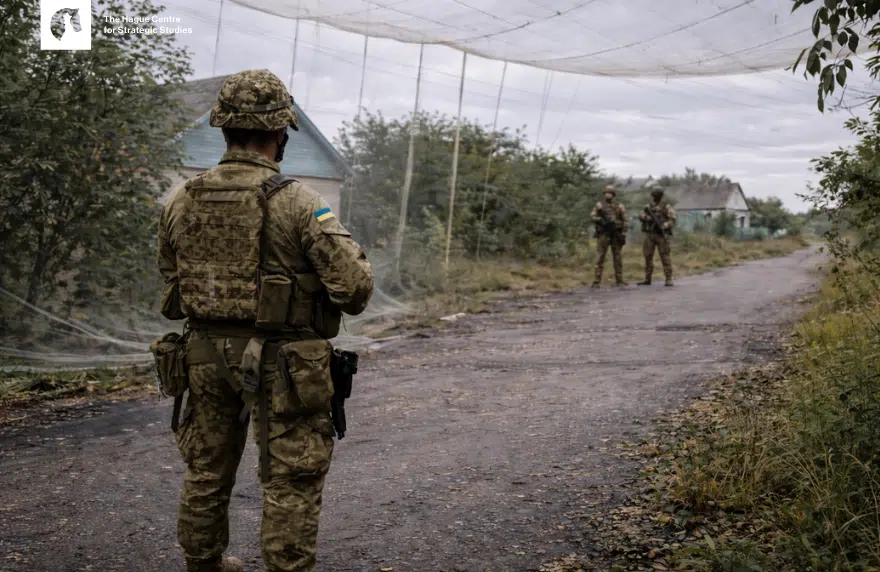
Since Russia’s full-scale invasion in February 2022, Europe has provided financial and military support to Ukraine, but the war continues to expose gaps in European adaptation, defence modernisation, and strategic thinking. In autumn 2025, HCSS researchers visited Kyiv to understand how Ukraine’s armed forces, society, and defence-industrial ecosystem have adapted to sustain high-intensity conflict – and what this means for Europe.
“Supporting Ukraine is no longer only an act of solidarity. It is a direct investment in Europe’s own security and adaptation to modern war,” notes HCSS research director Dr. Tim Sweijs. “Every delay risks leaving Europe exposed to threats that are already evolving on the battlefield.”
The visit revealed that Ukraine has become a “live war‑tech laboratory,” excelling less in breakthrough technology than in rapid adaptation, continuous experimentation, and swift dissemination of solutions. Semi-autonomous drones, AI-enabled targeting, unmanned ground vehicles, and integrated air-defence systems now define battlefield effectiveness.
Ukrainian brigades differ widely in performance, yet innovative units continuously feed lessons back into the system via digital reporting, gamification, and frontline experimentation. Civil society, volunteers, and private foundations have become integral to sustaining operations, demonstrating a model of societal resilience and industrial flexibility unparalleled in Europe.
Key Findings
- Ukraine’s adaptation cycles outpace many European militaries, highlighting gaps in Europe’s command, control, and industrial agility.
- Rapid, decentralised innovation drives battlefield advantage, not singular technological breakthroughs.
- Strategic neutralisation – denying Russia’s objectives over time – is the most viable theory of victory.
- Europe’s current support, though significant, is insufficient to enable Ukraine to fully shape the battlefield and safeguard European security interests.
Recommendations
- Short-term (0–12 months): Fill critical battlefield gaps in air and missile defence, ammunition, and counter-UAS. Speed is essential.
- Medium-term (12–36 months): Reform Ukraine’s force posture, regenerate units, and develop European-Ukrainian joint-venture defence-industrial partnerships.
- Long-term (36–120 months): Ensure Ukraine’s survival as an independent, militarily viable state through a “porcupine” model: a mix of financial support, selective imports, domestic mass production, and deep European integration.
Policymakers are urged to act decisively: “Europe must learn from Ukraine’s jungle-like innovation model and rapidly transform its militaries, industries, and societies, or risk facing a stronger, battle-hardened Russia at its borders,” warns lead researcher Tim Sweijs.
The time for cautious observation is over. Assisting Ukraine is simultaneously assisting ourselves – preparing for a future where Europe can deter or defeat Russia without shouldering the full cost alone.
Authors: Tim Sweijs, Elie Tenenbaum and Jan Feldhusen
Contributors: Markus Iven and Frank Bekkers
The research for and production of this report has been conducted within the PROGRESS research framework agreement. Responsibility for the contents and for the opinions expressed, rests solely with the authors and does not constitute, not should be construed as, an endorsement by the Netherlands Ministries of Foreign Affairs and Defence.



Related Content