Research
Europe needs its own theory of victory in Ukraine. Four years into the war, European governments still lack a shared understanding of what “victory” means and how it can be achieved under nuclear escalation constraints. In this timely new HCSS report, Markus Iven and Tim Sweijs argue that this strategic ambiguity is no longer sustainable. If Europe does not define the outcome of the war, Russia—and potentially the United States—will do so instead.
The report starts from a stark premise: the war cannot be decided through decisive military defeat without risking nuclear escalation. War termination therefore hinges on whether Russia concludes that continuing the war cannot improve its position—and that renewed aggression would not pay. As long as Moscow expects European fatigue, the war remains rational from the Kremlin’s perspective.
Tracing the conflict since 2022 as a sequence of failed theories of victory, the report explains the current stalemate and reconstructs Russia’s broader strategy to revise the European balance of power amid declining U.S. engagement.
Against this backdrop, the authors develop a European Theory of Victory tailored to European NATO Allies and the EU—one that Europe can execute largely independently.
“Victory is achieved when Russia concludes that continuing the war cannot possibly result in a more favourable position than ending it now,” explains lead author Markus Iven. “And victory endures only when Russia concludes that renewed aggression would either fail or cost more than it is worth.”
For this to happen, the Kremlin must simultaneously reach five conclusions:
- The Ukrainian state will not collapse;
- Ukraine’s major cities cannot be controlled;
- The war of attrition cannot be won;
- Settling the war offers more than continuing it;
- Future aggression will fail or trigger immediate and predictable costs.
Under each of these conditions, the report identifies concrete political, economic and military actions. It calls for organising European efforts through a Coalition of the Willing; making long-term, irreversible commitments to Ukraine; denying Russia its war aims; breaking Moscow’s attritional strategy; preparing a conditional settlement package; and establishing automatic sanctions and credible European security guarantees to prevent renewed aggression.
“Partial implementation preserves Russia’s theory of victory,” warns Tim Sweijs. “If Europe wants this war to end—and to stay ended—it must commit in ways that are credible and hard to reverse.”
The report’s central message is clear: Ukraine is decisive for European security, and Europe is in a stronger strategic position than it often assumes. Turning that position into durable outcomes requires commitments that are credible, sequenced and difficult to reverse.
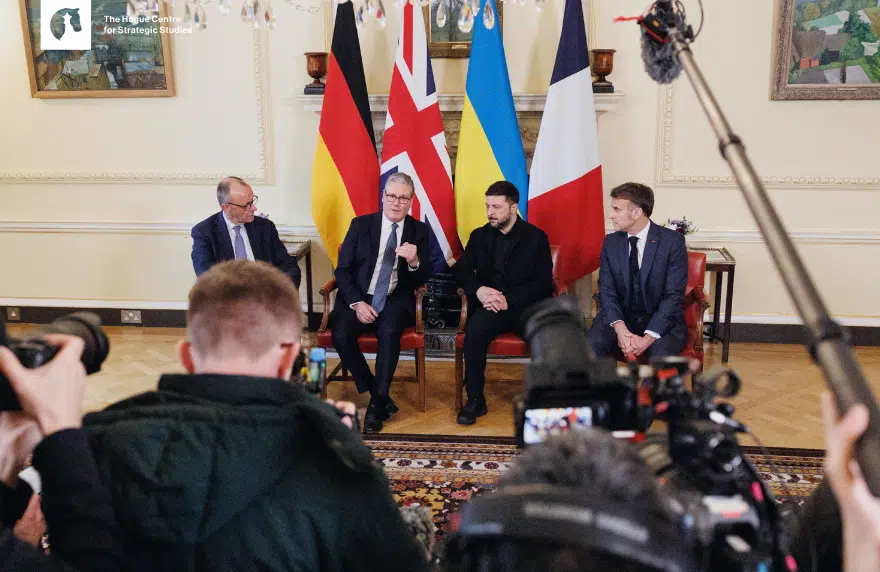
Cover image: UK Prime Minister
Authors: Markus Iven and Tim Sweijs
Contributions by Jan Feldhusen, Pieter-Jan Vandoren and Lennart Cramer; Figures made by Nicole Eichstaedt
The research for and production of this report has been conducted within the PROGRESS research framework agreement. Responsibility for the contents and for the opinions expressed, rests solely with the authors and does not constitute, not should be construed as, an endorsement by the Netherlands Ministries of Foreign Affairs and Defence.



Related Content