HCSS
  • News
    • BNR | De Strateeg
    • Columns
    • De Tafel van Mars
    • Events
    • HCSS Newsletter
    • Podcasts
  • Publications
    • Publications
      • All Projects
      • All Publications
    • Geopolitics & Governance
      • Transatlantic Relations
      • Russia & Eurasia
      • Europe in the Indo-Pacific
      • GC REAIM
      • PROGRESS / Strategic Monitor
    • Economics & Technology
      • Emerging Technologies
      • Critical Materials
      • Energy Security
    • Defence & Security
      • On Future War
      • Deterrence and Arms Control
      • Hybrid Threats
      • Cyber Security
    • Society & Resilience
      • Nationale Veiligheid en Weerbaarheid
      • Transnational Organised Crime
      • Strategic Monitor Dutch Police
    • Climate, Water & Food
      • Climate Security
      • Water, Peace & Security (WPS)
      • Food Security
  • Dashboards
    • Dashboards
      • All Tools
        • GINA
        • SARA
    • Geopolitics & Governance
      • DFRI
      • GINA | Diplomatic
      • GINA | Information
      • CLARIS
    • Economics & Technology
      • DOMINO
      • GATRI
      • GINA | Economic
      • Cyber Arms Watch
      • Cyber Comparator
      • Cyber Norms Observatory
      • Cyber Transparency
    • Defence & Security
      • GINA | Military
      • Nuclear Timeline
    • Society & Resilience
      • DAMON
    • Climate, Water & Food
      • Agrifood Monitor
      • CARMEN
      • CRM Dashboard
  • Services
    • GC REAIM
      • GC REAIM | Former Members
      • GC REAIM | Publications
      • GC REAIM | Conferences
      • GC REAIM | Partners, Sponsors, Supporters
    • HCSS Boardroom
    • HCSS Datalab
    • Socio-Political Instability Survey
    • Strategic Capability Gaming
    • Strategic Negotiations Course
    • Studio HCSS
    • Southern Africa-Netherlands Cyber Security School 2026
    • Indo-Dutch Cyber Security School 2025
  • About HCSS
    • Contact Us
    • Our People
    • Funding & Transparency
    • Partners & Clients
    • Internship Programme
    • Press & Media Inquiries
    • Working at HCSS
    • Global Futures Foundation
  • Click to open the search input field Click to open the search input field Search
  • Menu Menu

News

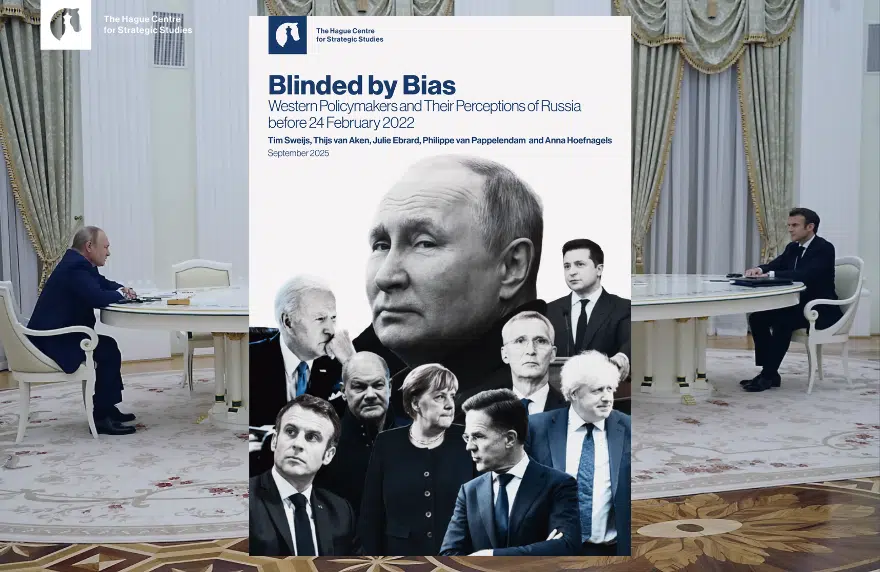
Western Blind Spot: New HCSS Report explores why the West failed to anticipate Russia’s Invasion of Ukraine

September 9, 2025

A new report from Dutch thinktank The Hague Centre for Strategic Studies (HCSS) reveals how psychological and cognitive biases — not just intelligence gaps — blinded Western governments to Russia’s intentions ahead of the full-scale invasion of Ukraine in February 2022.

Titled Blinded by Bias, the report is based on 44 interviews with high-level officials at NATO Headquarters, and in France, Germany, the Netherlands, the United Kingdom, and the United States, including advisers to presidents, prime ministers and secretary-generals. It reveals how Western policymakers misread — or outright dismissed — repeated Russian warnings and signals of an impending invasion. The result: delayed responses, strategic inertia, and insufficient support to Ukraine when it mattered most.

“Russia didn’t hide its intentions,” said lead author and HCSS research director Tim Sweijs. “The West just couldn’t — or wouldn’t — believe them.”

Report Link – Blinded By Bias

The report identifies seven key biases that distorted threat perception in the run-up to the war, including:

  1. Availability Heuristic – policymakers couldn’t imagine large-scale war in Europe because they hadn’t experienced it in recent history.
  2. Cognitive Dissonance – acknowledging the threat would have required rejecting core beliefs in diplomacy and economic interdependence.
  3. Mirror Imaging – assuming Russia would act rationally by Western standards.
  4. Poliheuristic Bias – political leaders avoided high-cost options (like military support) due to domestic concerns.
  5. Representativeness Heuristic – expectations were based on past limited Russian incursions, not full-scale war.
  6. Groupthink – internal pressure suppressed dissenting views and alternative scenarios.
  7. Self-Deterrence – fear of provoking Russia inhibited stronger action.

Despite months of intelligence warnings, only a few NATO states — such as the UK, US and Eastern European allies — took the threat seriously early on. Most Western European capitals, including Berlin, Paris and The Hague, underestimated Putin’s intentions, overestimated the effectiveness of diplomacy, and failed to prepare for the worst-case scenario.

The study introduces a novel typology of NATO responses before the invasion, categorising member states as Doves, Deers, Buzzards, or Wolves based on their perception of the Russian threat and their level of support to Ukraine.

“Understanding why policymakers didn’t act is more important than simply stating that they didn’t,” says Sweijs. “This wasn’t just a failure of intelligence — it was a failure of imagination.”

With geopolitical crises multiplying across the globe, Blinded by Bias calls for urgent institutional reforms, including bias-awareness training, red-teaming, and operational frameworks that force leaders to think like adversaries — not mirror them.

Read the full report by Tim Sweijs, Thijs van Aken, Julie Ebrard, Philippe van Pappelendam and Anna Hoefnagels now!


Report Link – Blinded By Bias
  • Share on Facebook
  • Share on X
  • Share on WhatsApp
  • Share on LinkedIn
  • Share by Mail

Experts

Tim Sweijs
Thijs van Aken

Related News

Related Content

Deterrence Warning Messages: A Short Guide for NATO
Securing the Digital Backbone: NATO’s Quest for Interoperability in the Age of Emerging Disruptive Technologies
A Militarily Regenerated Russia as a Future Threat to NATO? Perspectives from Russia Itself

Office Address

  • The Hague Centre for Strategic Studies
  • Lange Voorhout 1
  • 2514 EA The Hague
  • The Netherlands

Contact Us

  • Telephone: +31(70) 318 48 40
  • E-mail: info@hcss.nl
  • IBAN NL10INGB0666328730
  • BIC INGBNL2A
  • VAT NL.8101.32.436.B01
  • Contact

Legal & Privacy

  • Disclaimer & Privacy
  • Algemene Voorwaarden 2024 (NL) 
  • Terms & Conditions 2024 (ENG) 
  • Algemene Voorwaarden 2026 (NL) 
  • Terns & Conditions 2026 (EN) 
  • Coordinated Vulnerability Disclosure
  • Ethical Standards
  • Manual for Responsible Use of AI

Follow us

© The Hague Centre for Strategic Studies
    Link to: Verblind door Bias: Waarom het Westen de Russische invasie van Oekraïne niet zag aankomen Link to: Verblind door Bias: Waarom het Westen de Russische invasie van Oekraïne niet zag aankomen Verblind door Bias: Waarom het Westen de Russische invasie van Oekraïne niet... Link to: Nieuw rapport: Kritieke grondstoffen in Noord-Holland en Flevoland Link to: Nieuw rapport: Kritieke grondstoffen in Noord-Holland en Flevoland Nieuw rapport: Kritieke grondstoffen in Noord-Holland en Flevoland
    Scroll to top Scroll to top Scroll to top

    GDPR Consent

    Your privacy is important to us. Here you can set which consent you are allowing us with regards to the collection of general information, the placing of cookies of the collection of personal information. You can click 'Forget my settings' at the bottom of this form to revoke all given consents.

    Privacy policy | Close
    Settings

    GDPR Consent Settings

    Your privacy is important to us. Here you can set which consent you are allowing us with regards to the collection of general information, the placing of cookies of the collection of personal information. You can click 'Forget my settings' at the bottom of this form to revoke all given consents.

    Website statistics collect anonymized information about how the site is used. This information is used to optimize the website and to ensure an optimal user experience.

    View details

    Functional cookies are used to ensure the website works properly and are neccessary to make the site function. These cookies do not collect any personal data.  

    View details
    Forget my settings Deleted!