
HCSS
  • News
    • BNR | De Strateeg
    • Columns
    • Events
    • HCSS Newsletter
    • Podcasts
  • Publications
    • Publications
      • All Projects
      • All Publications
    • Geopolitics & Governance
      • Transatlantic Relations
      • Russia & Eurasia
      • Europe in the Indo-Pacific
      • GC REAIM
      • PROGRESS / Strategic Monitor
    • Economics & Technology
      • Emerging Technologies
      • Critical Materials
      • Energy Security
    • Defence & Security
      • On Future War
      • Deterrence and Arms Control
      • Hybrid Threats
      • Cyber Security
    • Society & Resilience
      • Nationale Veiligheid en Weerbaarheid
      • Transnational Organised Crime
      • Strategic Monitor Dutch Police
    • Climate, Water & Food
      • Climate Security
      • Water, Peace & Security (WPS)
      • Food Security
  • Dashboards
    • Dashboards
      • All Tools
        • GINA
        • SARA
    • Geopolitics & Governance
      • DFRI
      • GINA | Diplomatic
      • GINA | Information
      • CLARIS
    • Economics & Technology
      • DOMINO
      • GATRI
      • GINA | Economic
      • Cyber Arms Watch
      • Cyber Comparator
      • Cyber Norms Observatory
      • Cyber Transparency
    • Defence & Security
      • GINA | Military
      • Nuclear Timeline
    • Society & Resilience
      • DAMON
    • Climate, Water & Food
      • Agrifood Monitor
      • CARMEN
      • CRM Dashboard
  • Services
    • HCSS Boardroom
    • HCSS Datalab
    • Socio-Political Instability Survey
    • Strategic Capability Gaming
    • Strategic Negotiations Course
    • Studio HCSS
    • Southern Africa-Netherlands Cyber Security School 2026
    • Indo-Dutch Cyber Security School 2025
  • GC REAIM
    • GC REAIM | Former Members
    • GC REAIM | Publications
    • GC REAIM | Conferences
    • GC REAIM | Partners, Sponsors, Supporters
  • About HCSS
    • Contact Us
    • Our People
    • Funding & Transparency
    • Partners & Clients
    • Internship Programme
    • Press & Media Inquiries
    • Working at HCSS
    • Global Futures Foundation
  • Click to open the search input field Click to open the search input field Search
  • Menu Menu

News

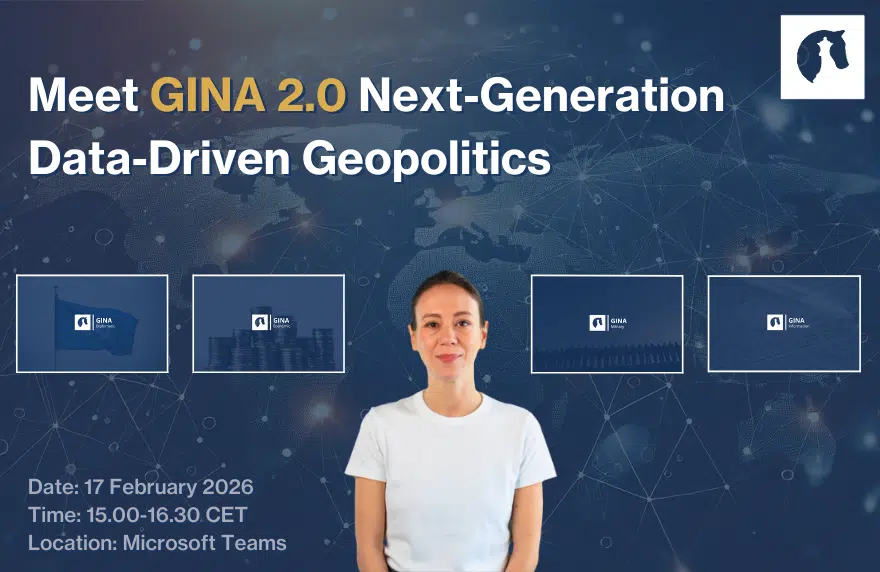
Webinar to Meet GINA 2.0 | Next-Generation Data-Driven Geopolitics

January 23, 2026

Join the HCSS Datalab for an online webinar introducing GINA 2.0, the next generation of the Geopolitical Interactive Network Analysis suite

  • Date: February 17, 2026
  • Time: 15.00 – 16.30 CET
  • Location: Microsoft Teams (link will be provided a few days before the event)
Registration link (Eventbrite)

As geopolitical competition intensifies and interdependencies become more complex, policy-makers and analysts require tools that go beyond static indicators and siloed datasets. GINA 2.0 represents a major step forward in data-driven geopolitical analysis, offering a unified and methodologically consistent framework to analyse diplomatic, economic, military, and informational interactions across states.

Building on the GINA series first introduced in late 2024, GINA 2.0 features:

  • Strengthened analytical methods based on network science
  • Expanded data coverage updated through 2024
  • Improved accessibility and usability across dashboards
  • Harmonised analytical frameworks to support comparative and longitudinal analysis

During this webinar, the HCSS Datalab team will present the vision behind GINA 2.0 and demonstrate how its dashboards can be used to support policy-relevant geopolitical analysis.

Programme

Why GINA 2.0? 
Learn why next-generation analytical tools are essential for understanding global power dynamics, interdependence, and strategic behaviour in an era of geopolitical uncertainty.

What Is GINA 2.0? 
Gain an in-depth overview of how GINA integrates diplomatic, economic, military, and informational data into a coherent analytical framework that enables systematic comparison across countries and over time.

How GINA 2.0 Was Built 
Discover the data sources, methodological choices, and network-based analytical techniques that underpin the GINA 2.0 dashboards.

The GINA 2.0 Dashboard Suite

  • GINA Diplomatic 2.0: Analyses global diplomatic engagement through UN voting behaviour, official speeches, and state leader visits, capturing patterns of cooperation, alignment, and divergence.
  • GINA Economic 2.0: Examines global economic interdependence by analysing international trade flows and foreign direct investment positions, enabling the assessment of supply chains, strategic dependencies, and economic statecraft.
  • GINA Military 2.0: Explores military interactions using event-based conflict data and arms trade relationships between states.
  • GINA Information 2.0: Focuses on information flows by analysing news data to map soft interactions of conflict and cooperation.
Registration link (Eventbrite)

Why Attend?

This webinar is relevant for:

  • Policy-makers and government analysts
  • Researchers and academics
  • Professionals working on geopolitics, security, or international economics

Participants will gain insight into how GINA 2.0 can:

  • Support evidence-based decision-making
  • Inform policy development
  • Enable structured comparison and longitudinal analysis
  • Improve understanding of international stability, competition, and interdependence

The session will include a live demonstration of selected GINA 2.0 dashboards, followed by an interactive Q&A.

Register for this event on this Eventbrite page.

For more information or to collaborate with us on GINA, please contact datalab@hcss.nl

  • Share on Facebook
  • Share on X
  • Share on WhatsApp
  • Share on LinkedIn
  • Share by Mail

Experts

Jesse Kommandeur
Emma Bokel
Rens van Dam

Related News

Related Content

HCSS Datalab introduces GINA – Geopolitics Powered by Data
Geopolitical Interactive Network Analysis (GINA)
Meet GINA! HCSS Datalab presents: the Geopolitical Interactive Network Analysis

Office Address

  • The Hague Centre for Strategic Studies
  • Lange Voorhout 1
  • 2514 EA The Hague
  • The Netherlands

Contact Us

  • Telephone: +31(70) 318 48 40
  • E-mail: info@hcss.nl
  • IBAN NL10INGB0666328730
  • BIC INGBNL2A
  • VAT NL.8101.32.436.B01
  • Contact

Legal & Privacy

  • Disclaimer & Privacy
  • Algemene Voorwaarden (NL) 
  • Terms & Conditions (ENG) 
  • Coordinated Vulnerability Disclosure
  • Ethical Standards
  • Manual for Responsible Use of AI

Follow us

© The Hague Centre for Strategic Studies
    Link to: Julien Bastrup-Birk | Hoe Europese blinde vlekken de schaduworde versterken Link to: Julien Bastrup-Birk | Hoe Europese blinde vlekken de schaduworde versterken Julien Bastrup-Birk | Hoe Europese blinde vlekken de schaduworde versterken Link to: Julien Bastrup-Birk | How European blind spots strengthen the shadow order Link to: Julien Bastrup-Birk | How European blind spots strengthen the shadow order Julien Bastrup-Birk | How European blind spots strengthen the shadow order
    Scroll to top Scroll to top Scroll to top

    GDPR Consent

    Your privacy is important to us. Here you can set which consent you are allowing us with regards to the collection of general information, the placing of cookies of the collection of personal information. You can click 'Forget my settings' at the bottom of this form to revoke all given consents.

    Privacy policy | Close
    Settings

    GDPR Consent Settings

    Your privacy is important to us. Here you can set which consent you are allowing us with regards to the collection of general information, the placing of cookies of the collection of personal information. You can click 'Forget my settings' at the bottom of this form to revoke all given consents.

    Website statistics collect anonymized information about how the site is used. This information is used to optimize the website and to ensure an optimal user experience.

    View details

    Functional cookies are used to ensure the website works properly and are neccessary to make the site function. These cookies do not collect any personal data.  

    View details
    Forget my settings Deleted!