No Bang for Buck: Exploring the Heterogeneous Relationships Between Official Development Assistance and Intrastate Conflict Casualties
What determines whether Official Development Assistance (ODA) can reduce casualties in intrastate conflicts? In the newly published master’s thesis, HCSS Data Scientist Emma Bokel examines 156 countries between 1989 and 2022 using Dynamic Panel GMM and a Causal Forest model to assess both average effects and underlying heterogeneity. The study finds that ODA does not reliably reduce conflict deaths on average, with a persistent “conflict trap” driven by prior-year fatalities. Instead, effectiveness depends on four key conditions: political stability, aid fragmentation, delivery channel, and purpose-specific aid dynamics, leading to policy recommendations emphasising context-sensitive allocation, multilateral delivery in fragile settings, and prevention over de-escalation.
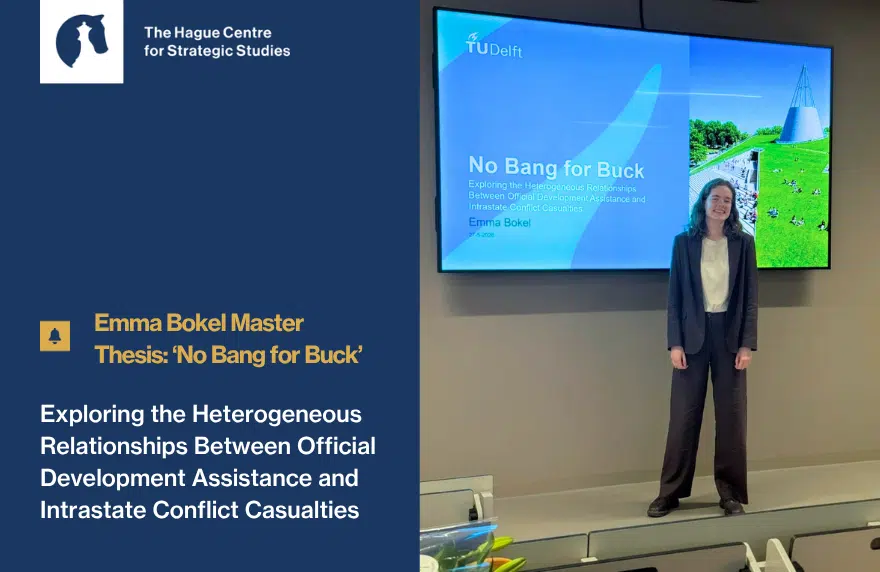
New publication | No Bang for Buck: Exploring the Heterogeneous Relationships Between Official Development Assistance and Intrastate Conflict Casualties
What determines whether Official Development Assistance (ODA) can reduce casualties in intrastate conflicts? In the newly published master’s thesis, HCSS Data Scientist Emma Bokel examines 156 countries between 1989 and 2022 using Dynamic Panel GMM and a Causal Forest model to assess both average effects and underlying heterogeneity. The study finds that ODA does not reliably reduce conflict deaths on average, with a persistent “conflict trap” driven by prior-year fatalities. Instead, effectiveness depends on four key conditions: political stability, aid fragmentation, delivery channel, and purpose-specific aid dynamics, leading to policy recommendations emphasising context-sensitive allocation, multilateral delivery in fragile settings, and prevention over de-escalation.
On Future War
"How Power, Technology, and Ideas Transform War and Warfare": the HCSS research programme On Future War explores how the nature of war endures, even as its character transforms. From Ukraine’s trenches to the cyber corridors of Brussels and Taipei, today’s conflicts merge kinetic, connected, and synthetic dimensions. By bridging the perspectives of traditionalists and futurists, our work seeks to understand both high-tech and low-tech conflict, offering insights that help policymakers navigate an increasingly complex and contested security environment.