

Following the relaunch of GINA Diplomatic last week, HCSS continues the roll out of its next-generation Geopolitical Interactive Network Analysis (GINA) tools with the launch of GINA Economic 2.0. Building on the GINA series introduced in late 2024, GINA 2.0 features improved analytical methods, enhanced accessibility, expanded data coverage, and a more consistent analytical framework across domains, strengthening its value for policy-relevant geopolitical analysis.
GINA Economic focuses on economic interdependence across the globe by systematically analysing and comparing international goods trade flows and foreign direct investment (FDI) positions. Designed for policy-makers, researchers, and analysts, the tool supports the examination of complex patterns of economic integration, supply chain exposure, and strategic dependencies. Drawing on authoritative data from the International Monetary Fund (IMF) and the United Nations, GINA Economic applies network science frameworks to construct quantitative representations of cross-border ownership and material exchange at both global and state-level scales.
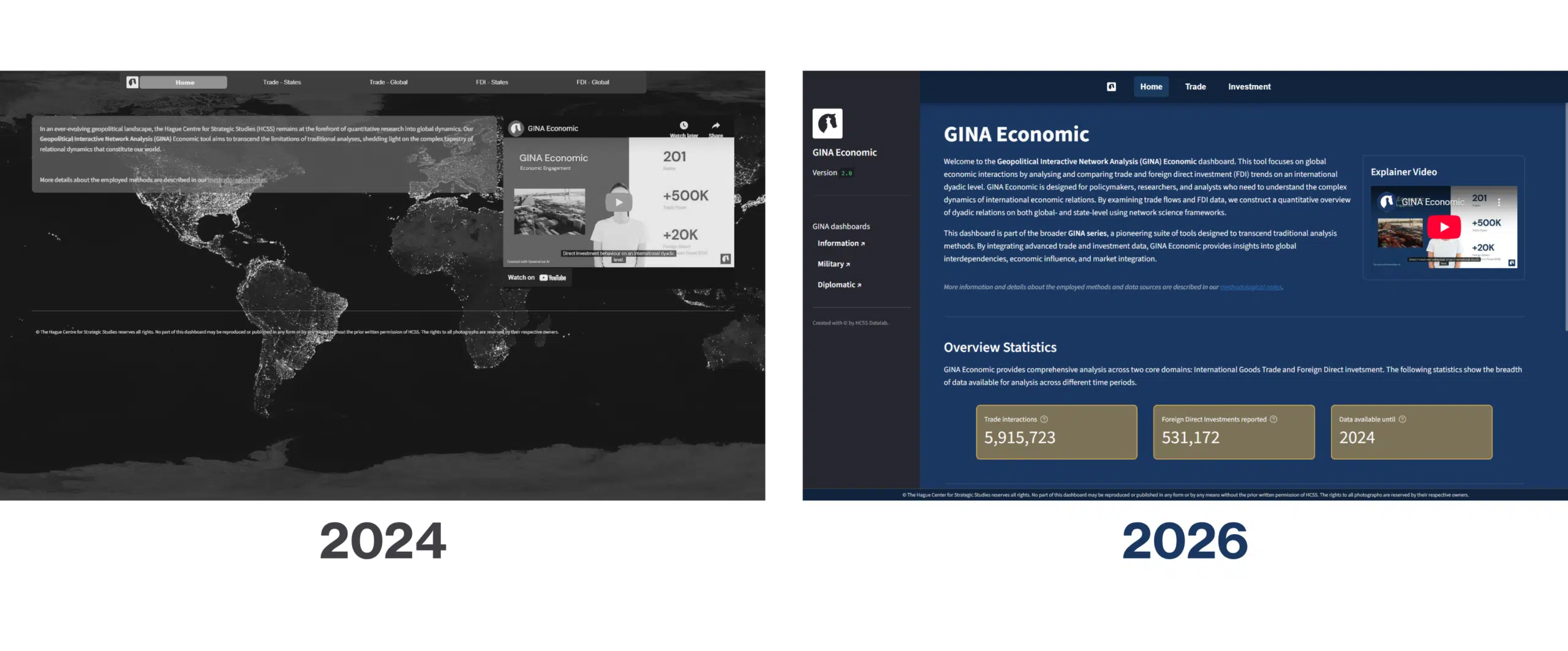
The dashboard integrates comprehensive bilateral investment data from the IMF’s Direct Investment Positions dataset alongside detailed trade statistics from the UN. In total, the platform harmonises more than 5 million trade interactions and +500,00 reported FDI positions within a single analytical environment. These data are represented through two interconnected network layers: an investment network capturing long-term capital ties, and a trade network visualising the flow of goods across 21 commodity groups based on the Harmonized System (HS) classification developed by the World Customs Organization. This dual-layer approach enables users to assess where financial ownership structures align with, or diverge from, physical trade relationships.
The platform has been fully updated through 2024 and offers deep longitudinal coverage of the global economy. Users can explore international trade data extending back to the early twentieth century, alongside investment position data available from 2009 onwards. This temporal depth supports the analysis of long-term structural change, the emergence of new economic hubs, and the effects of geopolitical shocks on global economic connectivity.
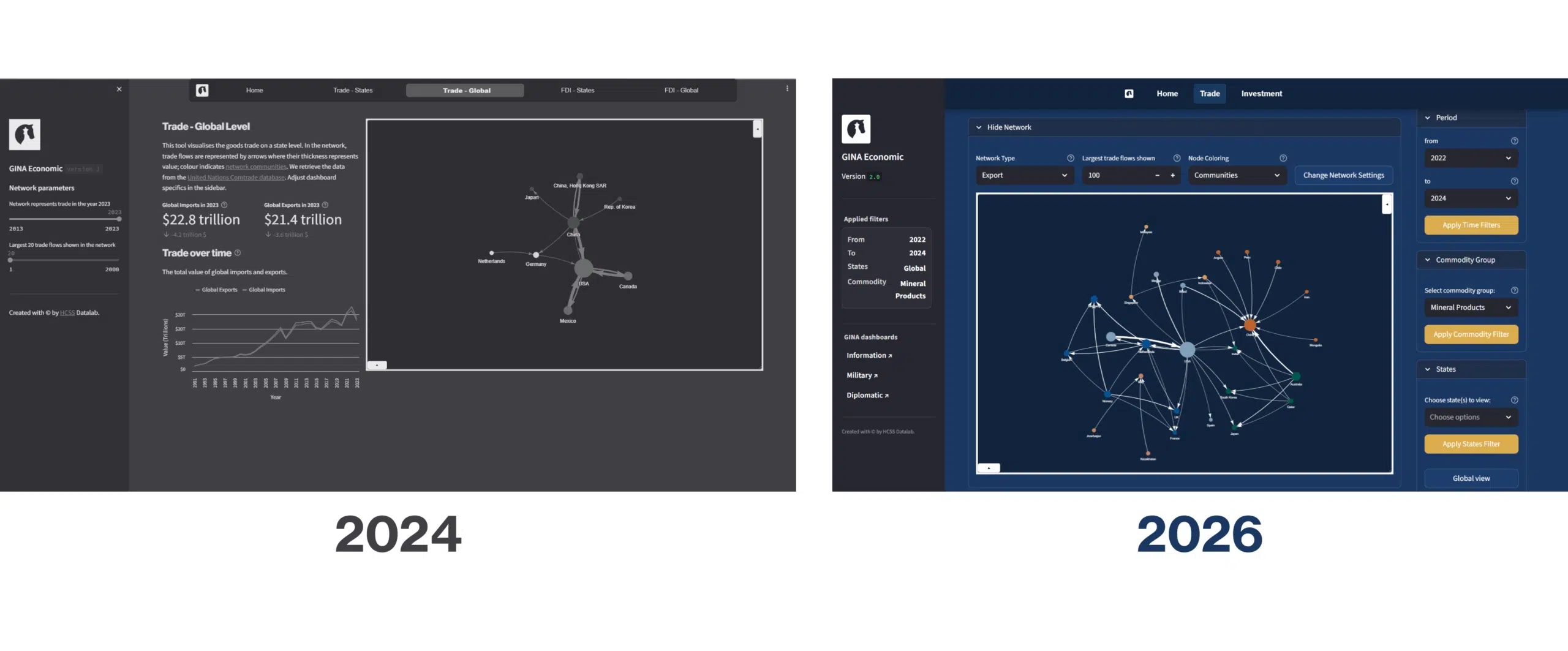
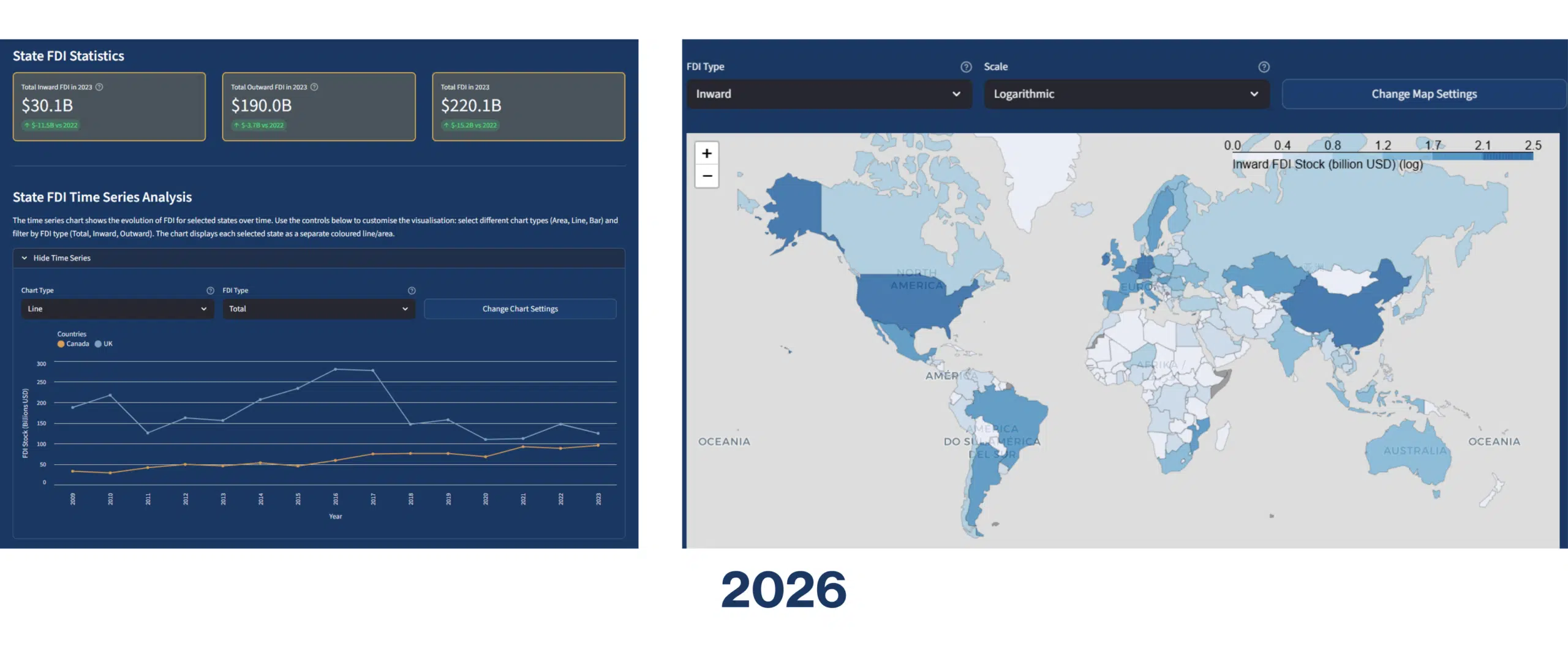
Across all analytical views, an interactive global map provides an overview of country-level economic activity and serves as an entry point to detailed country profiles. Each view includes summary statistics for the selected time period and commodity focus, alongside customisable time series that enable the systematic analysis of change over time. Together, these features support structured comparison, longitudinal analysis, and evidence-based assessment of economic statecraft in a rapidly evolving geopolitical landscape.
Additional GINA 2.0 dashboards, including updated versions of the Military, and Information domains, will be rolled out later in 2026.
Watch the explainer video below, or go directly to the GINA Economic landing page. If your organization is interested in our GINA tools or contributing to their evolution, please contact us at datalab@hcss.nl.



Related Content


