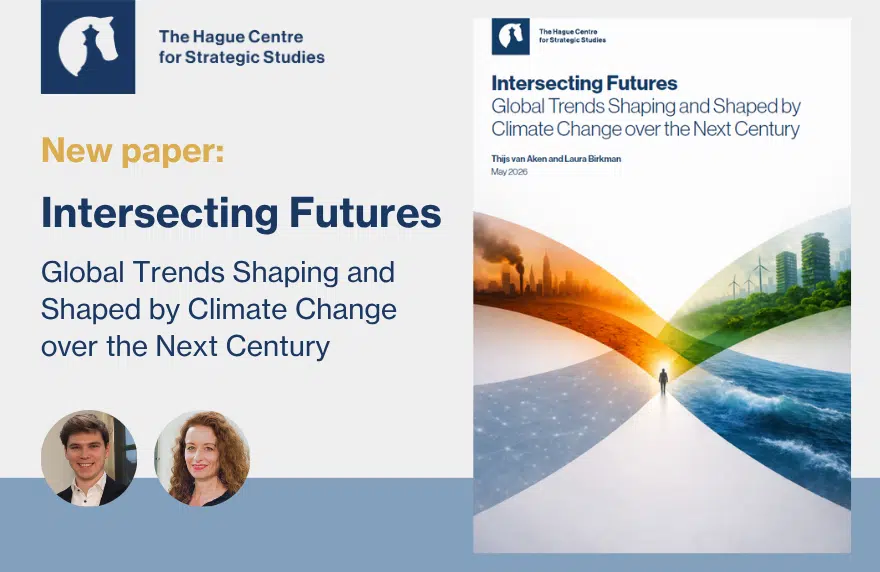
Climate change is no longer a distant environmental challenge – it is rapidly reshaping global stability, economic resilience, and geopolitical competition. In Intersecting Futures, Thijs van Aken and Laura Birkman show how climate impacts will interact with major global trends throughout the 21st century, acting as a powerful threat multiplier across systems.
The paper finds that first-order effects – such as extreme weather, rising temperatures, and resource scarcity – are intensifying, while second-order effects are accelerating instability. Climate-related disasters, health risks, and declining agricultural productivity are already placing pressure on societies. At the same time, competition over scarce resources, including water and critical raw materials, is expected to reshape geopolitical dynamics.
A key finding is that climate change will unfold in waves of disruption rather than a linear trajectory. These cascading shocks will intersect with demographic growth, technological change, and shifting power dynamics. By mid-century, drought exposure could quadruple and climate-induced migration could more than double, amplifying pressures on governance systems and international relations.
Lead author Thijs van Aken notes:
“Climate change will define not just environmental outcomes, but shape the balance of power in the 21st century. The ability to adapt quickly and strategically will become a decisive factor in global competition.”
The authors emphasise that adaptation capacity will determine winners and losers. Countries with access to technology, financing, and resilient governance structures will be better positioned, while structural inequalities risk deepening instability in vulnerable regions.
Key insights include:
- Prioritise climate adaptation as a core element of national and international security strategies
- Invest in climate-resilient infrastructure, data, and early warning systems
- Strengthen international cooperation, including development regional and minilateral partnerships
- Close the global adaptation financing gap, particularly for vulnerable states
- Accelerate innovation in climate technologies and ensure equitable access
Co-author Laura Birkman adds:
“Without decisive and coordinated action, climate risks will outpace our ability to manage them. Treating adaptation as a long-term issue risks locking in irreversible vulnerability.”
Authors: Thijs van Aken and Laura Birkman
Contributors: Anna Hoefnagels, Lennart Engel and Ali Aydogdu
This essay has been adapted from research conducted in 2025 for the Dutch Ministry of Infrastructure and Water Management.
Cover image: AI-generated with OpenAI’s ChatGPT.


Related Content