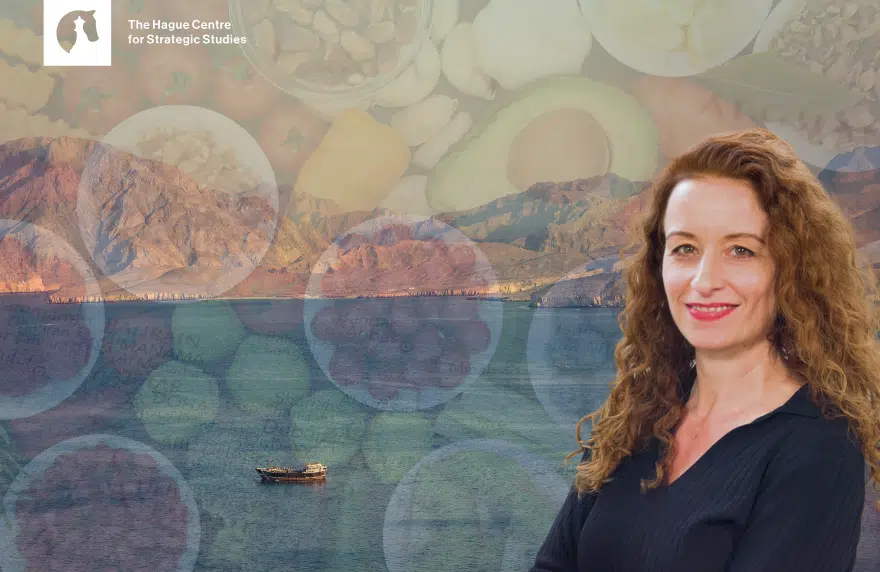
As tensions in the Middle East continue to disrupt the Strait of Hormuz, concerns are growing over the wider implications for global food security. During a recent Netherlands Food Partnership session, experts warned that the crisis could trigger cascading effects across energy, fertiliser, and food systems. Laura Birkman of HCSS highlighted how the Strait functions as a “cascading chokepoint,” where disruptions disproportionately affect countries already facing water scarcity, import dependence, and food insecurity. Her contribution underscored the need to view food security not in isolation, but as deeply connected to energy, trade, climate, and geopolitical resilience.
On April 15, the Netherlands Food Partnership (NFP) convened a session to explore the implications of the evolving conflict in the Middle East on global food security. Bringing together experts from policy, research, and practice, the session highlighted how interconnected and exposed global food systems have become. The disruption in the Strait of Hormuz is evolving from a shipping problem into a broader food system crisis, with far-reaching implications due to its critical role in global flows of energy, fertilisers, and trade.
In her contribution, Laura Birkman of The Hague Centre for Strategic Studies (HCSS), argued that Hormuz should be understood not only as a maritime chokepoint, but as a “cascading chokepoint”: disruption there can spread from energy to fertiliser to food systems, with the heaviest impacts falling on countries that are already water-scarce, import-dependent, and food-insecure.
Rather than a single shock, the current crisis triggers a chain reaction: from energy to fertilisers to food systems. She highlighted that the impacts are highly uneven: countries that are heavily import-dependent and water-scarce, particularly in parts of the Middle East, North Africa, and Sub-Saharan Africa, face the greatest risks, as they are exposed both to rising input costs and increasing food import bills.
Throughout the discussion, a clear message emerged: at first glance, the impact might seem distant, concentrated or indirect, the medium- to long-term consequences for food systems could be significant and require urgent attention.
Birkman, Director of the Climate, Water and Food Security programme at HCSS, stressed how clearly this crisis exposes a broader pattern. The shock does not occur in a vacuum but compounds existing vulnerabilities: “Food security cannot be separated from energy security, trade resilience, climate stress, and geopolitical risk. If anything, this is another signal that food resilience and diversification need to move much higher up the policy agenda.”
The severity of the crisis depends less on the size of the shock itself and more on where it lands, calling for a more integrated approach that links food security with energy security, trade resilience, and geopolitical risk management, and highlighting the need to shift from efficiency-driven systems towards more resilient and diversified food systems, Birkman added.
The session featured contributions by Ivo Demmers (Executive Director of the NFP), Timmo Gasbeek (Policy Coordinating Officer at the Ministry of Foreign Affairs), Hillefien Strijland (Coordinator for the consequences of the war in Ukraine and Iran at the Ministry of Agriculture, Fisheries, Food Security and Nature), Maximo Torero (Chief economist at FAO), James Thurlow (Director of Foresight and policy modelling at IFPRI), Bart de Steenhuijsen Piters (Senior Researcher on Food Systems and Food and Nutrition Security at WUR), Fred Gyasi (Team Lead for Market Information and Intelligence at IFDC), and Koen Dekeyser, Policy Analyst at ECDPM.
Across all contributions, a common thread emerged: food security can no longer be addressed in isolation. It is deeply intertwined with energy systems, global trade, and geopolitical dynamics. As a result, responses must also be more integrated, coordinated, and forward-looking.
Participants reflected on the importance of:
- strengthening monitoring and early warning systems,
- ensuring access to fertilisers and finance for farmers,
- avoiding export restrictions that could amplify shocks, and
- investing in more resilient and diversified food systems.
The session closed with a shared recognition that the implications of the Strait of Hormuz disruption extend far beyond a regional geopolitical crisis. As discussions throughout the day made clear, global food systems are increasingly shaped by the interaction between energy markets, trade dependencies, financial dynamics, and climate pressures, making vulnerabilities more interconnected and shocks more difficult to contain.
While many of the most severe impacts may still lie ahead, particularly as fertiliser shortages begin to affect future production cycles, participants stressed the importance of acting early rather than reactively. This requires not only continued monitoring and scenario analysis, but also stronger coordination across sectors and regions, practical support for vulnerable countries and farmers, and sustained investment in more resilient and diversified food systems.
Above all, the discussion highlighted the value of continued exchange and collective learning, ensuring that emerging insights can be translated into concrete actions to strengthen resilience, reduce risks, and better prepare for future disruptions.
Read the full NFP event summary here.
Experts

Related Content