How do countries respond when the boundaries between peace and war become increasingly blurred? Across the world, states face growing pressure from hybrid threats, ranging from disinformation and cyber-attacks to maritime coercion, sabotage and military intimidation. These activities take place in the grey zone: the twilight area between peace and war, where adversaries seek strategic gains without triggering open conflict.
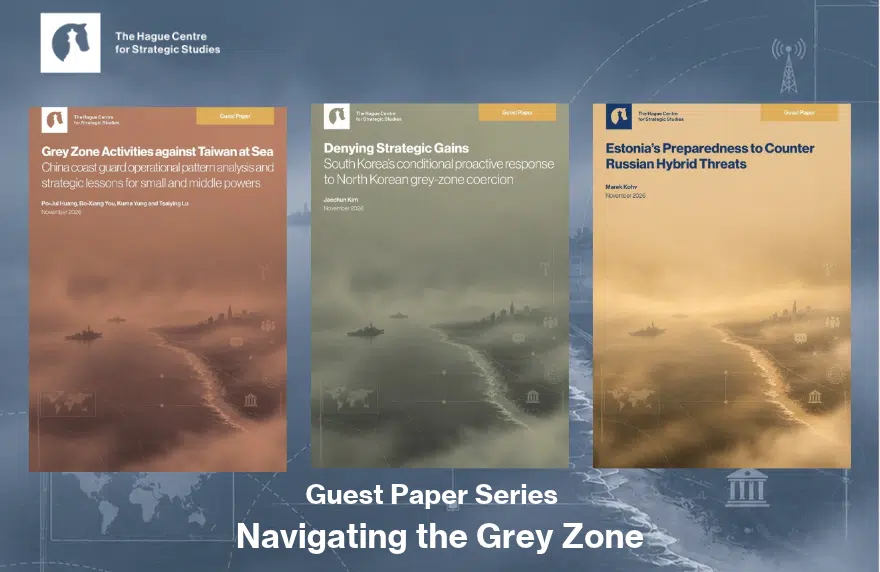
In this guest paper series, “Navigating the Grey Zone”, edited by HCSS analysts Hans Horan and Davis Ellison, several guest authors examine how South Korea, Taiwan and Estonia navigate these challenges. Each paper explores a distinct national experience and draws practical lessons for other small and middle powers seeking to strengthen their resilience, deter coercion and protect their sovereignty in an increasingly contested security environment.
Paper 1:
Estonia’s Preparedness to Counter Russian Hybrid Threats
For Estonia, the Russian threat is a constant feature of its security environment. From disinformation and cyber-attacks to sabotage and drone incursions, Russian hybrid operations seek to undermine public trust, social cohesion and the functioning of the state. How has Estonia developed the resilience to withstand this persistent pressure?
Guest author Marek Kohv (International Centre for Defence and Security (ICDS)) examines the country’s integrated approach to detecting, countering and recovering from hybrid threats. A central finding is that resilience cannot rest on government institutions or military capabilities alone. Instead, it depends on close cooperation between the state, civil society, the media and citizens.
Estonia’s experience highlights the importance of public awareness, education, security communication, cyber defence and continuity planning. The paper demonstrates that preparing for hybrid threats is a society-wide endeavour, offering valuable lessons for countries seeking to strengthen national resilience.
Paper 2:
Denying Strategic Gains: South Korea’s Conditional Proactive Response to North Korean Grey-Zone Coercion
How can a country respond to persistent aggression without provoking a full-scale war? South Korea faces precisely this dilemma in its dealings with North Korea, whose military provocations and coercive activities repeatedly test the boundaries between peace and conflict.
Professor Jaechun Kim (Sogang University) examines South Korea’s conditional and proactive approach to North Korean grey-zone coercion. Focusing in particular on the contested Northern Limit Line (NLL), the paper explores how Seoul has responded to decades of maritime incidents, infiltration operations and military confrontations.
South Korea’s experience offers important lessons for small and middle powers confronting coercion from more powerful neighbours. The central challenge is to deny adversaries strategic gains from sub-threshold aggression while avoiding uncontrolled escalation. Credible, proportionate and consistent responses are essential, particularly when nuclear capabilities complicate the balance between deterrence and restraint.
Paper 3:
Grey Zone Activities against Taiwan at Sea: China Coast Guard Operational Pattern Analysis and Strategic Lessons for Small and Middle Powers
China is increasingly using its coastguard and maritime law enforcement agencies to exert pressure around Taiwan. Through persistent patrols, joint exercises and civilian-vessel escort operations, Beijing is gradually seeking to reshape the maritime environment and normalise its presence without crossing the threshold into open conflict.
Guest authors Po-Jui Huang, Bo-Xiang You, Kuma Yung and Tsaiying Lu (Research Institute for Democracy, Society, and Emerging Technology (DSET) & Taiwan Association for Strategic Simulation) analyse three key patterns of Chinese maritime activity since 2024. They examine how these operations challenge Taiwan’s sovereignty and create new strategic dilemmas.
The authors argue that Taiwan’s experience holds important lessons for small and middle powers, including those in Europe. In particular, they highlight the importance of sustained surveillance, transparency, timely public evidence and coordinated legal action. As maritime cooperation between China and Russia develops, grey-zone pressure in the Indo-Pacific is increasingly relevant to European security.
About this Guest Paper series:
The research for and production of this report has been conducted within the PROGRESS research framework agreement. Responsibility for the contents and for the opinions expressed, rests solely with the authors and does not constitute, not should be construed as, an endorsement by the Netherlands Ministries of Foreign Affairs and Defence.
Quality assurance by Hans Horan and Davis Ellison.
Paper 1 | Estonia’s Preparedness to Counter Russian Hybrid Threats
Paper 2 | Denying Strategic Gains: South Korea’s Conditional Proactive Response to North Korean Grey-Zone Coercion
Paper 3 | Grey Zone Activities against Taiwan at Sea: China Coast Guard Operational Pattern Analysis and Strategic Lessons for Small and Middle Powers


Related Content