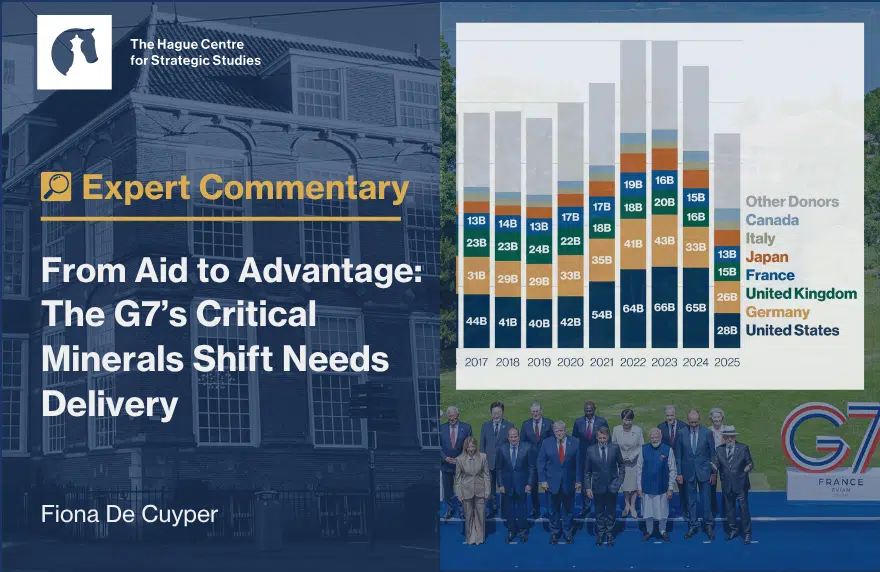
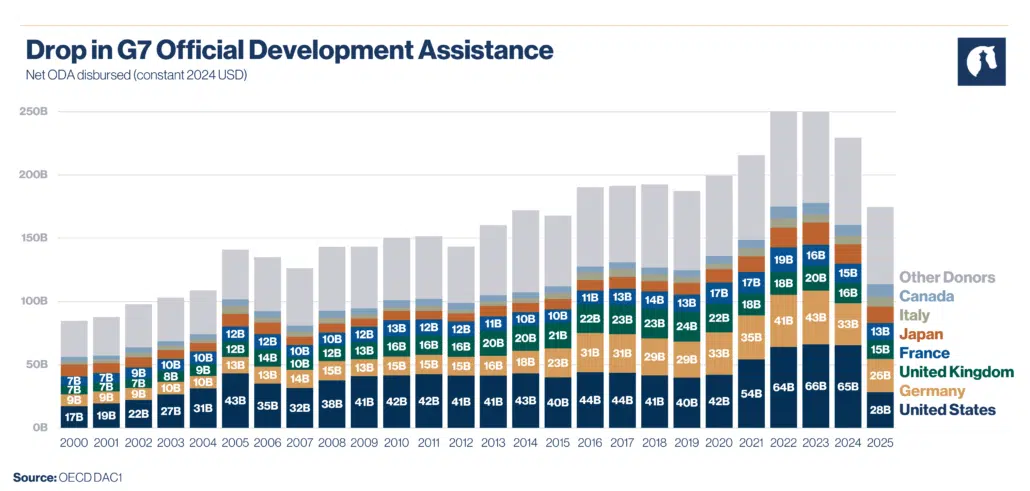
2025 saw the steepest fall in Official Development Assistance (ODA) on record.
Spending from OECD-DAC donors decreased by 23.1%, a decline of roughly USD 50 billion. The contribution of the G7 alone dropped by 29%, accounting for 86% of the total decrease in ODA.
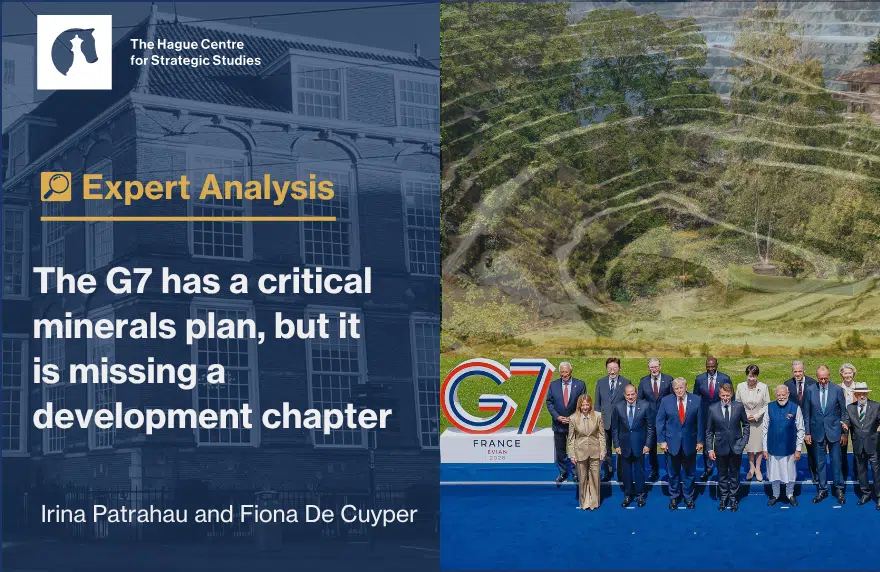
Ahead of the last week’s G7 Summit in France, HCSS strategic analysts Irina Patrahau and Fiona De Cuyper argued that development cooperation should not be treated as separate from critical raw materials security, but as central to it. If the EU wants to meet its own CRM objectives, it needs to get this link right.
That argument seems to have been heard in Évian.
The G7 2026 Summit outcomes suggest a move in the right direction: a broadened Critical Minerals Resilience and Production Alliance, explicit commitments to local value creation and processing capacity in partner countries, and a push to mobilise multilateral development banks and development finance institutions for enabling infrastructure. A parallel statement reaffirming ODA’s “strategic role” reinforces that message.
Taken together, these are signs that the G7 is moving beyond access and supply concerns alone, toward value addition, partnership, and shared economic benefit.
However, the Alliance is non-binding, meaning that a change in language is not yet a change in financing. Partner countries still need a real seat in shaping the standards, and the newly enabled financial infrastructure still lacks funding.
The “win-win” logic is thus making its way into the G7 agenda. The next step is implementation.
Experts

Related Content