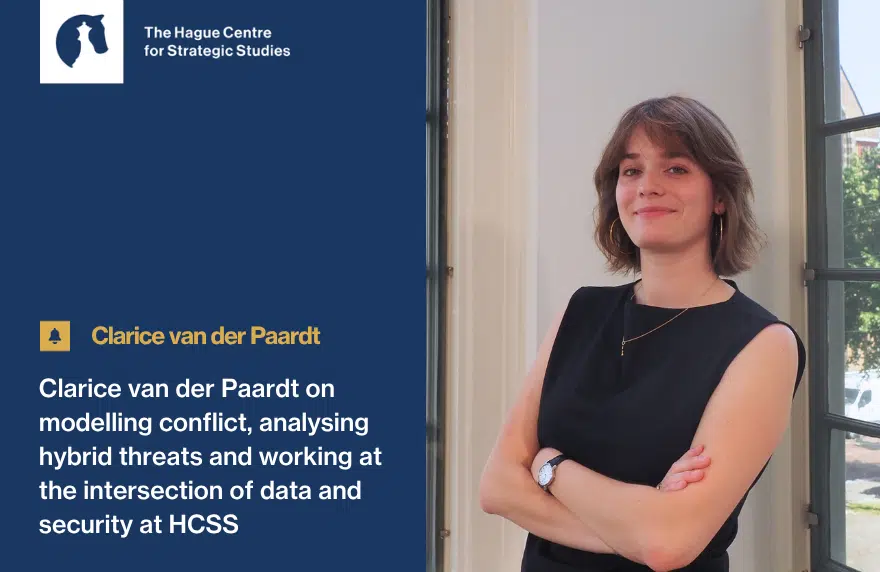
Hi Clarice, could you introduce yourself? Tell me where you are from, what your educational background is, if you had any prior work experience before your internship at HCSS?
Hi there! My name is Clarice van der Paardt and I was born and raised in Amsterdam. After high school, I studied Liberal Arts and Sciences at Amsterdam University College (AUC) where I majored in data and cognitive sciences. Near the end of my studies, I completed a minor in international relations. Without anticipating it whatsoever, this choice changed everything for me. With an education in the sciences, I found myself contemplating where my technological background met society, soon realising these questions were actually what mattered to me most. Wanting to address the intersection of digitalisation, information, and power further, I wrote my interdisciplinary Bachelor’s thesis ‘The Neurobiological Effects of Propaganda on Political Decision-Making – A Critique on Rational Choice Theory’ after which I graduated in the summer of 2025.
Last autumn, I enrolled into the pre-Master’s programme in International Relations at the University of Amsterdam to gain more research skills in political science before starting a Master’s degree. During my Bachelor’s, I had already completed two data internships at a start-up, but I had no professional experience in international relations. As my university programme was part-time, I was eager to find an internship that would allow me to further carve out my interests. When discovering the general internship programme at HCSS, I felt like this would be the ideal place for me to do exactly that.
So, what initially attracted you to the HCSS internship programme and why did you apply? How did you find out about HCSS?
I found out about this internship through an AUC alumnus who had been at HCSS a few years earlier. When browsing HCSS’ projects and fields of research, I saw that HCSS approaches the impact of technology through a wide variety of lenses: the shifting world order, big tech, technological sovereignty, cyber threats and FIMI to name a few. To me, the breadth of research topics really reflected the learning opportunities that this internship would offer me. HCSS also has a Datalab team, which assured me that this would be a great place for me to leverage my technological background. Beyond that, I also read a lot of intern testimonials when familiarising myself with the general internship programme. They helped a lot and made me excited to apply. Writing this therefore really feels like a full-circle moment!
Can you describe your time as a general intern? What does your day-to-day look like?
At HCSS, interns are onboarded on a lot of different projects. One way or another, analysts try to involve interns in as much of their project development as possible. Some days, I spend hours on end doing desktop research, deep diving the internet for specific articles and documenting my research as I go. I also frequently attend interviews, internal meetings, or appointments with clients throughout the day. When not researching or writing, I am usually occupied with design tasks for reports or events I am involved in. To sum it up: Barely any day looks the same.
Besides working in the office, I often go on a walk either during lunch or during a coffee break somewhere in the afternoon. Having lived in Amsterdam practically my whole life, it has been fun spending so much time in The Hague and getting to know the city, whether it is through a work-related event, getting a drink with colleagues after work, or well, a simple afternoon walk! The location of HCSS is, of course, really one of a kind.
What specific projects you have you been involved in during your internship? And how have these experiences helped you develop professionally?
Even though we are eight general interns, HCSS does a great job at tailoring each intern’s project allocation to their personal interests and ambitions. Throughout my internship, I primarily worked on hybrid threats, developing a better understanding of their elusive and pervasive character through extensive case study research. On top of that, I also had the chance to join analysts at numerous external events such as at Nieuwspoort, the Ministry of Foreign Affairs and the Ministry of Defence, experiencing first-hand how our work at HCSS helps inform public policy.
One of my favourite projects was together with the Datalab on European conflict simulation using agent-based modelling. My primary tasks focused on developing the methodology, where I worked to integrate political psychology frameworks to model agents that simulate leadership behaviour as authentically as possible. Bridging data science, psychology and international security issues, this project perfectly fit my interests. Given its complexity and scope, it was also inherently collaborative, allowing me to work closely with my fellow interns Alessandro Dell’Orto and Nicole Eichstaedt. As we continuously refined our approaches, exchanged ideas and helped each other out, working together was not only helpful but also just really fun.
What are your next steps after completing this internship?
Even though my first day in the office feels like only a week ago, I am nearing the end of my internship. Reflecting on my time here, I realise how formative HCSS has been for me as a learning environment. After the summer, I will be starting my Master’s degree in International Security at Sciences Po Paris, and I can say with confidence that this internship has given me a much stronger foundation (and no shortage of ambition!) to take with me to France.
This interview was conducted by HCSS Communications & Events Officer, Stephanie Govaerts
Experts

Related Content