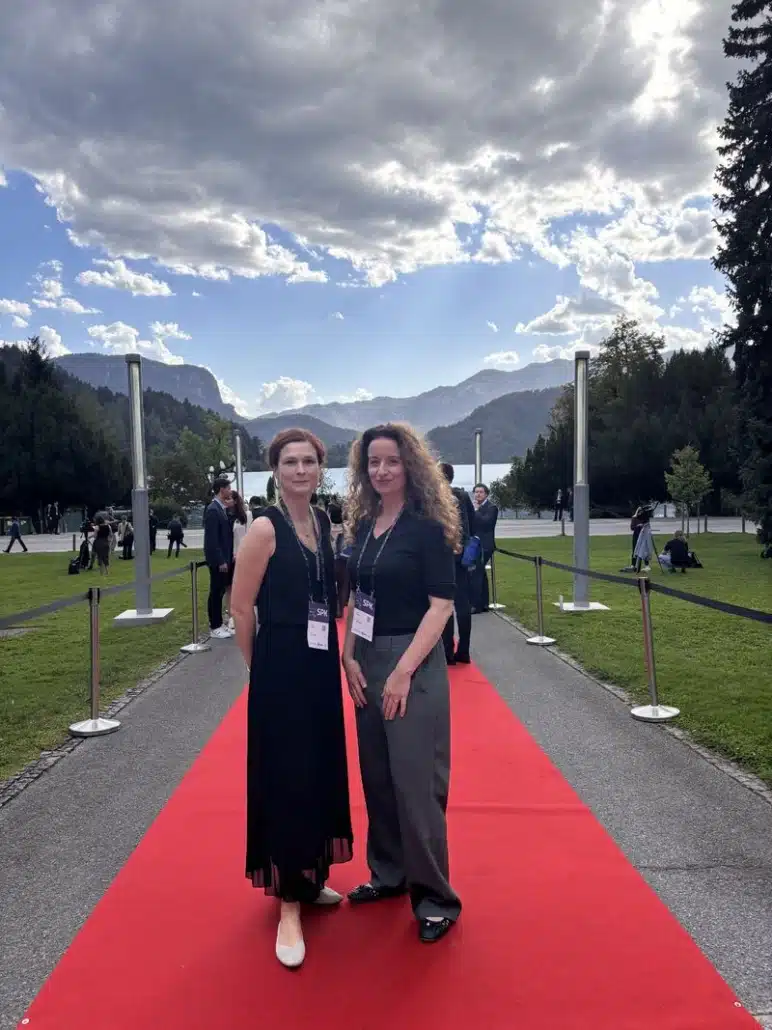
From 31 August – 1 September 2026, Laura Birkman, Director of the Climate, Water, and Food Security Programme at HCSS, participated in the 2026 Bled Strategic Forum in Slovenia, where she joined a timely panel discussion on water security and strategic stability.
Held under the theme “The Power to Shape the Future“, the Forum offered the opportunity to hear Central European perspectives directly from the region’s highest-level leaders. The Forum opened with an address by Slovenia’s Prime Minister, Janez Janša, followed by the Prime Ministers’ Session, “Shaping Europe from its Centre.” Hearing the leaders of Slovenia, Croatia, the Czech Republic and Hungary together offered valuable insight into how Central Europe views its role and responsibilities in Europe’s future, Birkman reflected.
Panel discussion | Water security and strategic stability
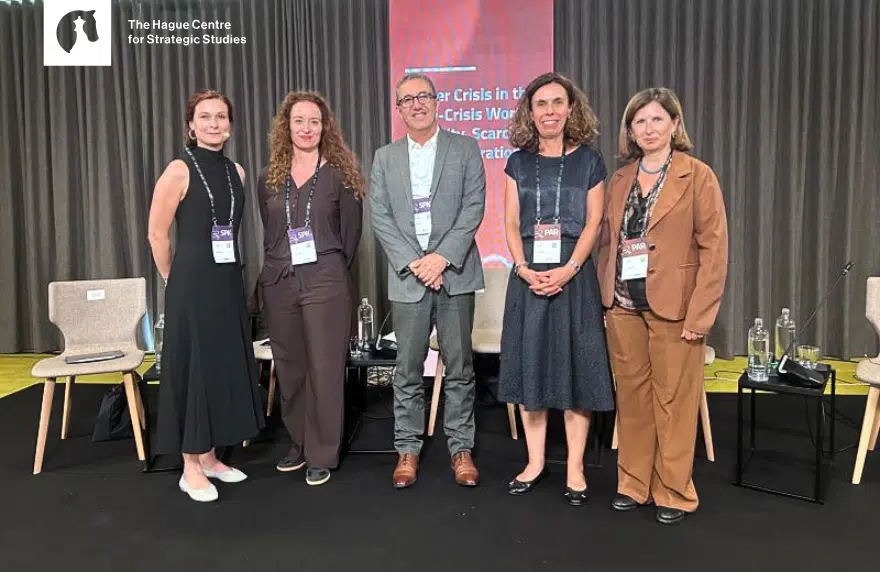
On Day 2 of the Forum, Birkman joined the expert panel on “Water Crisis in the Poly-Crisis World: Security, Scarcity, and Cooperation“, moderated by Professor Susanne Schmeier.
The panel also included contributions from
- Gidon Bromberg, Israeli Director, EcoPeace
- Tanja Miškova, Ambassador, Slovenian Ministry of Foreign and European Affairs
- Mara Tignino, Scientific Director, Geneva Water Hub
“We tend to notice water only when there is too little of it, too much of it, or when access to it becomes contested,” Birkman stated on the panel. “But shared water can also create vital space for cooperation: keeping practical dialogue alive even where wider political relations have stalled. Water is fundamental to economic resilience, the protection of critical infrastructure, peacebuilding, and geopolitical stability.”
The panel explored several interconnected priorities:
- Building domestic resilience while advancing practical transboundary cooperation;
- Recognising that effective governance, not technology alone, determines whether water systems can withstand growing pressure; and
- Supporting the growing role of defence and security actors in assessing and addressing water-related risks.
Birkman highlighted the need to integrate water risks more systematically into national resilience and security planning, an urgency underscored by the recent droughts across Europe and the catastrophic flooding in Nepal and Tibet. Water sits increasingly at the heart of regional and global stability. Addressing its risks, and its potential for cooperation, will require sustained collaboration across sectors, institutions, and borders.
“Managing water is not merely a technical or environmental issue, it is a strategic imperative,” Birkman stressed.
Rewatch the full panel discussion for a rich exchange on water security, scarcity, and cooperation in an increasingly complex poly-crisis world, here:
About the Bled Strategic Forum
Bled Strategic Forum is a platform for expressing and confronting opinions on modern society and its future. Its central annual event is the Bled Strategic Forum international conference, the leading conference in Central and South-Eastern Europe taking place in in picturesque Alpine setting of Lake Bled, Slovenia. The conference is a gathering of participants from various fields with diverse knowledge, encouraging them to exchange views and seek innovative solutions to present and future challenges. In addition, the Forum also offers a unique opportunity for tailored meetings and networking with regional and global stakeholders.
This year’s Presidential Conversation between Slovenia’s President Dr. Nataša Pirc Musar and Slovakia’s President Peter Pellegrini was a particular highlight, Laura Birkman reflected. “President Pirc Musar’s contribution offered, in my view, an essential message: Europe must confront global challenges with clarity while remaining firmly anchored in international law and the rules-based order. These are not abstract ideals, but the foundations of the European project and of Europe’s capacity to act collectively.”
“She also challenged a narrow framing of ‘pragmatism’ that portrays climate action as economically unrealistic or incompatible with European competitiveness. The costs and distributional effects of the transition deserve serious attention, but this should not obscure the larger strategic reality: a stronger European economy and greater geopolitical resilience require adaptation. As China’s industrial transformation advances at speed and scale, Europe needs a green transition that is ambitious, competitive, and fair.”
“Climate action is therefore not a departure from pragmatism. It is pragmatism,” Birkman concludes.
Website: https://bledstrategicforum.org/


Related Content