HCSS
  • News
    • BNR | De Strateeg
    • Columns
    • Events
    • HCSS Newsletter
    • Podcasts
  • Publications
    • Publications
      • All Projects
      • All Publications
    • Geopolitics & Governance
      • Transatlantic Relations
      • Russia & Eurasia
      • Europe in the Indo-Pacific
      • AI in the Military Domain
      • PROGRESS / Strategic Monitor
    • Economics & Technology
      • Emerging Technologies
      • Critical Materials
      • Energy Security
    • Defence & Security
      • On Future War
      • Deterrence and Arms Control
      • Hybrid Threats
      • Cyber Security
    • Society & Resilience
      • Nationale Veiligheid en Weerbaarheid
      • Publieksmonitor Maatschappelijke Stabiliteit
      • Transnational Organised Crime
      • Strategic Monitor Dutch Police
    • Climate, Water & Food
      • Climate Security
      • Water, Peace & Security (WPS)
      • Food Security
  • Dashboards
    • Dashboards
      • All Tools
        • GINA
        • SARA
    • Geopolitics & Governance
      • DFRI
      • GINA | Diplomatic
      • GINA | Information
      • CLARIS
    • Economics & Technology
      • DOMINO
      • GATRI
      • GINA | Economic
      • Cyber Arms Watch
      • Cyber Comparator
      • Cyber Norms Observatory
      • Cyber Transparency
    • Defence & Security
      • GINA | Military
      • Nuclear Timeline
    • Society & Resilience
      • DAMON
    • Climate, Water & Food
      • Agrifood Monitor
      • CARMEN
      • CRM Dashboard
  • Leadership Practice
    • HCSS Leadership Practice
    • HCSS Boardroom
    • Strategic Negotiations Course
    • Serious Gaming
    • IDCSS | Indo-Dutch Cyber Security School
    • SANCS | Southern Africa-Netherlands Cyber Security School
  • About HCSS
    • Contact Us
    • HCSS Datalab
    • Our People
    • Funding & Transparency
    • Internship Programme
    • Press & Media Inquiries
    • Studio HCSS
    • Working at HCSS
    • Global Futures Foundation
  • Click to open the search input field Click to open the search input field Search
  • Menu Menu

News

Auditing of the Sustainable Society Index (SSI)

January 14, 2013

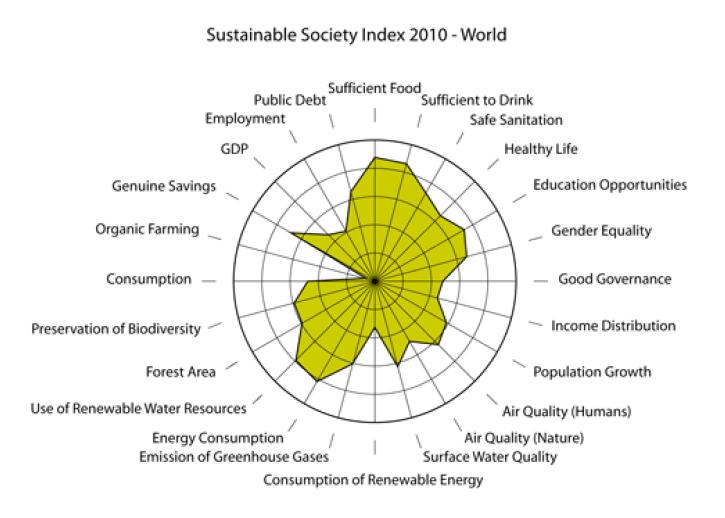
Recently, the Econometrics and Applied Statistics Unit of the Joint Research Centre (JRC) of the European Commission audited the Sustainable Society Index (SSI). Based on the 2012 edition of the SSI, the JRC drew a number of important conclusions.

1. The revised SSI framework is conceptually coherent:

• The indicators are more correlated to their own category than to any other category;

• All correlations within a category are significant and positive;

• The same conclusion is drawn at the dimension level.

2. The revised SSI framework meets the statistical requirements as set by the JRC:

• In most SSI categories the underlying indicators have similar implicit weights in classifying countries within each category;

• Few imbalances were found within the Transition and the Economy category;

• The marginal weights of the indicators on the SSI categories scores do not differ too much;

• A robustness analysis of country ranks for each SSI Wellbeing dimension showed that the SSI provides a reliable picture of the countries’ performance, that is not driven by methodological assumptions.

The Sustainable Society Index appears to be a comprehensive and quantitative method to measure and monitor the health of coupled human-environmental systems at national level worldwide.

3. The SSI is a comprehensive quantitative method well suited to assess nations’ development towards sustainability in its broad sense: Human, Environmental and Economic Wellbeing:

• The SSI framework goes beyond a purely protectionist approach that would aim to maintain natural systems with minimal human impact;

• It describes societal progress along all three dimensions: human, environmental and economic, built on 21 indicators;

• It is a conceptually and statistically sound tool, that is widely applicable for on-going assessment of the human-environmental systems and a key benchmark against which to compare future progress and inform comprehensive societal policies;

• It can be used to simulate the consequences of a range of potential actions, providing a powerful tool to inform decisions about how to achieve human and economic growth without compromising the environmental wellbeing.

The Hague Centre for Strategic Studies (HCSS), who cooperates with the Sustainable Society Foundation (SSF) to further develop the SSI, would like to congratulate the SSF with the positive evaluation by the Joint Research Centre of the European Commission. For the full evaluation report, please download the PDF.

  • Share on Facebook
  • Share on X
  • Share on WhatsApp
  • Share on LinkedIn
  • Share by Mail

Experts

Related News

Related Content

HCSS signs Cooperation Agreement with the Sustainable Society Foundation to further develop the Sustainable Society Index
Big Society, Big Data. The radicalisation of the network society.
LGBT Military Index

Office Address

  • The Hague Centre for Strategic Studies
  • Lange Voorhout 1
  • 2514 EA The Hague
  • The Netherlands

Contact Us

  • Telephone: +31(70) 318 48 40
  • E-mail: info@hcss.nl
  • IBAN NL10INGB0666328730
  • BIC INGBNL2A
  • VAT NL.8101.32.436.B01
  • Contact

Legal & Privacy

  • Disclaimer & Privacy
  • Algemene Voorwaarden 2024 (NL) 
  • Terms & Conditions 2024 (ENG) 
  • Algemene Voorwaarden 2026 (NL) 
  • Terns & Conditions 2026 (EN) 
  • Coordinated Vulnerability Disclosure
  • Ethical Standards
  • Manual for Responsible Use of AI

Follow us

© The Hague Centre for Strategic Studies
    Link to: Moslimextremisme bloeit, met dank aan de Arabische ‘Lente’ Link to: Moslimextremisme bloeit, met dank aan de Arabische ‘Lente’ Moslimextremisme bloeit, met dank aan de Arabische ‘Lente’ Link to: Biobased economie: tussen gouden bergen en groene business Link to: Biobased economie: tussen gouden bergen en groene business Biobased economie: tussen gouden bergen en groene business
    Scroll to top Scroll to top Scroll to top

    GDPR Consent

    Your privacy is important to us. Here you can set which consent you are allowing us with regards to the collection of general information, the placing of cookies of the collection of personal information. You can click 'Forget my settings' at the bottom of this form to revoke all given consents.

    Privacy policy | Close
    Settings

    GDPR Consent Settings

    Your privacy is important to us. Here you can set which consent you are allowing us with regards to the collection of general information, the placing of cookies of the collection of personal information. You can click 'Forget my settings' at the bottom of this form to revoke all given consents.

    Website statistics collect anonymized information about how the site is used. This information is used to optimize the website and to ensure an optimal user experience.

    View details

    Functional cookies are used to ensure the website works properly and are neccessary to make the site function. These cookies do not collect any personal data.  

    View details
    Forget my settings Deleted!