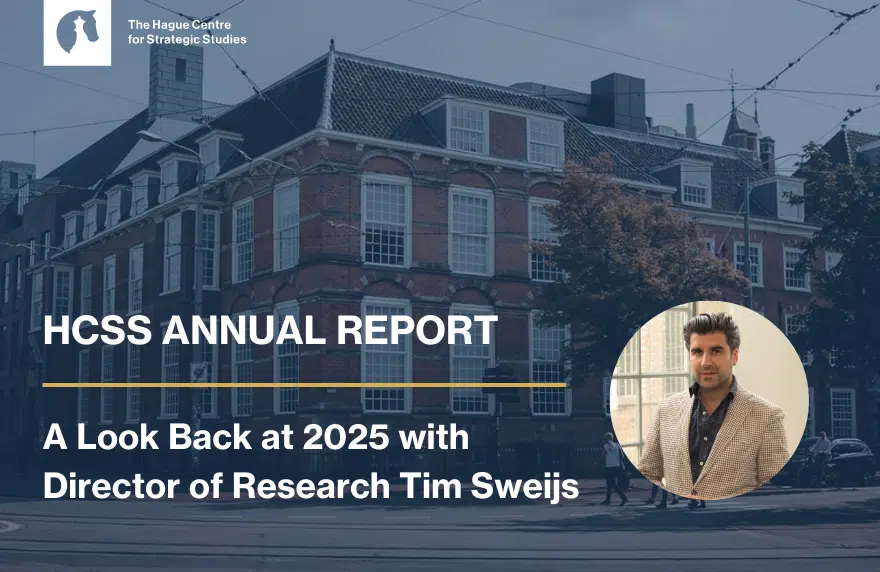
In his introduction for the HCSS Annual Report 2025, Director of Research Dr. Tim Sweijs reflects on a year of turbulence, transformation, and technological disruption. For HCSS, these developments and the challenges they pose to the well-being of our societies, means that this year there never was a dull moment. Our Team has worked unrelentingly to contribute to understanding these big challenges and offering solutions towards a more peaceful, prosperous and equitable world with, what we hope, are meaningful insights. Our Annual Report offers a comprehensive overview of our activities this year.
We live in dangerous times. 2025 was, again, a year of tremendous turbulence. Large scale conventional war on our European Continent continued unabated. The pull and push of rising, incumbent and resurging powers created fresh fissures in regional security systems often with global consequences – politically, socially and militarily. In the first year of his second reign, US President Trump tried to put the G back in Great power politics targeting both allies and adversaries, emphasising the US ability to coerce rather than induce. Some small and middle powers sought to toe the party line balancing, at least ostensibly, with the US. Others started adjusting their policies and alignment strategies to create more freedom of manoeuvre for themselves.
European Union leaders found out that those who exclusively cling to the status quo in times of transformational change, only do so at their own peril. Strategic autonomy, once merely an aspirational pipedream, has started to gain actual momentum not just in Brussels but across different European capitals. Political slogans have started to be combined with actual spending power to turn them into a reality. Necessity, after all, is the mother of adaptation and transformation, even if real change arrives painstakingly slow.
Meanwhile, the disruptive impact of emerging and emerged technologies became clearer for anyone to see with first generation generative AI applications, including most visibly Large Language Models, penetrating societies and, as of now, threatening to upset entire industries. Societal polarisation, based not on ties that bind but on differences that divide, has become a constant feature of European societies. Amidst all the geopolitical hard security tumult, the pernicious effects of climate change are ever harder to deny, although leaders and corporations are still reluctant to counter it with decisive action.
For HCSS, these developments and the challenges they pose to the well-being of our societies, means that this year there never was a dull moment. Our Team has worked unrelentingly to contribute to understanding these big challenges and offering solutions towards a more peaceful, prosperous and equitable world. We have worked day and night to inform public discourse, advise policymakers, convene stakeholders from the public and private sectors, and infuse discussions with, what we hope, are meaningful insights.
Our research portfolio has continued to evolve. We have expanded our thematic focus and reorganised our focal areas into five core Programmes: Geopolitics & Governance, Economics & Technology, Defence & Security; Society & Resilience; and Climate, Water & Food. We have also added a variety of new analytical techniques to our portfolio facilitated by a significant expansion of our Research Methods and Datalab. We do so at a time when the emergence of generative AI opens an array of promising research avenues whilst at the same time posing important methodological and ethical questions. Also here, we try and remain ahead of the curve – always in a responsible manner.
In 2025, we further expanded our analytical toolkit, incorporating advanced methodologies such as multilingual natural language processing, structural and relational causal models, optimisation techniques for policy interventions, and experimentation with generative AI for strategic analysis. We also launched a number of new dashboards and monitors, publicly available at our website, to analyse complicated if not complex phenomena in national and international affairs.
I invite you to take a look at, for instance, CARMEN (Critical Raw Materials Early Navigation Dashboard), DOMINO (the Dutch Observer for Materials Intelligence and Operations), DAMON (Disturbances and Aggression Monitor), or GATRI (our Geopolitical Annual Trade Risk Index), amongst others.
We maintain our rigorous standards to ensure that our research meets the highest quality benchmarks:
- Clear Focus, Clear Argument, Clear Message; Our work is precise, well-structured, and conveys a distinct message.
- Well-Articulated, Well-Written, Well-Structured; Our insights are presented intelligently, with accessible language and coherent organisation.
- Evidence-Based, Methodologically Sound; Our research is driven by data and empirical evidence, adhering to robust methodologies that ensure reliability, validity, and objectivity.
- Creative and Innovative; We challenge conventional wisdom, offering fresh perspectives and novel approaches.
- Policy-Relevant and Actionable; Our work is designed to provide concrete, practical value to policymakers, advocacy specialists, and private-sector leaders.
We meet these standards with our multidisciplinary team of experts from a variety of fields, including, but not limited to, strategists, political scientists, economists, philosophers, mathematicians, and data scientists, which are featured on the following pages.
Our Annual Report offers a comprehensive overview of our activities this year. Our Team’s output has been nothing short of exceptional—publishing over 100 in-depth reports, policy briefs, academic articles, and books. Our experts have provided over 2000 commentaries for major national and international media – in print, online, on television, and on the radio.
Several studies generated substantial media attention and spurred discussion among policymakers and politicians and amongst the public at large. The “Strategic Guidance” report of the Global Commission on the Responsible Use of Artificial Intelligence in the Military Domain (GC REAIM), for which HCSS acted as the Secretariat for the past two years, was presented at the UN by Dutch Prime Minister Schoof, contributing directly to international norm development in this sphere. We also launched a new periodical societal survey, the HCSS Public Monitor on Societal Stability, to gain a better understanding of Dutch citizens’ perceptions, including on what they perceive as threats in their daily lives, where they lose trust in authorities, but also when they feel safe and experience cohesion.
We have forged and strengthened partnerships with leading institutions worldwide while hosting many decision makers at the highest levels of government, from Europe, the Indo-Pacific and elsewhere, at more than 35 events on our premises at the Lange Voorhout in The Hague. We have welcomed more than 2,200 participants to our conferences, symposia, workshops, and closed-door sessions at our Institute. We are particularly proud to have been a co-host of the NATO Public Forum during the historical NATO Summit in The Hague, where we received another 500 participants from 32 NATO allies and partners.
2026 will undoubtedly be another demanding year but our mission will remain unchanged: we will seek to inform public discourse, support strategic decision-making in both public and private sectors, and contribute to national and international security in alignment with liberal democratic values.
Dr. Tim Sweijs, Director of Research
Experts

Related Content