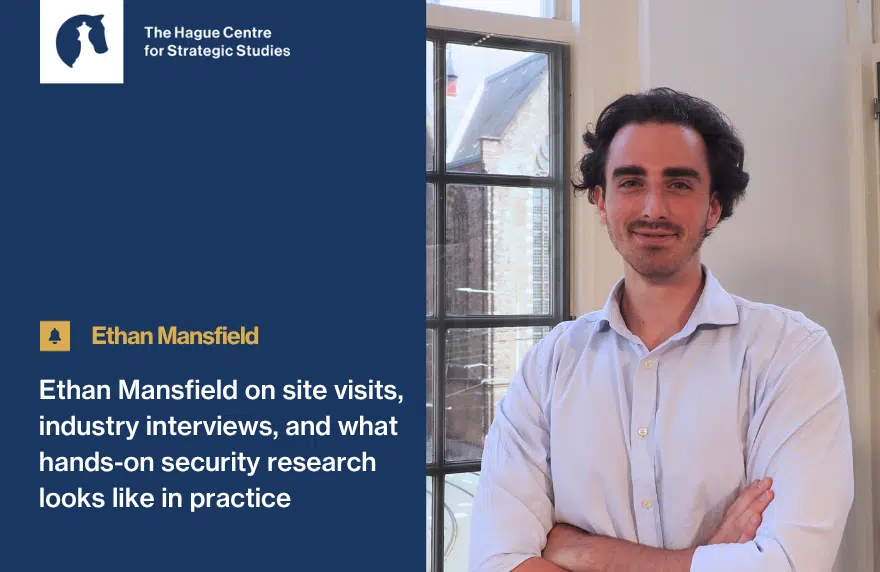
Hi Ethan, could you introduce yourself? Tell me where you are from, what your educational background is, if you had any prior work experience before your internship at HCSS?
Hello! My name is Ethan Mansfield, and I was born in California. For the last year, I have been living in Den Haag, and before that, I lived in Scotland as I got my bachelor’s degree in history from the University of Edinburgh. I moved to the Netherlands to study the MSc of International Relations and Diplomacy at the University of Leiden, which I will finish in one more year. I transitioned from History to International Relations as I wanted to transition from studying the past to applying my skills to the present and future. That same desire led me to HCSS as an opportunity to find real application for my previously theoretical knowledge. Except for several volunteering experiences in different student associations, my internship at HCSS is my first proper working experience.
Can you describe your time as a datalab intern? What does your day-to-day look like?
Each of my days at HCSS starts with a tea, a nice chat with my coworkers, and a look at my email, calendar, and any other updates. After that, the foundation of my duties consists of research, writing, and editing for a variety of reports and projects. The critical software for any general intern is Word, Excel, and Zotero!
In addition to these normal duties, the projects I am working on include meetings, conferences, interviews, and site visits. These can be in person, hybrid, or fully online depending on the availability and distance between participants. For such cases, a notebook, laptop, and tea are typically my equipment of choice. The meetings are often with one or more analysts to onboard a new team member, discuss updates, or brainstorm ideas and solutions on a topic of choice. The conferences, interviews, and site visits are disparate, ranging from academic discussions to visits to private corporations supplying military goods. The day typically ends with a final rounding off of whatever project I have been working on and sending messages and emails to the relevant project leads discussing updates and next steps.
How did the team or your supervisor/mentor contribute to your internship experience?
The people I met and worked with during the internship have really made the experience as enjoyable and fruitful as it has been. I have had the pleasure of working across a variety of fields from nuclear deterrence to hybrid warfare, unmanned systems, industrial planning, underwater infrastructure, and water, peace, and security in Iraq. Each of these projects was led by premier experts in their field and people I have had the pleasure of getting to know and learn from. It is because of the people, the conversations I have had with them, the guidance they have given, and the work I have done under them that I have fallen in love with these topics. I do not think I could have learned so much or enjoyed the work as much as I have without the people involved.
Additionally, the people working at HCSS are extremely welcoming and always open to a nice chat. There is no feeling of hierarchy, and I felt that my input and work was desired and utilized, allowing me to thrive on the projects I was assigned. The intern coordinators Benedetta Girardi and Fiona De Cuyper and my mentor, Davis Ellison, have also helped to support me and guide me through the experience. Whether being an approachable face at the office or a source of advice and support, they have helped to make the entire experience more beneficial and enjoyable.
What specific projects have you been involved in during your internship? And how have these experiences helped you develop professionally?
The projects I have worked on have been diverse. To name just a couple, I have helped research and write single reports on topics like Russian hybrid threats to the EU, where I was responsible for one of the case studies for the project. Additionally, I have been part of multi-report projects, such as a project on nuclear deterrence from a European perspective, where I have helped with multiple input papers and conference sessions. These experiences were immeasurably beneficial in expected ways, such as the application of my analytical skills, researching, writing, and editing. However, some of my greatest developments came from my participation in conferences, interviews with industry, meetings, and brainstorming sessions. In these experiences, I learned to apply my knowledge in the moment and learned how to engage in a practical professional environment. A recent highlight of such experiences came from an interview with a private ISR aircraft provider to the Netherlands where I was able to meet their staff and even tour their facilities and equipment to gather information for a project on critical underwater infrastructure.
This interview was conducted by HCSS Communications & Events Officer, Stephanie Govaerts
Experts

Related Content