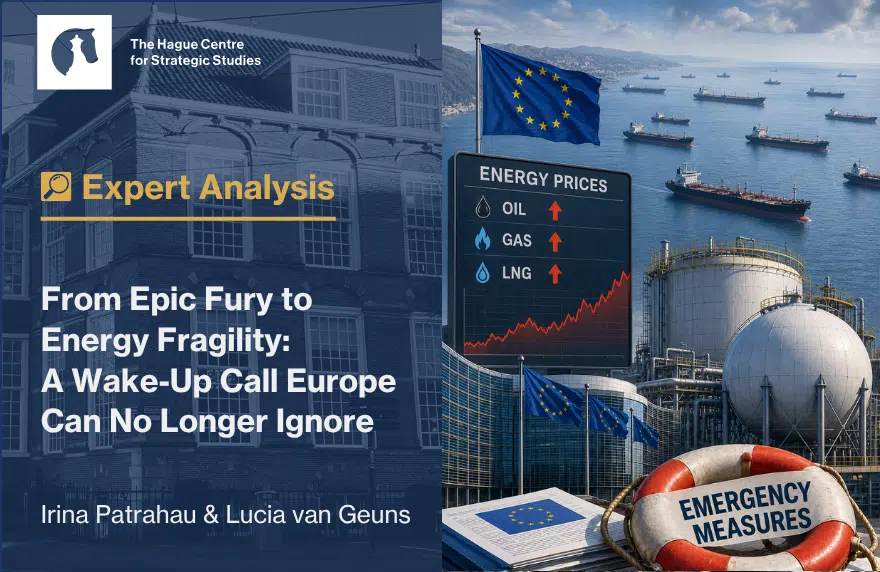
The 2026 Hormuz Crisis has triggered the largest and most complex energy shock in modern history, exposing deep vulnerabilities in Europe’s energy system. While the immediate disruption stems from conflict in the Gulf, the crisis has revealed a longer-term problem, warn Irina Patrahau and Lucia van Geuns: Europe remains heavily dependent on external energy supplies and continues to respond with emergency measures rather than structural reform. As geopolitical tensions and climate-related risks intensify, the continent faces a stark choice between recurring crises and building lasting resilience.
This analysis was finalized at the beginning of June 2026 and events are still unfolding.
Key takeaways
1. The 2026 Hormuz Crisis is the largest and most complex energy shock in history. The blockade of the Strait of Hormuz has triggered severe energy disruption, surpassing the 1973 oil shock in both volume and commodity scope, extending beyond oil to Liquefied Natural Gas (LNG), fertilisers, chemicals, and plastics. Even after the Strait reopens, the market is expected to take at least six months to stabilise. The pre-crisis normal may never fully return.
2. The global impact is deeply uneven, exposing which countries invested in resilience and which did not. Asian economies, including Vietnam, Japan, South Korea, and Singapore, face the sharpest disruption, having imported 60-75% of their crude, oil products and Liquified Petroleum Gas (LPG) through the Strait. China, by contrast, has been insulated by large strategic stockpiles and a heavily electrified economy, demonstrating that prior structural investment directly determines crisis resilience.
3. Resilience is about access, not just production. The crisis has exposed that vulnerability is not just determined by the global volume of energy products, but by who controls the chokepoints between producers and consumers, and which countries have the financial and logistical depth to absorb a sudden stop.
4. Europe is once again responding reactively to an energy crisis, and this carries compounding costs it can no longer afford. Europe entered the 2026 crisis heavily import-dependent. It has relied on strategic reserve releases coordinated by the International Energy Agency (IEA) and deployed its fourth temporary state aid framework since 2020. This is a reminder of events during the energy shock following Russia’s invasion of Ukraine. Each crisis that passes without the EU completing structural reform makes the next one more expensive, more politically destabilising, and harder to finance.
5. Europe must shift to an integrated security-driven energy system. The energy transition is not just a climate imperative; it is the only durable answer to ensuring resilience. But transition alone is insufficient if supply chains reproduce the same vulnerabilities in critical materials that Europe is trying to escape in fossil fuels. What is required is an integrated, security-driven energy strategy: one that combines binding diversification targets, strategic reserves for refined products and LNG, resilient critical material and alternative fuel supply chains, and a permanent investment architecture that does not have to be rebuilt from scratch every time a crisis strikes. The 2026 crisis is painful. But its clearest lesson is one Europe has already been taught and chosen not to learn.
Introduction
The blockade of the Strait of Hormuz and attacks on energy infrastructure between Israel and the United States and Iran in 2026 created the largest energy shock ever recorded according to the International Energy Agency.[1] A quarter of seaborne oil trade transits the Strait, with supplies from Saudi Arabia, the United Arab Emirates (UAE), Iran, Iraq, Kuwait, Qatar and Bahrain.[2] Iraq, Kuwait, the UAE and Saudi Arabia have had to significantly reduce their output.[3] While about 25% can be rerouted via pipelines in Saudi Arabia and the UAE, the rest is blocked as a result of the conflict.[4] The oil market has never experienced a physical disruption of this proportion. The issue is not just that flows cannot transit the Strait of Hormuz any longer, but that the production capacity of Gulf producers has been significantly affected by the attacks.
The main global impacts of the 2026 energy crisis have been widely discussed over the last few months, but how is Europe reacting to the crisis? This article by Irina Patrahau and Lucia van Geuns explores the European response, characterised by reactive policies and state support to minimise impact. We argue that immediate structural reform is needed for the European energy market to embed resilience in the system and reduce exposure to global events.
The largest energy crisis in history
The 2026 Hormuz crisis differs from the 1973 oil shock in both its mitigating factors and its aggravating ones. On the positive side, the world economy has become roughly 60–70% less oil-intensive per unit of GDP since the 1970s, driven by three structural shifts: far more fuel-efficient transport, the near-elimination of oil from power generation, and the growth of services and high-tech industries that require little energy to produce.[5] This means that the same oil price spike transmits considerably less damage into GDP than it did in 1973.
Yet the 2026 shock compensates for that buffer in several ways. The volume disrupted is vastly larger. Crucially, it is not just an oil shock. It affects not only refineries that were dependent on crude coming from the Gulf, but also consumers of oil products (diesel and jet fuel), liquefied natural gas (LNG), aluminium, and chemicals and petrochemicals like fertilisers, helium, and plastics.[6] About 17% of LNG flowed via the Strait of Hormuz, and 10-30% of global fertilisers, helium, and plastics.[7]
Producing countries are sitting on oil they cannot export. Consuming countries are paying prices for oil they cannot receive. The crisis has exposed that what matters is not just how much energy exists, but who controls the chokepoints between producers and consumers, and which countries have the financial and logistical depth to absorb a sudden stop.
And paradoxically, the Gulf states that produce the oil are themselves among the victims, unable to export and forced to cut production as onshore storage fills. The crisis is therefore simultaneously less severe per dollar of GDP, more complex, broader in commodity scope, and more dangerous for the specific countries least able to absorb it.
The geographic impact is also inverted. While the 1973 crisis hit the US and Europe, 2026 strikes hardest at Asia’s export-led economies, many of which hold only weeks of reserves.[8] Countries that are hit the hardest include Vietnam, Japan, South Korea and Singapore, who imported 60-75% of their crude through the strait.[9] India and Indonesia are most heavily hit by the shortage of liquid petroleum gas (LPG), on which 80% and 90% of households depend on for cooking. According to the IEA, the LPG exported from the Middle East to Asia was sufficient for the cooking needs of 820 million people.[10]
China is not affected as heavily as its neighbours. China’s major oil stockpiles made it more resilient than other countries, even though prices have increased. Moreover, China’s economy has been strongly electrified, so that oil is less of a contributor to its energy mix.[11]
The long-term impact depends on the length of the conflict and the ability of oil producers in the Gulf to recover after the attacks. Generally, even if the Strait of Hormuz reopens in the short-term, it could take months for the market to be stable again due to the needed recovery time of the damaged energy infrastructure, like refineries. Saudi Arabia is the best placed to recover the fastest. It has the largest technical and financial resources, and a demonstrated history of quick recovery after the 2019 attacks on their facilities in a very short period – 10 days to recover 10 million barrels/day (mb/d) and 2 months to regain maximum capacity of 12 md/d.[12] The UAE, Qatar, and Kuwait are in good positions too, although they are dependent on more factors like offshore outputs and bypass of the Strait of Hormuz.
Europe: Choosing subsidies over structural measures?
Europe’s imports of oil products, notably diesel and jet fuel, have been significantly affected. Half of Europe’s jet fuel imports came from the Gulf region, which is difficult to replace from other imports in a tight market. It is also difficult to quickly expand production domestically, as the product slate of each refinery differs based on technology and on the types of crudes brought in. Short-term measures like the release of strategic reserves and the ease of US sanctions on Russian and Iranian oil are relieving some of the pressure, but the effect can only be mitigated for a limited time.[13] Reserves have been drained within the first four weeks of the crisis, with storage levels below seasonal averages at the end of March.[14]
In response, the European Commission released in April 2026 AccelerateEU. The communication outlines measures to address this fossil energy crisis, including national emergency measures to ensure the availability of jet fuel and diesel, but also structural actions to assess available stocks and refining capacity for transport fuels and increase domestic production of sustainable fuels.[15] It also refers to a reassessment of the Oil Stocks Directive with a view to expand specifications of oil products in strategic storage.
The crisis exposes the vulnerability of Europe’s fuel system and shows the slow pace of structural measures to reduce risky dependencies. Europe has been here before, and that is precisely the problem. In 2022, the Russian invasion of Ukraine triggered what was framed as a generational reckoning with energy dependency, producing ambitious policy packages and bold rhetoric about structural reform. European countries spent over 1 trillion euros on state-subsidies and infrastructure-related costs to overcome the gas crisis.[16]
Now, in 2026, the Gulf crisis finds Europe in a structurally familiar position: heavily exposed, reacting with emergency measures, and reaching for the same toolkit of short-term subsidies and long-term promises for structural change. The EU is subsidizing extra costs for consumers via its Middle East Temporary State Aid Framework, the fourth such framework since 2020.
Every crisis, diversification and an accelerated energy transition get pursued far enough to relieve immediate pressure, but no further. European countries are reactive in their response and manage to overcome the crises by paying off the costs to mitigate the impact on consumers. Yet there is no guarantee that the EU will continue being able to pay itself out of crises. To some extent, the model has worked through the financial crisis, the sovereign debt crisis, COVID-19, and the 2021-2022 energy crisis. But each iteration leaves less fiscal capacity in reserve, while the potential shocks ahead, particularly those associated with climate change and geopolitical fragmentation, may be larger and more frequent than anything previously managed. The margin for the next response is narrowing.
The road ahead: Towards an integrated security-driven energy policy
The crisis reinforces once again that energy security and climate policy are inseparable, and that Europe has been slow to treat them as such.
In the short to medium term, pragmatic damage control is essential. Europe should ensure that its refining capacity and gas plants remain online in the short term, so that it is resilient to potential future crises. The imports of crude, diesel, jet fuel, and LNG, should be diversified once again, not just across different countries but also geographical regions. European vulnerability arises in times of supply crises, but also demand peaks, for instance in the case of armed conflict.[17] The EU must be prepared to address such challenges.
In the long term, the deeper imperative is the energy transition itself. Transitioning away from fossil fuels is no longer just a climate strategy, it is a security strategy. Domestic renewable energy is, by definition, immune to geopolitical disruption. Wind blowing over the North Sea cannot be sanctioned. Electrolysers producing green hydrogen are not subject to Strait of Hormuz closures. And bio- and synthetic fuels can be produced domestically and blended with liquid fuels.
Still, this transition depends on a supply chain that is itself at geopolitical risk. Critical raw materials, lithium, cobalt, rare earth elements essential to batteries, wind turbines, and electric motors, are heavily concentrated in a handful of countries, China foremost among them. Feedstocks for biofuels, mainly used cooking oils, are also sourced primarily from China. Europe cannot replace one strategic dependency with another.
What is required is an integrated, security-driven energy strategy: one that combines binding diversification targets, strategic reserves for refined products and LNG, resilient critical material and alternative fuel supply chains, and a permanent investment architecture that does not have to be rebuilt from scratch every time a crisis strikes.
This crisis is painful. But it is also clarifying. Europe has been given another warning it cannot afford to ignore.
Irina Patrahau and Lucia van Geuns
[1] International Energy Agency, Oil Market Report.
[2] IEA, ‘Strait of Hormuz’.
[3] Fattouh and Economou, The Anatomy of the Strait of Hormuz Oil Shock.
[4] IEA, ‘Strait of Hormuz’.
[5] Bordoff, Jason, and Meghan O’Sullivan. “The New Energy Order.” Columbia University Center on Global Energy Policy, 2023. https://www.energypolicy.columbia.edu
[6] BCG Global, ‘The Hormuz Strait’.
[7] BCG Global, ‘The Hormuz Strait’.
[8] Kpler. “US-Iran Conflict: Strait of Hormuz Crisis Reshapes Global Oil Markets.” Kpler Insight, March 1, 2026. https://www.kpler.com/blog/us-iran-conflict-strait-of-hormuz-crisis-reshapes-global-oil-markets
[9] Altaghlibi, ‘Oil Market – The Ripple Effects of Strait of Hormuz Closure’.
[10] https://www.iea.org/commentaries/energy-crisis-threatens-world-s-most-vulnerable-as-cooking-fuel-shortages-grow
[11] Zhou and Downs, ‘China’s Energy Powerhouse Ambitions’.
[12] Fattouh and Economou, The Anatomy of the Strait of Hormuz Oil Shock.
[13] Altaghlibi, ‘Oil Market – The Ripple Effects of Strait of Hormuz Closure’.
[14] Wittels, ‘Europe Has Enough Jet Fuel For Coming Weeks as Stocks Pressured’.
[15] European Commission, AccelerateEU – Energy Union.
[16] https://www.sciencedirect.com/science/article/pii/S221462962300261X
[17] Patrahau et al., No Fuel, No Fight.


Related Content