HCSS
  • News
    • BNR | De Strateeg
    • Columns
    • Events
    • HCSS Newsletter
    • Podcasts
  • Publications
    • Publications
      • All Projects
      • All Publications
    • Geopolitics & Governance
      • Transatlantic Relations
      • Russia & Eurasia
      • Europe in the Indo-Pacific
      • AI in the Military Domain
      • PROGRESS / Strategic Monitor
    • Economics & Technology
      • Emerging Technologies
      • Critical Materials
      • Energy Security
    • Defence & Security
      • On Future War
      • Deterrence and Arms Control
      • Hybrid Threats
      • Cyber Security
    • Society & Resilience
      • Nationale Veiligheid en Weerbaarheid
      • Publieksmonitor Maatschappelijke Stabiliteit
      • Transnational Organised Crime
      • Strategic Monitor Dutch Police
    • Climate, Water & Food
      • Climate Security
      • Water, Peace & Security (WPS)
      • International Military Council on Climate and Security (IMCCS)
      • Food Security
  • Dashboards
    • Dashboards
      • All Tools
        • GINA
        • SARA
        • GATRI
        • DOMINO
    • Geopolitics & Governance
      • Diplomatic Networks
      • News Networks
      • Dutch Foreign Relations
      • Chinese Hybrid Threats
    • Economics & Technology
      • Economic Networks
      • Economic Risk
      • Critical Materials Supply Chains
      • Critical Materials Map
      • Critical Materials Pricing
      • Cyber Arms Watch
    • Defence & Security
      • Military Networks
      • Nuclear Timeline
    • Society & Resilience
      • Conflict Monitor
    • Climate, Water & Food
      • Agrifood Monitor
  • Leadership Practice
    • HCSS Leadership Practice
    • HCSS Boardroom
    • Leergang Strategie en Weerbare Rechtsorde
    • Strategic Negotiations Course
    • Serious Gaming
    • IDCSS | Indo-Dutch Cyber Security School
    • SANCS | Southern Africa-Netherlands Cyber Security School
  • About HCSS
    • Contact Us
    • HCSS Datalab
    • Our People
    • Funding & Transparency
    • Internship Programme
    • Press & Media Inquiries
    • Studio HCSS
    • Working at HCSS
    • Global Futures Foundation
  • Click to open the search input field Click to open the search input field Search
  • Menu Menu

News

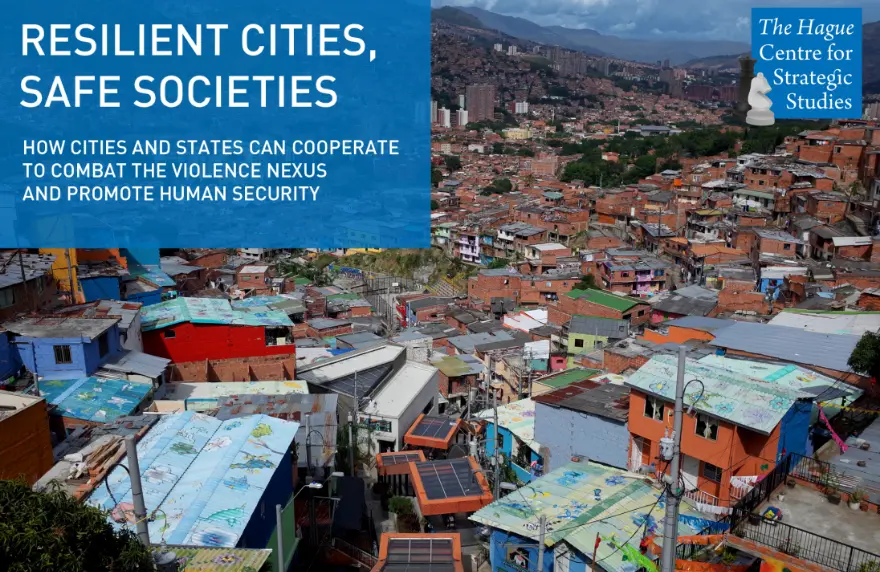
Resilient cities, safe societies

February 28, 2018

In his well-known book The End of Power, Moises Naim argues that urbanization – which he regards as “the most aggressively power-transforming aspect of the mobility revolution” – will have “intense” consequences for the distribution of power within a country. The emerging role of cities in world politics makes governance of cities not just a local or national issue, but an international – or, if you will, a transnational – issue.

More people living in cities will inevitably have consequences for the nature of conflict. In response, cities are stepping up cooperation between them, which is now giving rise “to new power relations altogether” according to sociologist Saskia Sassen. However, it is not a given that cities working together will themselves be able to tackle conflict and violence, let alone take the lead in combating global violence and conflict, especially in the developing world.

For authorities at multiple levels, this prompts the need to rethink existing governance structures so as to ensure not only that different forms of violence and conflict in urban areas can be combated in the most effective ways, but also that appropriate preventative policies that tackle root causes be implemented. The result of such an exercise can be to create an ecosystem of stakeholders, from citizens to international organizations, suitable to address these very issues from a broad-based human security perspective.

HCSS’ latest study ‘Resilient cities, safe societies – how cities and states can cooperate to combat the violence nexus and promote human security’ examines the relationships between urbanization and conflict from multiple angles, based on data-driven research. Subsequently, it considers the consequences for urban governance, and provides suggestions on how cities and national governments can improve cooperation on urban security together with other relevant stakeholders.

  • Share on Facebook
  • Share on X
  • Share on WhatsApp
  • Share on LinkedIn
  • Share by Mail

Experts

Related News

Related Content

resilient cities safe societies
Resilient cities, safe societies
HCSS_Resilient-Cities-Safe-Societies
SVI_Amsterdam_2015_PDF_I

Office Address

  • The Hague Centre for Strategic Studies
  • Lange Voorhout 1
  • 2514 EA The Hague
  • The Netherlands

Contact Us

  • Telephone: +31(70) 318 48 40
  • E-mail: info@hcss.nl
  • IBAN NL10INGB0666328730
  • BIC INGBNL2A
  • VAT NL.8101.32.436.B01
  • Contact

Legal & Privacy

  • Disclaimer & Privacy
  • Algemene Voorwaarden 2024 (NL) 
  • Terms & Conditions 2024 (ENG) 
  • Algemene Voorwaarden 2026 (NL) 
  • Terns & Conditions 2026 (EN) 
  • Coordinated Vulnerability Disclosure
  • Ethical Standards
  • Manual for Responsible Use of AI

Follow us

© The Hague Centre for Strategic Studies
    Link to: Flow Security and Dutch Interests Link to: Flow Security and Dutch Interests Flow Security and Dutch Interests Link to: Russische desinformatie of online kattenkwaad? – Hollands Nepnieuws Link to: Russische desinformatie of online kattenkwaad? – Hollands Nepnieuws Russische desinformatie of online kattenkwaad? – Hollands Nepnieuws
    Scroll to top Scroll to top Scroll to top

    GDPR Consent

    Your privacy is important to us. Here you can set which consent you are allowing us with regards to the collection of general information, the placing of cookies of the collection of personal information. You can click 'Forget my settings' at the bottom of this form to revoke all given consents.

    Privacy policy | Close
    Settings

    GDPR Consent Settings

    Your privacy is important to us. Here you can set which consent you are allowing us with regards to the collection of general information, the placing of cookies of the collection of personal information. You can click 'Forget my settings' at the bottom of this form to revoke all given consents.

    Website statistics collect anonymized information about how the site is used. This information is used to optimize the website and to ensure an optimal user experience.

    View details

    Functional cookies are used to ensure the website works properly and are neccessary to make the site function. These cookies do not collect any personal data.  

    View details
    Forget my settings Deleted!