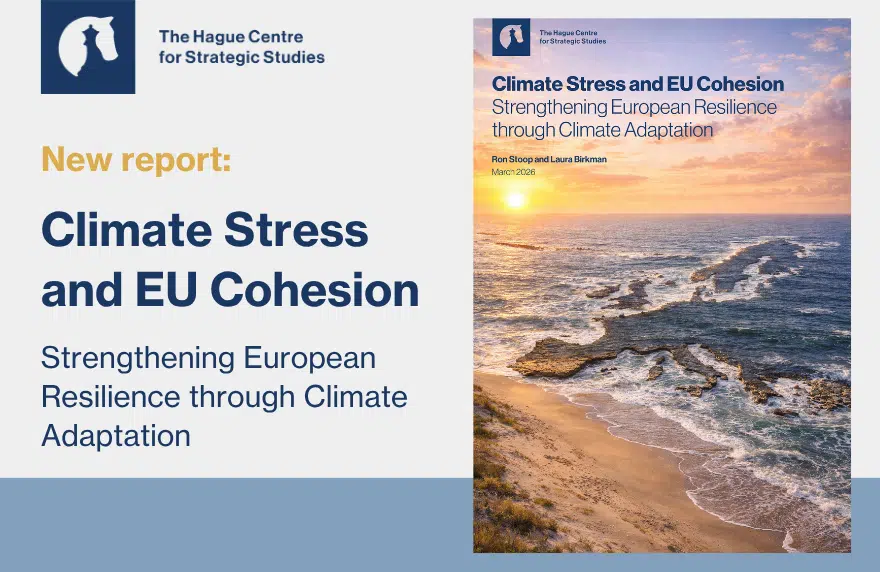
Climate stress threatens EU cohesion, but adaptation can turn risk into resilience. As Europe faces accelerating climate change, a new HCSS report by Ron Stoop and Laura Birkman warns that uneven climate impacts across the continent risk deepening political divides within the European Union, with implications for economic security and collective action.
Our latest report, Climate Stress and EU Cohesion, shows that climate hazards such as heat, drought and wildfires disproportionately affect Southern and Southeastern Europe, while flooding increasingly impacts Central and Northern regions. These uneven pressures translate into widening socio-economic disparities, particularly in agriculture, infrastructure, health and the broader economy.
“Climate change is more than just an environmental challenge. it is a structural stress test for European cohesion,” says strategic analyst and lead author Ron Stoop. “If its uneven impacts remain unaddressed, they will translate into political fragmentation.”
“Without a clear focus on adaptation, climate risks will continue to erode Europe’s economic stability and political unity,” stresses Laura Birkman, Director of the Climate, Water, and Food Security Programme at HCSS. “Policymakers should treat adaptation as a core investment in Europe’s resilience, not a secondary priority.”
The analysis identifies three emerging fault lines between EU Member States:
- Transfer payment tensions, as more affected countries seek financial support from less exposed economies;
- Diverging policy priorities, with climate adaptation competing against defence, agriculture and fiscal concerns;
- Short-term versus long-term trade-offs, undermining structural resilience.
These dynamics risk weakening the EU’s ability to act collectively, undermining systemic cohesion of the EU. However, the report argues that climate adaptation offers a pathway to reinforce cohesion. Targeted investments in resilience can reduce disparities, limit economic damage and strengthen Europe’s strategic position.
Key recommendations include scaling up five areas where Dutch expertise can contribute at EU level:
- Climate-resilient crop development in vulnerable agricultural regions;
- Expansion of controlled-environment agriculture;
- Climate-smart livestock systems;
- Reinforcement of river and flood management infrastructure;
- Adaptation of ports and coatal cities.
In addition, the report highlights a strategic opportunity in the upcoming EU budget, which allocates substantial resources to climate-related spending but risks underprioritising adaptation. It calls for stronger coordination mechanisms and a more coherent EU-wide adaptation framework.
“Climate change is rapidly becoming a systemic risk to European cohesion. For policymakers, the challenge is no longer whether to adapt, but how to do so in a way that reduces disparities, strengthens resilience, and preserves the EU’s ability to act collectively,” adds Birkman.
The authors conclude that coordinated adaptation efforts can reduce the need for future financial transfers, ease political tensions and transform shared vulnerability into a foundation for stronger European cooperation.
“Climate adaptation is not only an economic no-brainer, but also a strategic imperative for Europe,” concludes Ron Stoop.
Authors: Ron Stoop and Laura Birkman. With contributions from: Julie Jeuken, Marit Weurding, Freek Vossenaar, Tom Middendorp, and Frank Bekkers.
External review undertaken by senior researchers from Deltares (Ad Jeuken) and Wageningen University & Research (Tim van Hattum).
The research for and production of this report has been conducted within the PROGRESS research framework agreement. Responsibility for the contents and for the opinions expressed, rests solely with the lead authors and does not constitute, nor should be construed as, an endorsement by the Netherlands Ministries of Foreign Affairs and Defence.




Related Content