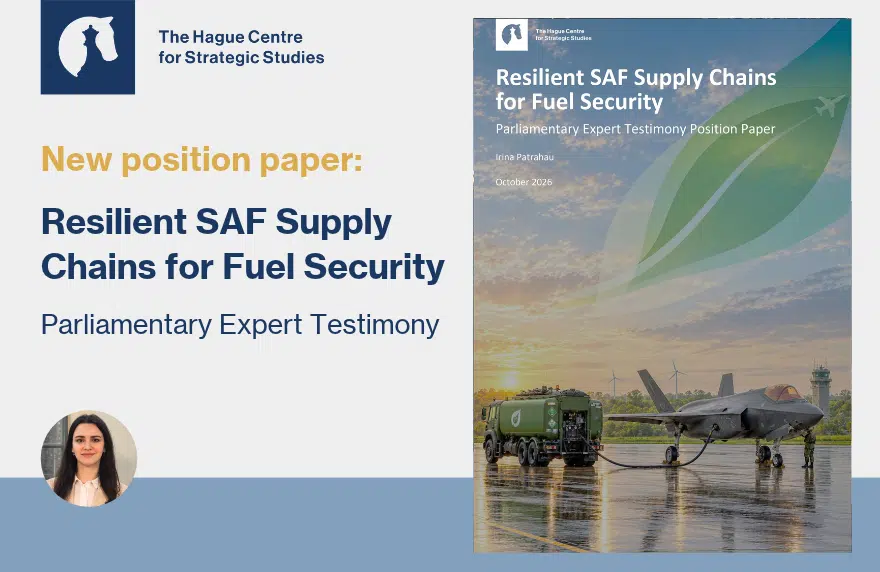
On Wednesday, November 4, 2026, the Standing Committee on Infrastructure and Water Management of the House of Representatives of the Netherlands will hold a roundtable discussion on Sustainable Aviation Fuel (SAF) with several experts, including HCSS strategic analyst Irina Patrahau.In preparation for the roundtable discussion with the members of parliament, Patrahau has drafted this position paper in which she outlines three priorities for the Netherlands and the EU: strengthen civil-military cooperation on fuel, build resilience into supply chains, and recognise alternative fuel plants as strategic dual-use assets.
How can sustainable aviation fuels (SAF) strengthen Europe’s energy security, industrial competitiveness and military readiness? In a new position paper prepared ahead of a parliamentary roundtable on Sustainable Aviation Fuel in the Dutch House of Representatives, HCSS Strategic Analyst Irina Patrahau examines the strategic importance of building resilient supply chains for alternative fuels.
SAF and synthetic sustainable aviation fuels (e-SAF) offer opportunities to reduce aviation emissions while strengthening Europe’s autonomy over fuel production and supply. However, scaling up production alone is not enough. Dependence on imported feedstocks, limited access to renewable electricity and green hydrogen, and vulnerabilities in international supply routes all pose risks to long-term fuel security. These challenges have implications for both civilian aviation and military operations, which rely heavily on shared fuel infrastructure and supply chains.
The paper outlines three priorities for the Netherlands and the EU to address these challenges:
- coordinate fuel security through stronger civil-military planning and European cooperation;
- build resilience into alternative fuel supply chains by addressing vulnerabilities across production, infrastructure and feedstock sourcing;
- and recognise alternative fuel plants as strategic dual-use assets, supporting investment through defence funding, long-term offtake agreements and other financing mechanisms.
By treating alternative fuel production as a strategic capability rather than solely an energy transition objective, the Netherlands and its European partners can strengthen fuel security, support industrial development and improve preparedness for future disruptions.
Experts

Related Content