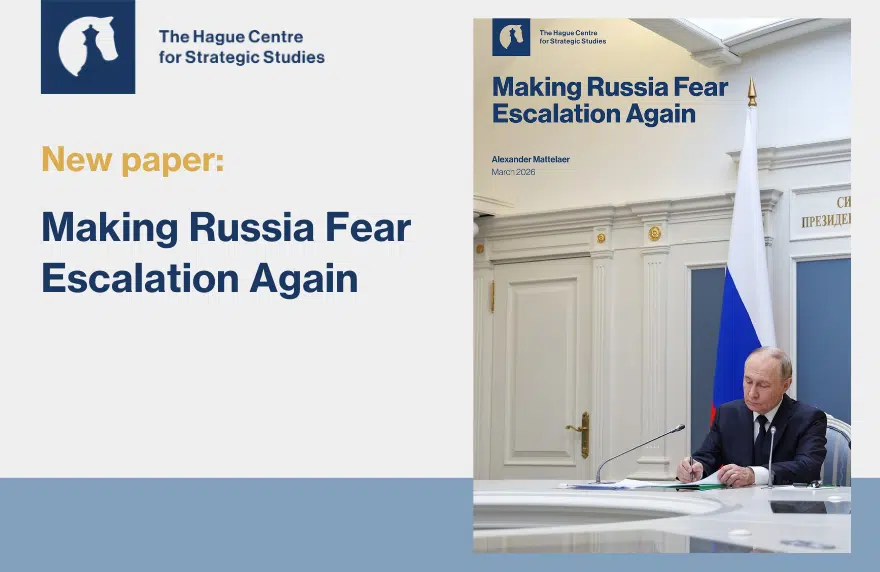
Russia’s hybrid war is expanding, exploiting NATO’s reluctance to escalate. Alexander Mattelaer’s latest HCSS guest paper argues that defensive resilience alone cannot stop Moscow. NATO must undermine the Kremlin’s confidence by demonstrating credible escalation options and reinforcing political will. “If NATO wants Moscow to back down, Russian leaders must fear escalation again,” Mattelaer warns. The paper lays out how Europe can restore strategic restraint and counter Russia’s confidence-driven hybrid strategy.
Russia’s hybrid war against Europe continues to expand, with drone sightings, cyber-attacks, airspace violations, disinformation campaigns, and sabotage operations steadily increasing across the continent. Rather than being a series of isolated incidents, these actions reflect a broader strategy: Moscow believes its nuclear advantage allows it to manage escalation risks better than NATO, turning escalation itself into a source of strategic leverage.
“This is not merely about improving our resilience,” says author Alexander Mattelaer, “it is about undermining the Kremlin’s confidence that escalation works in its favour.” The paper argues that NATO faces a dual challenge: defending against hybrid threats while simultaneously instilling fear of escalation in Russian decision-makers.
Key findings include:
- Partial deterrence failure: NATO’s success in preventing a conventional Russian attack has paradoxically encouraged Moscow to pursue hybrid escalation below the threshold of armed conflict.
- Escalation as strategy: Russia’s confidence stems from both its material advantage in non-strategic nuclear weapons and the perceived asymmetry in political resolve between NATO and the Kremlin.
- Limits of defensive measures: Defensive resilience alone favours Russia economically and strategically. Without credible escalation options, NATO cannot effectively constrain Russian behaviour.
Recommendations for NATO and policymakers:
- Revise deterrence posture: Ensure NATO can escalate deliberately if necessary, including considering offensive measures to signal credible risk imposition.
- Address nuclear asymmetry: Adapt strategies to account for Russia’s non-strategic nuclear advantage while reinforcing the political will to escalate if required.
- Strengthen collective resolve: Demonstrate that NATO’s commitment to escalation on its own terms is credible and unwavering.
Mattelaer underscores the stakes: “If NATO wants Moscow to back down from its quest to revise the post-Cold War settlement, Russian leaders must have compelling reasons to fear escalation again.”
The paper concludes that reversing Russia’s escalation confidence requires a combination of strategic clarity, credible deterrence, and a willingness to match Moscow’s risk acceptance in a controlled manner. Only by demonstrating that
The research for and production of this report has been conducted within the PROGRESS research framework agreement. Responsibility for the contents and for the opinions expressed, rests solely with the authors and does not constitute, not should be construed as, an endorsement by the Netherlands Ministries of Foreign Affairs and Defence.
Dr. Alexander Mattelaer is Professor of International Security at the VUB Centre for Security, Diplomacy and Strategy. He is also a Senior Research Fellow at Egmont – the Belgian Royal Institute for International Relations – and Chair of the Scientific Committee of the Belgian Royal Higher Institute for Defence.
The contents and the opinions expressed in this publication rest solely with the author and do not constitute, nor should be construed as, an endorsement by the Belgian Ministry of Defence.
Cover photo credit: The President of Russia
Experts

Related Content