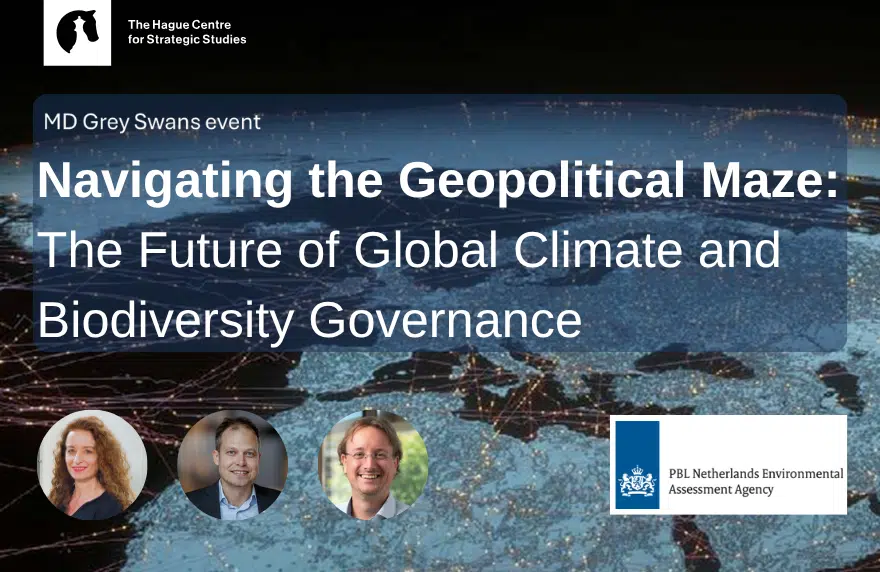
HCSS Programme Director Laura Birkman was one of the speakers at the Netherlands Environmental Assessment Agency (PBL) Grey Swans event on March 31, “Navigating the Geopolitical Maze: The Future of Global Climate and Biodiversity Governance,” where she explored how geopolitical change is reshaping international cooperation on climate, biodiversity, and ecosystems.
The hybrid event formed part of PBL’s broader effort to deepen research and reflection on the geopolitical dimensions of biodiversity and ecosystems, and what these mean for multilateral cooperation. In that context, Birkman highlighted how environmental governance is increasingly shaped by strategic competition, shifting power relations, and growing pressures on natural systems.
Drawing on a security and nexus perspective, Birkman examined how climate and biodiversity governance is being reconfigured by critical dependencies, Arctic dynamics, regulatory power, cascading risks, and emerging forms of minilateral cooperation. Her presentation stressed that biodiversity and ecosystem governance can no longer be treated separately from wider geopolitical developments, particularly as climate impacts, resource pressures, and supply chain vulnerabilities become more closely intertwined.
A central message of the presentation was that, in a more fragmented and multipolar world, minilateralism – smaller, purpose-driven coalitions of states and institutions – is likely to become an increasingly important complement to multilateralism. While universal frameworks remain essential for legitimacy, common rules, and burden sharing, more focused coalitions can help unlock progress where broader negotiations stall, including through implementation, financing, and technical cooperation. Examples discussed include the G7-backed Just Energy Transition Partnerships and Africa-EU green energy cooperation.
At the same time, Birkman emphasised that such approaches will only strengthen climate and biodiversity governance if they are anchored in transparency, fairness, legitimacy, and local ownership. Without these conditions, smaller coalitions risk reinforcing inequalities and undermining trust, especially between the Global North and South.
In her contribution, Birkman, Director of HCSS’s Climate, Water, and Food Security Programme, also underscored that climate and ecosystem degradation can act as systemic risks, with implications for food and water security, political stability, human wellbeing, and international cooperation. As climate change accelerates and ecosystems come under growing stress, governance will increasingly need to account for cross-sectoral vulnerabilities and unequal adaptive capacity.
The programme also featured contributions from Jorrit Oppewal, Advisor to the Development Cooperation Committee of the Advisory Council on International Affairs (AIV), who presented the AIV report The Netherlands, Europe and the Global South in a changing world order, and Daniel Scholten, Lecturer in Geopolitics and Governance of the Energy Transition at Wageningen University & Research (WUR).
The event concluded with an interactive discussion and a reflection on key takeaways by PBL, underscoring the importance of coalitions of the willing and other pragmatic approaches to climate and biodiversity governance, while highlighting the role of justice and security and raising broader questions about how climate and ecosystem impacts may shape geopolitics and international cooperation.
Organised by the Netherlands Environmental Assessment Agency (PBL), the event forms part of ongoing efforts to advance thinking on the future of global sustainability governance in an era of geopolitical change.
Experts

Related Content