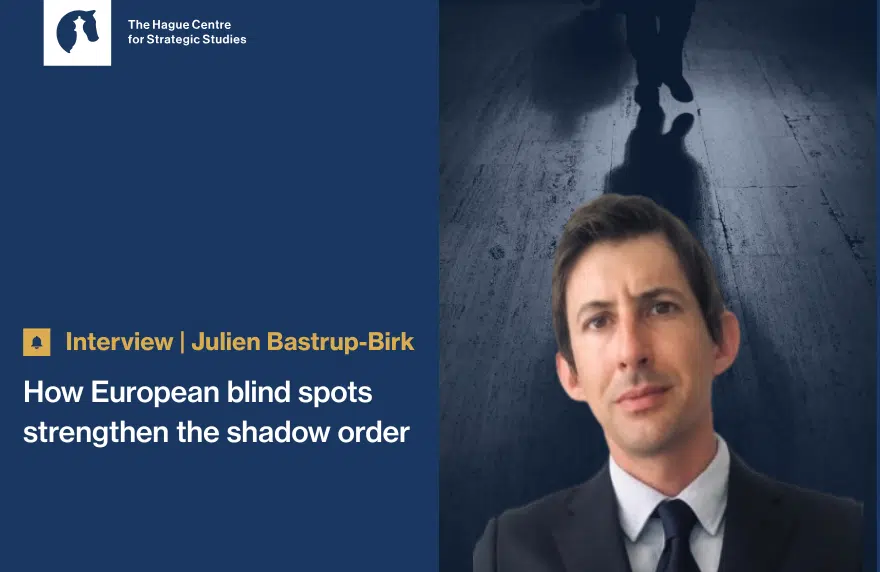
Criminal networks, terrorist groups and insurgents operate as a parallel international system. HCSS strategic advisor Julien Bastrup-Birk explains why Europe underestimates this “shadow order” — and how that weakens its ability to respond. As a strategy and international security specialist, Bastrup-Birk has advised both NATO and the United Nations Office on Drugs and Crime and worked at the UK Foreign and Defence ministries. Last week he defended his PhD on clandestine non-state power in the international system.
Your CV is impressive. What motivated you to pursue a PhD?
‘When you work full time, you do not always have the opportunity to step back and really reflect on what you have seen and observed in your work. That is precisely what my PhD now focuses on: the interconnected networks of organised crime, terrorism and guerrilla movements across different countries.’
What exactly did your research focus on?
‘I wanted to examine whether there are similarities in the ways these so-called clandestine non-state actors operate, including across borders. Specifically, I looked at the most powerful Italian mafia organisation, the ’Ndrangheta, al-Qaeda, and the guerrilla movement FARC (Fuerzas Armadas Revolucionarias de Colombia) and their respective approaches to undermining and challenging state authority. I wanted to know how they projected power, organised their activities and responded to state pressure. A key question was: what makes them effective at what they do, despite that opposition?’
‘They benefit from opportunities created by geostrategic competition and from weak governance in parts of the world’
How were you able to conduct this research? That sounds risky.
‘It was certainly complex. My professional background helped: I am familiar with governments and their operations from the inside, and I knew where to look. I focused as much as possible on primary sources. For example, when Osama bin Laden was killed in Pakistan, the US Navy SEALs discovered a vast amount of material in his compound, including documents, video files and correspondence. Around five years ago, this material was declassified. Letters exchanged between leaders and cells around the world offered unique insights into their thinking, communication, plans and strategies. For research purposes, such detailed primary sources are invaluable.’
And how did you study the Italian mafia and FARC?
‘In the Colombian context, there were major data leaks such as the so-called ‘FARC files’ and the Panama Papers, which exposed the global scale of money-laundering operations and the involvement of several of these groups. This helped me to understand how they ran their operations. In the case of the ’Ndrangheta, I relied on judicial records, including audio recordings from Italian police investigations and witness testimonies. In addition, many terrorist groups are strikingly active online. Through open-source research, specialised tools and, increasingly, AI tools, it was possible to analyse how they recruit, which ideologies and narratives they promoted, and how they presented themselves to their followers.’
Can the ‘terror content’ circulating on social media be trusted?
‘Insofar as it reflects how these groups want to be seen, yes. Al-Qaeda and later IS have been and continue to be very active on platforms such as Telegram and X, with official accounts and designated spokespersons. What you mainly see there is propaganda. Information about operations is deliberately kept secret and is not something I would trust on social media.’
What are your main findings?
‘My central question was how these actors are able to operate successfully, and to answer that I compared their strategies, structures, activities and capabilities. When we talk about the international system, we usually think of states. But there is also a parallel international system, which I refer to as the “shadow order”. These groups develop policies in ways that are comparable to states, but they operate one level below them.’
‘These groups possess instruments of power that are conceptually very similar to those of states’
What does that shadow order look like?
‘These groups possess instruments of power that are conceptually very similar to those of states. They have their own armed capabilities and forces, financial instruments and even dedicated financial departments. They engage in forms of trade policy, deploy strategic communications campaigns and possess intelligence capabilities. When you look at their core functions, instruments and resources, they are not fundamentally different from those of states, albeit on a smaller scale.’
And technology plays an important role in this.
‘Yes, that is very clear from my research. They communicate via encrypted channels, coordinate online and are showing an increasing interest in drone technology – something which could potentially give these groups their own air and naval power component in the future. Until recently, that would have been almost unimaginable. This represents a form of ‘levelling up’: access to high-tech instruments of power is no longer reserved exclusively for states.’
So does this mean the threat will increase in the future?
‘That is certainly expected. These groups will continue to benefit from opportunities created by geostrategic competition and from weak governance in various parts of the world. At the same time, countries such as Iran, Russia and China already make use of proxies: criminal networks and armed groups that do their dirty work while allowing for plausible deniability. What is striking is that the West currently makes little use of such tactics, even though it has done so historically, for example during the Cold War.’
‘Countries such as Iran, Russia and China already make use of proxies’
Why does Europe respond so weakly?
‘We see acts of sabotage, drone incursions and other forms of subversion here in Europe, yet a proportional response is lacking. What does Europe actually have at its disposal? You can’t use conventional military assets – such as a military warship – to counter a local criminal gang or a hacker group working on behalf of hostile states. At the same time, you cannot strengthen resilience without an appropriate counter-response. The only way to truly fight fire with fire is to build our own counter-networks of influence, at the sub-state level and within specific zones. Only in this way can we effectively push back against the activities we are currently seeing across Europe.’
What are the key implications of your research?
‘One core conclusion is that clandestine non-state actors constitute political and social power-wielding entities. They are also polymorphous, which is to say that they are structurally adaptive and prone to engaging in different activities – criminal, armed operations and state capture – concurrently. Despite this, expertise pertaining to different manifestations of threats such as organized crime, terrorism and insurgency is siloed within separate communities of expertise and practice. This is also impacts the response. For example, the primary task of law enforcement lies in investigation and prosecution, and less in analysing structural causes, economic networks and political infiltration.’
What would you recommend?
‘I strongly advocate for the creation of highly multidisciplinary teams, bringing together economists, political scientists, sociologists and anthropologists. Organised crime, terrorism and insurgencies often emerge from the same structural breeding grounds: political marginalisation, lack of economic opportunity and weak governance. If you want to genuinely undermine these groups, you need to deprive them of the oxygen they require to flourish.’
Bron: Universiteit Leiden
Experts

Related Content