HCSS
  • News
    • BNR | De Strateeg
    • Columns
    • Events
    • HCSS Newsletter
    • Podcasts
  • Publications
    • Publications
      • All Projects
      • All Publications
    • Geopolitics & Governance
      • Transatlantic Relations
      • Russia & Eurasia
      • Europe in the Indo-Pacific
      • GC REAIM
      • PROGRESS / Strategic Monitor
    • Economics & Technology
      • Emerging Technologies
      • Critical Materials
      • Energy Security
    • Defence & Security
      • On Future War
      • Deterrence and Arms Control
      • Hybrid Threats
      • Cyber Security
    • Society & Resilience
      • Nationale Veiligheid en Weerbaarheid
      • Transnational Organised Crime
      • Strategic Monitor Dutch Police
    • Climate, Water & Food
      • Climate Security
      • Water, Peace & Security (WPS)
      • Food Security
  • Dashboards
    • Dashboards
      • All Tools
        • GINA
        • SARA
    • Geopolitics & Governance
      • DFRI
      • GINA | Diplomatic
      • GINA | Information
      • CLARIS
    • Economics & Technology
      • DOMINO
      • GATRI
      • GINA | Economic
      • Cyber Arms Watch
      • Cyber Comparator
      • Cyber Norms Observatory
      • Cyber Transparency
    • Defence & Security
      • GINA | Military
      • Nuclear Timeline
    • Society & Resilience
      • DAMON
    • Climate, Water & Food
      • Agrifood Monitor
      • CARMEN
      • CRM Dashboard
  • Services
    • HCSS Boardroom
    • HCSS Datalab
    • Socio-Political Instability Survey
    • Strategic Capability Gaming
    • Strategic Negotiations Course
    • Studio HCSS
    • Southern Africa-Netherlands Cyber Security School 2026
    • Indo-Dutch Cyber Security School 2025
  • GC REAIM
    • GC REAIM | Members
    • GC REAIM | Publications
    • GC REAIM | Conferences
    • GC REAIM | Partners, Sponsors, Supporters
  • About HCSS
    • Contact Us
    • Our People
    • Funding & Transparency
    • Partners & Clients
    • Internship Programme
    • Press & Media Inquiries
    • Working at HCSS
    • Global Futures Foundation
  • Click to open the search input field Click to open the search input field Search
  • Menu Menu

News

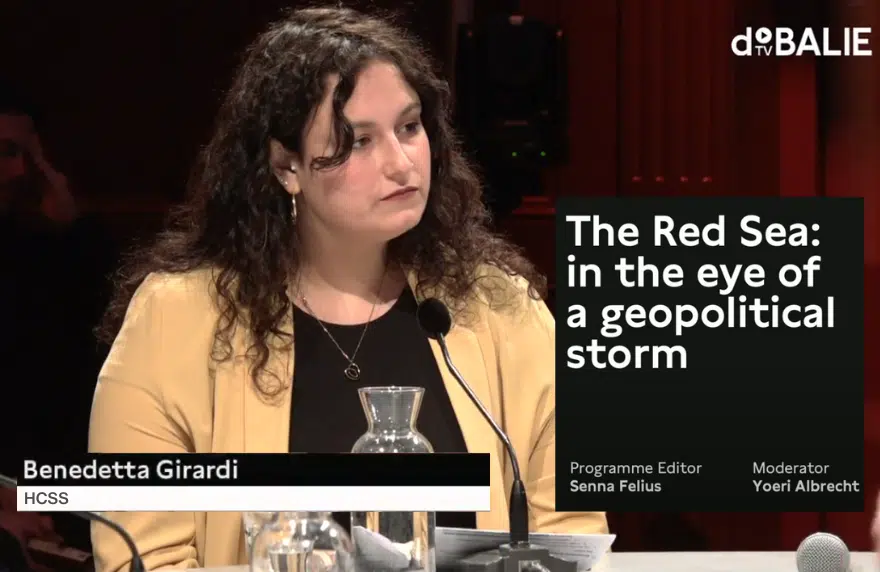
De Balie Rewatch | The Red Sea: in the eye of a geopolitical storm

February 4, 2026

The Red Sea has become the centre of a geopolitical crisis. What does this mean for global trade, maritime security, for NATO and Europe? How to secure one of the world’s most crowded trade routes?

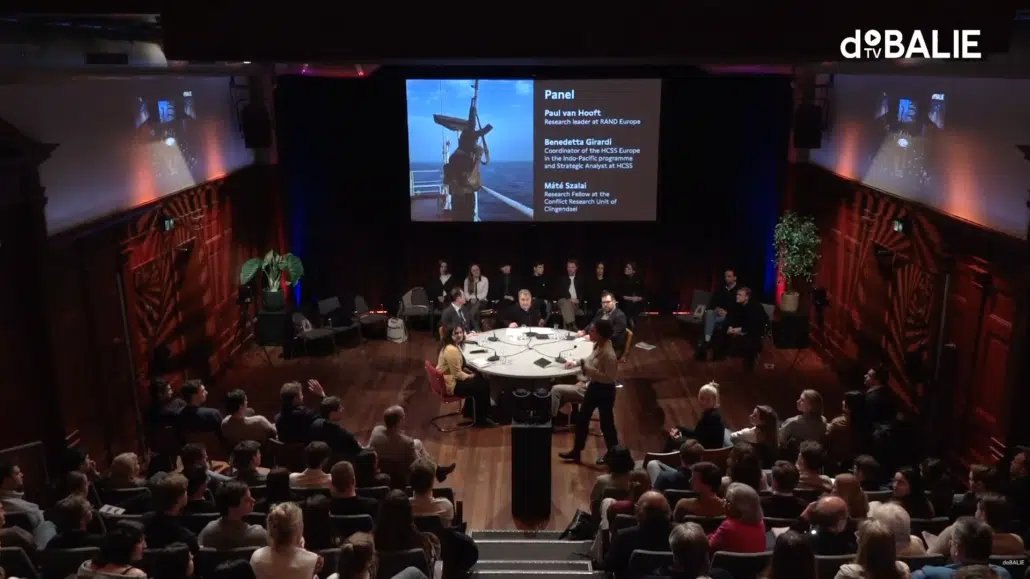
On the 3th of February, NATO-Chief of Staff Geoffrey van Leeuwen and HCSS Strategic Analyst Benedetta Girardi spoke about proxy wars, maritime strategy and trade, together with other experts, at a roundtable discussion in Amsterdam’s De Balie, co-organised by the Jason Institute.

Every year, roughly 33% of global containerised trade passes through the Red Sea. At its narrowest point, just 26 kilometres wide, the sea is one of the world’s most critical maritime chokepoints. The attacks in the last years by the Yemen-based Houthis have once again demonstrated the vulnerability of this geostrategic corridor. By sinking four vessels and hijacking another with relative ease, the Houthis have found an effective means to exert political leverage and managed to decrease maritime traffic through the passage from November 2023 onwards with 55%, bringing international trade through the Red Sea effectively to a standstill.

With the Bab el-Mandeb Strait and the Suez Canal no longer viable routes for most shipping companies, vessels traveling between Europe and Asia have increasingly diverted around Africa. For the EU, particularly for a maritime trading nation like the Netherlands, this divergence significantly complicates supply chains, increases costs, and critically exposes strategic vulnerabilities. As the cessation of Houthi attacks appears contingent on the fragile ceasefire in Gaza, European shipping companies ask whether a return to the strait is a realistic option at all.

During this event we discussed a set of interrelated questions: what geopolitical stakes are at play in the Red Sea region, what conditions are required to ensure safety and security, who are the key actors shaping developments in this strategically vital corridor, and specifically what role does NATO take on in its naval strategy?

Rewatch the event moderated by Yoeri Albrecht here:

About the speakers

Geoffrey van Leeuwen is NATO-Chief of Staff and Director of the Office of the Secretary General. Before taking over as Chief of Staff and Director of the Office of the Secretary General, Geoffrey van Leeuwen served as Minister for Foreign Trade and Development Cooperation for the Netherlands, after having spent several years as National Security Advisor to Prime Minister Mark Rutte.

Benedetta Girardi is Programme Coordinator of the HCSS Europe in the Indo-Pacific programme and Strategic Analyst at HCSS. Her research focuses on the role of Europe in the Indo-Pacific, with specific attention to supply chains of energy, critical raw materials, and semiconductors as well as avenues for engagement between European and Indo-Pacific states. 

Paul van Hooft is expert on international security, nuclear deterrence and strategy, US-European relations, and the Indo-Pacific. He  is a research leader at RAND Europe.

Máté Szalai is a Research Fellow at the Conflict Research Unit of Clingendael. As a member of the Middle East group, he specializes in the international relations and the domestic political economic systems of the broader Gulf region.

Bron: De Balie
  • Share on Facebook
  • Share on X
  • Share on WhatsApp
  • Share on LinkedIn
  • Share by Mail

Experts

Benedetta Girardi

Related News

Related Content

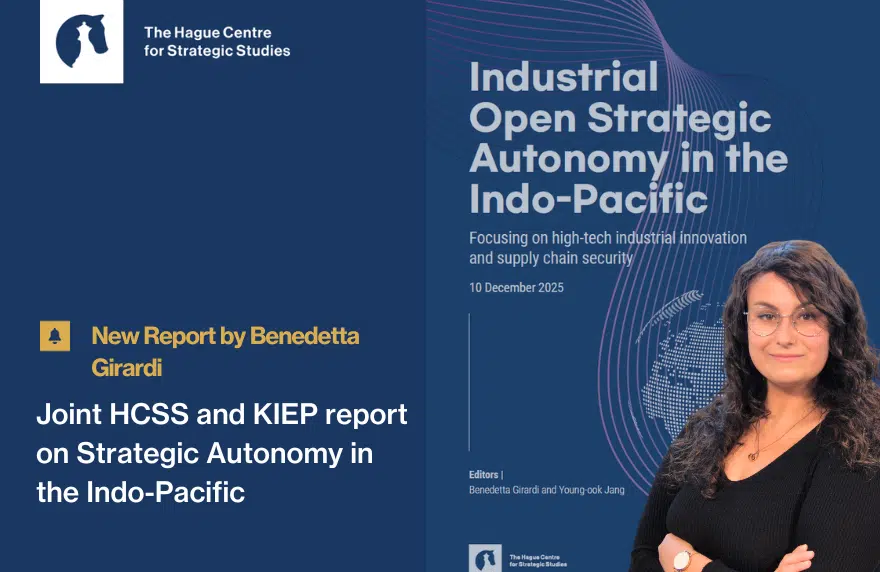
Industrial Open Strategic Autonomy in the Indo-Pacific: Focusing on high-tech industrial innovation and supply chain security
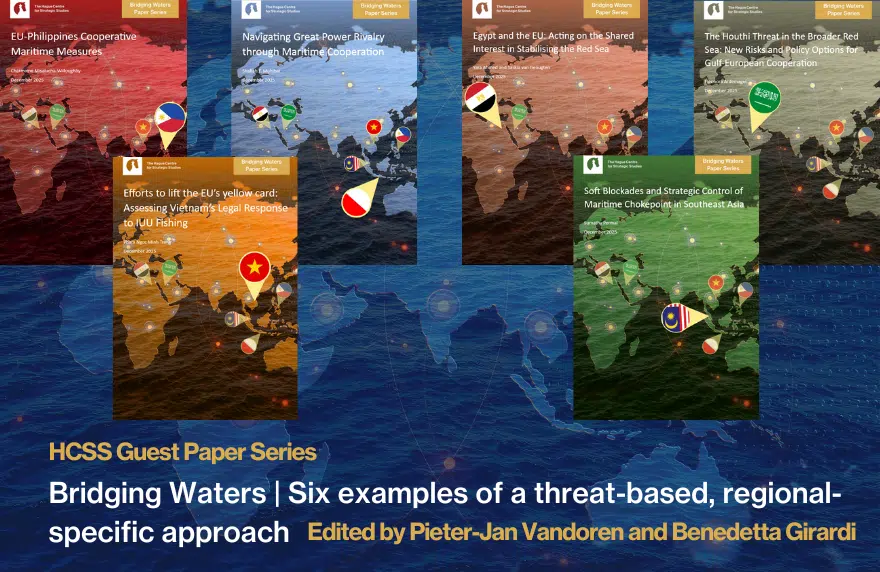
Bridging Waters Paper Series | Six examples of a threat-based, regional-specific approach
Benedetta Girardi | The Indo-Pacific In Focus: What is the Indo-Pacific?

Office Address

  • The Hague Centre for Strategic Studies
  • Lange Voorhout 1
  • 2514 EA The Hague
  • The Netherlands

Contact Us

  • Telephone: +31(70) 318 48 40
  • E-mail: info@hcss.nl
  • IBAN NL10INGB0666328730
  • BIC INGBNL2A
  • VAT NL.8101.32.436.B01
  • Contact

Legal & Privacy

  • Disclaimer & Privacy
  • Algemene Voorwaarden (NL) 
  • Terms & Conditions (ENG) 
  • Coordinated Vulnerability Disclosure
  • Ethical Standards
  • Manual for Responsible Use of AI

Follow us

© The Hague Centre for Strategic Studies
    Link to: New report | Shields and Spears: Nuclear-Conventional Force Balancing and the European Deterrence Architecture Link to: New report | Shields and Spears: Nuclear-Conventional Force Balancing and the European Deterrence Architecture New report | Shields and Spears: Nuclear-Conventional Force Balancing and the... Link to: HCSS Research Director Tim Sweijs visits India to strengthen strategic ties in the Indo-Pacific Link to: HCSS Research Director Tim Sweijs visits India to strengthen strategic ties in the Indo-Pacific HCSS Research Director Tim Sweijs visits India to strengthen strategic ties...
    Scroll to top Scroll to top Scroll to top

    GDPR Consent

    Your privacy is important to us. Here you can set which consent you are allowing us with regards to the collection of general information, the placing of cookies of the collection of personal information. You can click 'Forget my settings' at the bottom of this form to revoke all given consents.

    Privacy policy | Close
    Settings

    GDPR Consent Settings

    Your privacy is important to us. Here you can set which consent you are allowing us with regards to the collection of general information, the placing of cookies of the collection of personal information. You can click 'Forget my settings' at the bottom of this form to revoke all given consents.

    Website statistics collect anonymized information about how the site is used. This information is used to optimize the website and to ensure an optimal user experience.

    View details

    Functional cookies are used to ensure the website works properly and are neccessary to make the site function. These cookies do not collect any personal data.  

    View details
    Forget my settings Deleted!