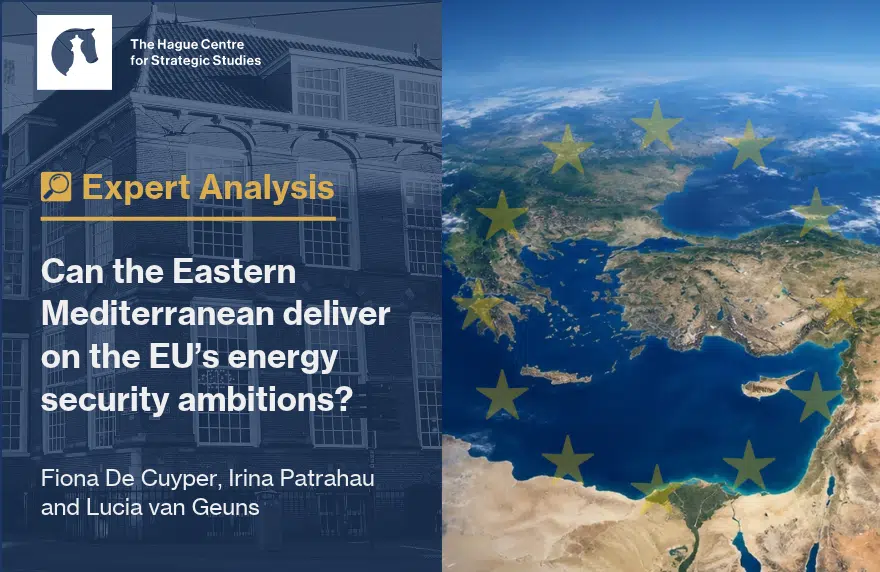
The Eastern Mediterranean is emerging as a potential contributor to European energy security. New gas developments in Cyprus and Israel, alongside Egypt’s LNG export infrastructure, offer opportunities to diversify the EU’s energy supplies. Yet unresolved maritime disputes, geopolitical rivalries and competing regional interests threaten to undermine this potential. Can energy cooperation pave the way for political rapprochement, or is political cooperation a prerequisite for unlocking the region’s energy resources? In this new HCSS Expert Analysis, strategic analysts Fiona De Cuyper, Irina Patrahau and Lucia van Geuns examine three possible scenarios and explore how the EU can balance energy ambitions with regional stability and security.
The energy and security dilemma of the Eastern Mediterranean
The disruption in the Strait of Hormuz, starting in March 2026, quickly reaffirmed how vulnerable the EU’s gas and electricity systems are. About 19% of the global trade of liquefied natural gas (LNG) could no longer be transported outside of the Arabian Gulf. This reignited the conversation around geographical diversification of energy sources, a debate that had already begun in 2022, following Russia’s full-scale invasion of Ukraine. As a result, eyes are shifting towards the Eastern Mediterranean as a possible answer to the Union’s need for energy diversification.
The region constitutes an important geopolitical flashpoint where energy interests, maritime security dynamics, and competing regional partnerships converge. Currently, natural gas forms the most developed regional energy network, with renewable electricity providing a long-term opportunity. Israel is exporting gas to Egypt and Jordan, while Egypt provides the region’s principal liquefied natural gas (LNG) export infrastructure. July 2026 marked a pivotal moment – Italian and French companies Eni and TotalEnergies took a final investment decision (FID) on the development of Cronos, a gas field in the Cypriot exclusive economic zone (EEZ), with production targeted for 2028. This could be the start of more investment announcements in Cyprus, complementing the already extensive Israeli gas production. It could also spark an escalation of tensions, as structural disputes with Türkiye and Libya, the main opposing forces to this emerging energy supply chain, have not yet been addressed.
Greece, Türkiye, and Cyprus maintain conflicting positions in the delimitation of exclusive economic zones (EEZs) and continental shelves, particularly regarding the maritime entitlements of islands. Other regional tensions and competing alignments further complicate the situation, including strained relations between Israel and Türkiye, the ongoing Israeli-Palestinian conflict, deepening strategic and energy cooperation between Israel, Greece, and Cyprus, and the involvement of external actors such as the EU, US, Russia, and Gulf states.
These disagreements affect where drilling can take place, which governments can issue licences, and how pipelines or electricity cables can be routed. Moreover, they increase the risk that drilling operations and naval deployments lead to unintended escalation or active confrontation.
For the EU, the Eastern Mediterranean presents an interrelated energy and security dilemma. Additional gas supplies and infrastructure could strengthen diversification and resilience, but commercial viability depends on construction costs, available export volumes, political stability, and long-term demand. Beyond these considerations, supplies from the Eastern Mediterranean could support affordability, but should also be planned in view of the EU’s legally binding objective of achieving climate neutrality by 2050. Moreover, regional tensions affect the EU’s broader security interests and the internal cohesion of the North Atlantic Treaty Organisation (NATO). Greece and Türkiye are both NATO members, but disagreements between them have resulted in competing naval deployments and a heightened risk of incidents between allied forces.
What comes first: energy or political cooperation?
The question of whether energy resources drive political cooperation or whether political cooperation must come first to unlock energy development remains contested in the literature and is particularly consequential in the Eastern Mediterranean. Some research argues that natural gas discoveries have generated new processes of regionalisation by drawing governments, companies, and other actors into increasingly dense networks of interaction. Others emphasise that such incentives remain subordinate to security and sovereignty concerns and states may sacrifice the economic gains of energy cooperation when these conflict with perceived security interests. For instance, in the past the Cyprus conflict and other regional rivalries have constrained otherwise commercially attractive forms of cooperation. In other examples, gas discoveries have given rise to both competition and cooperation, partially depending on whether ownership and jurisdiction over resources are sufficiently established.
The Eastern Mediterranean therefore faces a sequencing problem. Can energy cooperation gradually improve political relations? Or is a political framework needed first to sufficiently reduce risks so deeper cooperation on energy projects can emerge?
Option 1: Energy development leading political cooperation. Energy development gradually creates economic interdependencies that encourage states to cooperate despite unresolved political disputes. Cooperation emerges pragmatically around specific commercial projects, as governments and companies seek to protect mutual economic interests and avoid the costs of confrontation. However, this cooperation remains selective, with sovereignty and security disputes largely unresolved and existing regional alignments potentially reinforced. For the EU and NATO, this offers relatively rapid but limited benefits through energy diversification and reduced incentives for confrontation, while leaving underlying regional tensions intact.
Option 2: Political cooperation leading energy development. Gradual political accommodation and stronger regional governance create the stability and predictability needed for sustained energy development. Through institutional cooperation, maritime clarification, and greater regional integration, energy projects can expand beyond individual bilateral arrangements towards interconnected infrastructure and integrated markets. Although this pathway requires a more substantial and time-consuming diplomatic shift, it offers the most sustainable form of regional cooperation. For the EU and NATO, it provides the strongest long-term benefits by improving energy security, reducing regional tensions, and strengthening political and institutional cohesion.
Option 3: Deterioration of relations. If neither type of cooperation described above can succeed, there is a third option too. Escalating geopolitical tensions, unresolved maritime disputes, and weak regional governance reinforce existing divisions and undermine both political cooperation and energy investment. Growing security concerns discourage companies from pursuing projects that depend on stable cross-border arrangements, while regional energy relationships become increasingly fragmented and nationally oriented. This creates a vicious cycle in which political fragmentation constrains energy development, further reducing incentives for cooperation. For the EU and NATO, this is the least favourable outcome, as it undermines energy diversification, complicates relations with Türkiye, Greece, and Cyprus, and increases tensions and weakens cohesion within the alliance.
The EU’s role in the Eastern Mediterranean
The Eastern Mediterranean stands at the crossroads of pivotal energy and security challenges that directly impact the EU’s pursuit of energy diversification and regional stability. While the region shows promise to contribute to the diversification of the EU’s energy supplies, ongoing maritime disputes and geopolitical tensions present substantial risks to this potential. Neither “energy first” nor “politics first” alone can ensure regional stability or secure European energy and security interests, but reducing cooperation would have wide-ranging negative implications. Even though neither of these options is a silver bullet, any deterioration in relations would harm regional stability and European interests.
The EU should actively support and facilitate functional cooperation platforms that unite Türkiye, Egypt, Greece, and Cyprus, focusing specifically on maritime deconfliction mechanisms and joint management of shared infrastructure. These platforms should prioritise building practical interdependencies and reducing tensions, even in the absence of comprehensive dispute settlements, thereby fostering incremental political de-escalation and enhancing regional stability. Here, the EU should use its political, regulatory, and financial weight to produce tangible benefits without requiring the resolution of underlying disputes.
At the same time, the EU should treat energy and maritime security as interconnected pillars of its regional engagement, coordinating diplomatic, defence, and infrastructure efforts to address overlapping risks and opportunities. This should be complemented by a multi-faceted energy engagement strategy that includes: (a) maximisation of existing Egyptian LNG export capacity as an immediate short-term diversification tool; (b) strategic investment in new mid- to long-term natural gas infrastructure, particularly focused on fields around Cyprus and Israel; and (c) accelerated development of renewable energy projects and cross-border electricity interconnectors to support climate neutrality goals.
Fiona De Cuyper, Irina Patrahau and Lucia van Geuns



Related Content