HCSS
  • News
    • BNR | De Strateeg
    • Columns
    • Events
    • HCSS Newsletter
    • Podcasts
  • Publications
    • Publications
      • All Projects
      • All Publications
    • Geopolitics & Governance
      • Transatlantic Relations
      • Russia & Eurasia
      • Europe in the Indo-Pacific
      • AI in the Military Domain
      • PROGRESS / Strategic Monitor
    • Economics & Technology
      • Emerging Technologies
      • Critical Materials
      • Energy Security
    • Defence & Security
      • On Future War
      • Deterrence and Arms Control
      • Hybrid Threats
      • Cyber Security
    • Society & Resilience
      • Nationale Veiligheid en Weerbaarheid
      • Publieksmonitor Maatschappelijke Stabiliteit
      • Transnational Organised Crime
      • Strategic Monitor Dutch Police
    • Climate, Water & Food
      • Climate Security
      • Water, Peace & Security (WPS)
      • Food Security
  • Dashboards
    • Dashboards
      • All Tools
        • GINA
        • SARA
    • Geopolitics & Governance
      • DFRI
      • GINA | Diplomatic
      • GINA | Information
      • CLARIS
    • Economics & Technology
      • DOMINO
      • GATRI
      • GINA | Economic
      • Cyber Arms Watch
      • Cyber Comparator
      • Cyber Norms Observatory
      • Cyber Transparency
    • Defence & Security
      • GINA | Military
      • Nuclear Timeline
    • Society & Resilience
      • DAMON
    • Climate, Water & Food
      • Agrifood Monitor
      • CARMEN
      • CRM Dashboard
  • Leadership Practice
    • HCSS Leadership Practice
    • HCSS Boardroom
    • Strategic Negotiations Course
    • Serious Gaming
    • IDCSS | Indo-Dutch Cyber Security School
    • SANCS | Southern Africa-Netherlands Cyber Security School
  • About HCSS
    • Contact Us
    • HCSS Datalab
    • Our People
    • Funding & Transparency
    • Internship Programme
    • Press & Media Inquiries
    • Studio HCSS
    • Working at HCSS
    • Global Futures Foundation
  • Click to open the search input field Click to open the search input field Search
  • Menu Menu

News

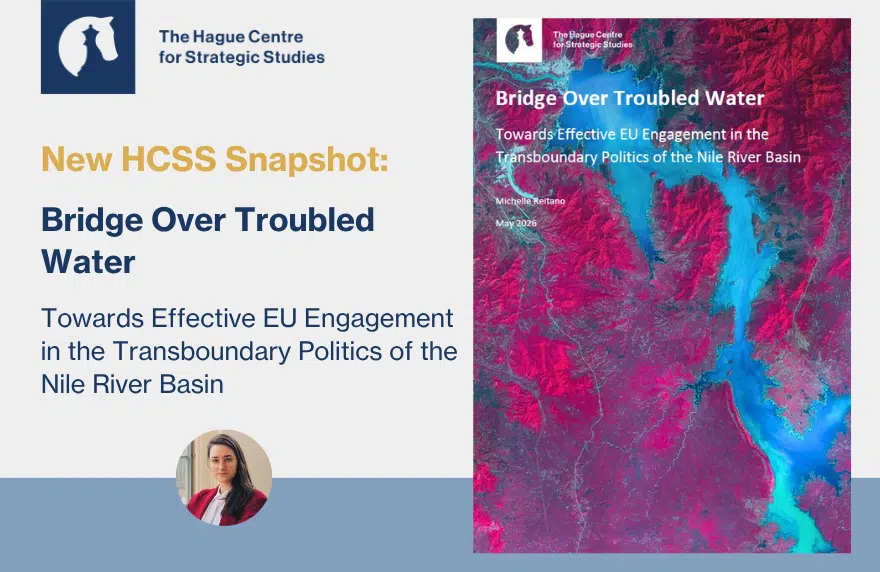
New Snapshot | Bridge Over Troubled Water: Towards Effective EU Engagement in the Transboundary Politics of the Nile River Basin

May 26, 2026
Download Snapshot (PDF)

Since the project’s inception in 2011, tensions surrounding the Grand Ethiopian Renaissance Dam have heightened the risk of conflict and instability in Europe’s extended Southern neighbourhood. However, despite promises to strengthen its involvement in water diplomacy and support a resolution to the GERD dispute, the EU’s ability to ease transboundary tensions in the Nile River Basin remains limited.

In this snapshot, Assistant Analyst Michelle Reitano, in collaboration with Director of the Climate, Water, and Food Security Programme Laura Birkman and Strategic Analyst Thijs van Aken, answers the question: Why has the EU been limited in its engagement in the transboundary politics of the Nile River Basin and how can the EU move towards an effective engagement strategy in the Nile’s water disputes?

The snapshot argues that three limiting factors impact the EU’s ability to meaningfully engage in the GERD dispute: (1) a turn from mediation to crisis management, (2) a strategic re-alignment towards Egypt, and (3) a difficulty in mobilising its technical engagements.

Based on these limitations, the author proposes three strategic outlooks:

  • Prioritise long-term geostrategic interests in the face of crises. The EU needs to engage with its extended Southern neighbourhood not only through the lense of crisis management but also through sustained investment long-term solutions.
  • Build effective partnerships and ensure the EU’s image as a legitimate actor. While the EU must balance a range of competing interests across riparian states, it needs to position itself as a credible and even-handed actor in the GERD dispute.
  • Strengthen coherence and invest in conflict-sensitive infrastructure development. While member states retain their own national foreign policies, stronger EU-level coordination is essential to engage credibly on the GERD dispute and translate technical cooperation into political progress.

Author Michelle Reitano notes:

“Water resources and infrastructure have become part of geopolitical contestation. The EU must ready itself to face increased transboundary tensions, pressures due to climate change, and water-related security challenges in its neighbourhoods.”

Author: Michelle Reitano

Editors: Laura Birkman and Thijs van Aken

Cover photo: NASA/METI/AIST/Japan Space Systems, and U.S./Japan ASTER Science Team

Download Snapshot (PDF)
  • Share on Facebook
  • Share on X
  • Share on WhatsApp
  • Share on LinkedIn
  • Share by Mail

Experts

Laura Birkman
Thijs van Aken

Related News

Related Content

WPS Policy Brief | Addressing Water-related Security Challenges in Fragile Settings: Opportunities and Limitations for Defence and Security Actors
Uncovering the Climate – Conflict Link: Mapping the Causal Pathways in Iraq
WPS Policy Brief | Entry-points for Collaborative Water Governance in Southern Iraq

Office Address

  • The Hague Centre for Strategic Studies
  • Lange Voorhout 1
  • 2514 EA The Hague
  • The Netherlands

Contact Us

  • Telephone: +31(70) 318 48 40
  • E-mail: info@hcss.nl
  • IBAN NL10INGB0666328730
  • BIC INGBNL2A
  • VAT NL.8101.32.436.B01
  • Contact

Legal & Privacy

  • Disclaimer & Privacy
  • Algemene Voorwaarden 2024 (NL) 
  • Terms & Conditions 2024 (ENG) 
  • Algemene Voorwaarden 2026 (NL) 
  • Terns & Conditions 2026 (EN) 
  • Coordinated Vulnerability Disclosure
  • Ethical Standards
  • Manual for Responsible Use of AI

Follow us

© The Hague Centre for Strategic Studies
    Link to: New paper| Intersecting Futures: Global Trends Shaping and Shaped by Climate Change over the Next Century Link to: New paper| Intersecting Futures: Global Trends Shaping and Shaped by Climate Change over the Next Century New paper| Intersecting Futures: Global Trends Shaping and Shaped by Climate... Link to: Persbericht HCSS: Klimaatverandering wordt bepalend voor mondiale veiligheid en machtsverhoudingen Link to: Persbericht HCSS: Klimaatverandering wordt bepalend voor mondiale veiligheid en machtsverhoudingen Persbericht HCSS: Klimaatverandering wordt bepalend voor mondiale veiligheid...
    Scroll to top Scroll to top Scroll to top

    GDPR Consent

    Your privacy is important to us. Here you can set which consent you are allowing us with regards to the collection of general information, the placing of cookies of the collection of personal information. You can click 'Forget my settings' at the bottom of this form to revoke all given consents.

    Privacy policy | Close
    Settings

    GDPR Consent Settings

    Your privacy is important to us. Here you can set which consent you are allowing us with regards to the collection of general information, the placing of cookies of the collection of personal information. You can click 'Forget my settings' at the bottom of this form to revoke all given consents.

    Website statistics collect anonymized information about how the site is used. This information is used to optimize the website and to ensure an optimal user experience.

    View details

    Functional cookies are used to ensure the website works properly and are neccessary to make the site function. These cookies do not collect any personal data.  

    View details
    Forget my settings Deleted!