HCSS
  • News
    • BNR | De Strateeg
    • Columns
    • The Draghi Report Revisited
    • Events
    • Podcasts
  • Publications
    • Publications
      • All Publications
    • Defence & Security
      • (Nuclear) Deterrence and Arms Control
      • Foreign Information Manipulation and Interference (FIMI)
      • Hybrid Threats
      • Nationale Veiligheid en Weerbaarheid
      • NATO Summit
      • On Future War
      • Robotic and Autonomous Systems
      • Strategic Monitor Dutch Police
      • Transnational Organised Crime
    • Geopolitics & Geo-economics
      • Europe in the Indo-Pacific
      • Knowledge base on Russia (RuBase)
      • PROGRESS / Strategic Monitor
      • Transatlantic Relations
    • Climate, Energy, Materials & Food
      • Climate and Security
        • International Military Council on Climate and Security (IMCCS)
        • Water, Peace & Security (WPS)
      • Critical Minerals
      • Energy Security
      • Food Security
    • Strategic Technologies
      • Cyber Policy & Resilience
        • Global Commission on the Stability of Cyberspace (GCSC)
      • Emerging Technologies
      • Global Commission on Responsible Artificial Intelligence in the Military Domain (GC REAIM)
      • Semiconductors
      • Space
  • Dashboards
    • Dashboards
      • All Tools
        • GINA
        • SARA
    • Defence & Security
      • DAMON
      • GINA | Military
      • Nuclear Timeline
    • Geopolitics & Geo-economics
      • DFRI
      • GATRI
      • GINA | Diplomatic
      • GINA | Economic
      • GINA | Information
    • Climate, Energy, Materials & Food
      • Agrifood Monitor
      • CARMEN
      • DOMINO
      • CRM Dashboard
    • Strategic Technologies
      • Cyber Arms Watch
      • Cyber Comparator
      • Cyber Norms Observatory
      • Cyber Transparency
  • Services
    • HCSS Boardroom
    • HCSS Datalab
    • HCSS Socio-Political Instability Survey
    • Strategic Capability Gaming
    • Studio HCSS
    • Southern Africa-Netherlands Cyber Security School 2026
    • Indo-Dutch Cyber Security School 2025
  • GC REAIM
    • GC REAIM | Members
    • GC REAIM | Publications
    • GC REAIM | Conferences
    • GC REAIM | Partners, Sponsors, Supporters
  • About HCSS
    • Contact Us
    • Our People
    • Funding & Transparency
    • Partners & Clients
    • HCSS Newsletter
    • HCSS Internship Programme
    • Press & Media Inquiries
    • Working at HCSS
    • Global Futures Foundation
  • Click to open the search input field Click to open the search input field Search
  • Menu Menu

News

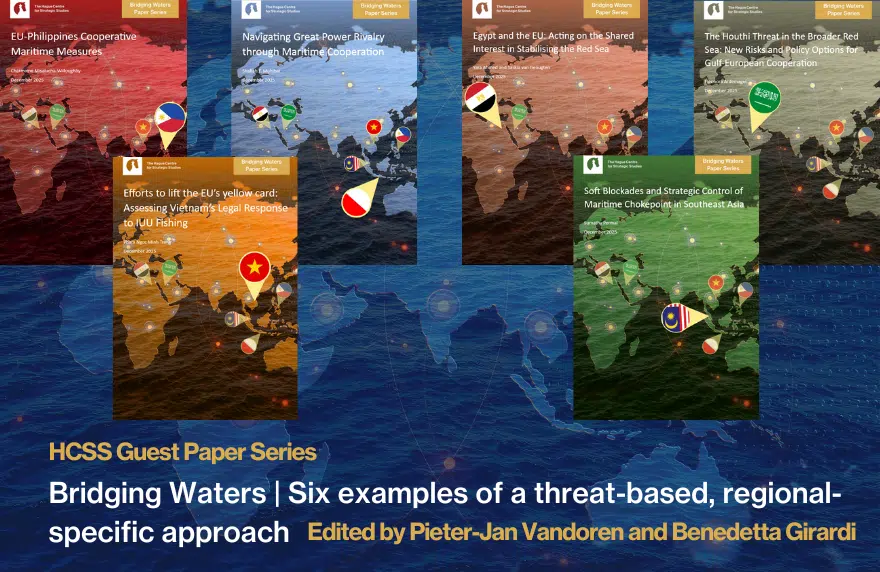
New report | Bridging Waters: Strengthening Europe’s Maritime Security Engagement Through Partnerships with Rising Middle Powers    

December 8, 2025
Download Report
Annexes

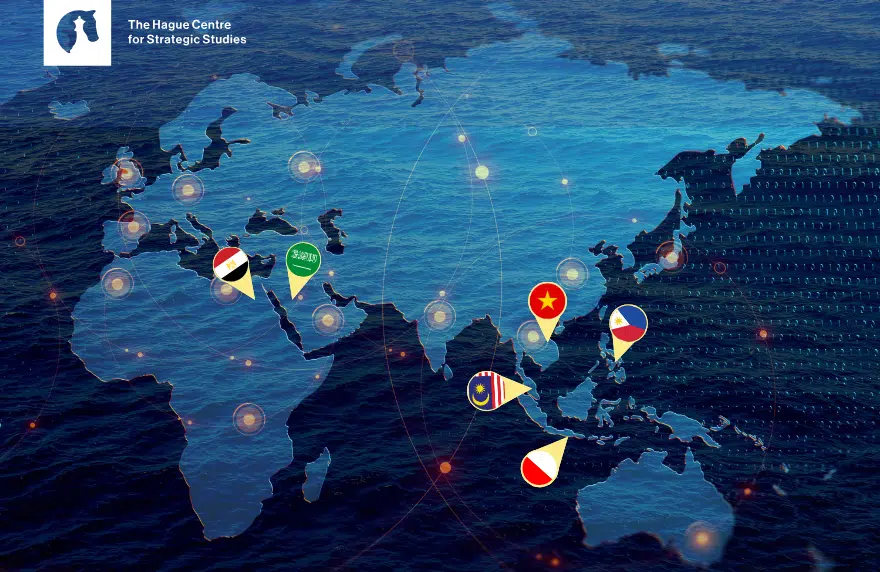
HCSS Strategic Analysts Benedetta Girardi and Pieter-Jan Vandoren examine how Europe can strengthen its maritime security engagement in two of the world’s most strategically vital regions: the South China Sea and the Red Sea. The report argues that Europe’s prosperity depends on secure and open sea lanes — yet both regions face rising instability driven by great-power rivalry, blue crime, chokepoint disruptions, hybrid threats, and accelerating environmental pressures. 

Using a threat-based methodology grounded in the AMCAT and Cooperative Effectiveness Assessment Frameworks, the report identifies the most urgent risks, evaluates preventive and responsive countermeasures, and maps out where cooperation with regional emerging powers can be both feasible and impactful. 

Key findings 

  • Threat landscapes are distinct but converging. 
    – In the South China Sea, threats are geostrategic and long-term, dominated by great-power competition and interstate disputes. 
    – In the Red Sea, threats are more episodic, driven by non-state actors, chokepoint vulnerabilities, terrorism, and piracy. 
  • Preventive measures offer Europe the most sustainable entry point, especially through capacity-building, joint training, maritime domain awareness, and information sharing. 
  • Responsive measures remain essential for high-intensity threats, but effectiveness hinges on trust, interoperability, and clear legal frameworks. 
  • Europe must match limited resources with strategic prioritisation, tailoring engagement to regional realities rather than adopting uniform approaches. 

Recommendations 
In the South China Sea, Europe should: 

  1. Develop multilateral crisis-management and deconfliction mechanisms with regional navies. 
  1. Strengthen maritime governance through cooperation on blue crime. 
  1. Future-proof critical infrastructure by supporting resilience in ports, undersea cables, and climate-adapted facilities. 

In the Red Sea, priorities include: 

  1. Enhancing chokepoint resilience through contingency planning and real-time surveillance systems. 
  1. Expanding coordinated multinational operations against piracy and smuggling. 
  1. Co-developing climate-resilient maritime infrastructure and environmental early-warning systems. 

Lead author Benedetta Girardi emphasises: 

“Europe cannot secure its sea lines of communication alone. Partnerships with rising middle powers are no longer optional — they are the key to preserving stability, protecting global trade, and building a resilient, rules-based maritime order.” 

The report concludes that Europe’s ability to act effectively at sea depends on a threat-based, region-specific approach that balances preventive investment with responsive readiness. By focusing on cooperation with emerging middle powers, Europe can strengthen maritime security where it matters most. The report proposes an actionable agenda to do so. 

Download Report
Annexes

Authors: Benedetta Girardi and Pieter-Jan Vandoren

Contributor: Thomas Jansen

Quality Assurance: Dr. Tim Sweijs

The research for and production of this report has been conducted within the PROGRESS research framework agreement. Responsibility for the contents and for the opinions expressed, rests solely with the authors and does not constitute, nor should be construed as, an endorsement by the Netherlands Ministries of Foreign Affairs and Defence.

  • Share on Facebook
  • Share on X
  • Share on WhatsApp
  • Share on LinkedIn
  • Share by Mail

Experts

Benedetta Girardi
Pieter-Jan Vandoren
Tim Sweijs

Related News

Related Content

Bridging Waters: Strengthening Europe’s Maritime Security Engagement Through Partnerships with Rising Middle Powers 
New Webinar | Bridging Waters: Middle Powers’ Cooperation on Maritime Security
Bridging Waters: Middle Powers’ Cooperation on Maritime Security

Office Address

  • The Hague Centre for Strategic Studies
  • Lange Voorhout 1
  • 2514 EA The Hague
  • The Netherlands

Contact Us

  • Telephone: +31(70) 318 48 40
  • E-mail: info@hcss.nl
  • IBAN NL10INGB0666328730
  • BIC INGBNL2A
  • VAT NL.8101.32.436.B01
  • Contact

Legal & Privacy

  • Disclaimer & Privacy
  • Algemene Voorwaarden (NL) 
  • Terms & Conditions (ENG) 
  • Coordinated Vulnerability Disclosure
  • Ethical Standards
  • Manual for Responsible Use of AI

Follow us

© The Hague Centre for Strategic Studies
    Link to: Benedetta Girardi | The Indo-Pacific In Focus: What is the Indo-Pacific? Link to: Benedetta Girardi | The Indo-Pacific In Focus: What is the Indo-Pacific? Benedetta Girardi | The Indo-Pacific In Focus: What is the Indo-Pacific?
    Scroll to top Scroll to top Scroll to top

    GDPR Consent

    Your privacy is important to us. Here you can set which consent you are allowing us with regards to the collection of general information, the placing of cookies of the collection of personal information. You can click 'Forget my settings' at the bottom of this form to revoke all given consents.

    Privacy policy | Close
    Settings

    GDPR Consent Settings

    Your privacy is important to us. Here you can set which consent you are allowing us with regards to the collection of general information, the placing of cookies of the collection of personal information. You can click 'Forget my settings' at the bottom of this form to revoke all given consents.

    Website statistics collect anonymized information about how the site is used. This information is used to optimize the website and to ensure an optimal user experience.

    View details

    Functional cookies are used to ensure the website works properly and are neccessary to make the site function. These cookies do not collect any personal data.  

    View details
    Forget my settings Deleted!