
HCSS
  • News
    • BNR | De Strateeg
    • Columns
    • Events
    • HCSS Newsletter
    • Podcasts
  • Publications
    • Publications
      • All Projects
      • All Publications
    • Geopolitics & Governance
      • Transatlantic Relations
      • Russia & Eurasia
      • Europe in the Indo-Pacific
      • AI in the Military Domain
      • PROGRESS / Strategic Monitor
    • Economics & Technology
      • Emerging Technologies
      • Critical Materials
      • Energy Security
    • Defence & Security
      • On Future War
      • Deterrence and Arms Control
      • Hybrid Threats
      • Cyber Security
    • Society & Resilience
      • Nationale Veiligheid en Weerbaarheid
      • Publieksmonitor Maatschappelijke Stabiliteit
      • Transnational Organised Crime
      • Strategic Monitor Dutch Police
    • Climate, Water & Food
      • Climate Security
      • Water, Peace & Security (WPS)
      • International Military Council on Climate and Security (IMCCS)
      • Food Security
  • Dashboards
    • Dashboards
      • All Tools
        • GINA
        • SARA
        • GATRI
        • DOMINO
    • Geopolitics & Governance
      • Diplomatic Networks
      • News Networks
      • Dutch Foreign Relations
      • Chinese Hybrid Threats
    • Economics & Technology
      • Economic Networks
      • Economic Risk
      • Critical Materials Supply Chains
      • Critical Materials Map
      • Critical Materials Pricing
      • Cyber Arms Watch
    • Defence & Security
      • Military Networks
      • Nuclear Timeline
    • Society & Resilience
      • Conflict Monitor
    • Climate, Water & Food
      • Agrifood Monitor
  • Leadership Practice
    • HCSS Leadership Practice
    • HCSS Boardroom
    • Leergang Strategie en Weerbare Rechtsorde
    • Strategic Negotiations Course
    • Serious Gaming
    • IDCSS | Indo-Dutch Cyber Security School
    • SANCS | Southern Africa-Netherlands Cyber Security School
  • About HCSS
    • Contact Us
    • HCSS Datalab
    • Our People
    • Funding & Transparency
    • Internship Programme
    • Press & Media Inquiries
    • Studio HCSS
    • Working at HCSS
    • Global Futures Foundation
  • Click to open the search input field Click to open the search input field Search
  • Menu Menu

News

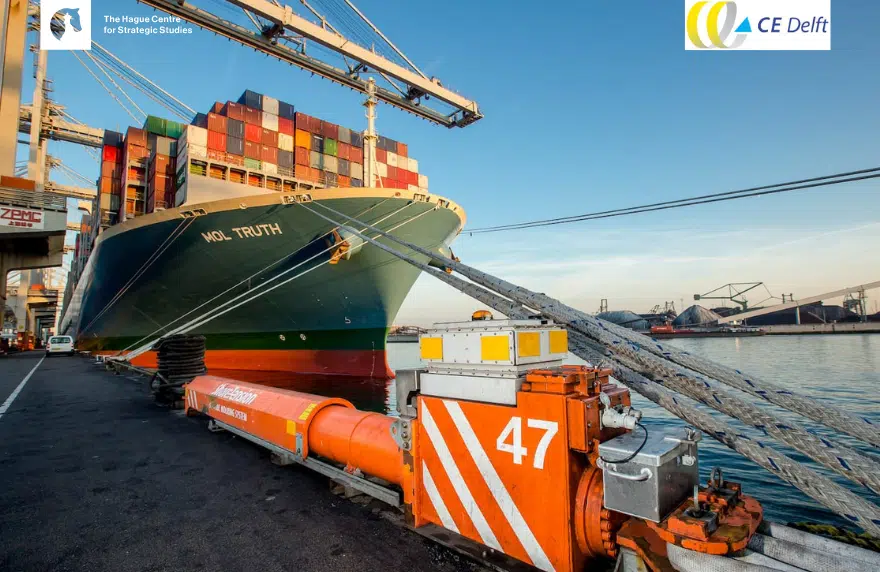
New report | Decarbonising maritime bunkering in the Netherlands and the embargo on Russian oil

March 20, 2023

The European Union’s (EU) sanctions on the import of Russian oil have far-reaching consequences for the global oil market and for European security of supply. At the same time, Fit-for-55 (FF55) plans for decarbonizing maritime shipping are under development and the various legislative proposals are expected to start being implemented around 2025. Sanctions could have an impact on the international position and decarbonization trajectory of the ARA (Amsterdam-Rotterdam-Antwerp) region, an important energy trade hub and the second largest bunkering port in the world. This report develops qualitative storylines that focus on the impacts of the sanctions on Russian oil on bunkering in ARA and the implementation of FF55 plans up to 2030.

The impact of the crude oil boycott of December 5th on European oil prices has been relatively weak and did not bring unexpected price hikes. Companies have been busy adapting to the sanctions during the second half of 2022, and most of Russian crude oil used in Europe had been replaced with alternatives by December 5th. However, Russian oil is still flowing to non-European countries that have not implemented sanctions, so the price of bunker fuels – specifically of fuel oil – in Europe may increase relatively to other locations that (still) sell discounted Russian oil.

In the longer term, the Dutch bunker market could develop in two ways – it could stay at levels similar to the pre-2022 situation or become more depressed than pre-2022. The position of Rotterdam and ARA as the EU’s largest bunker market is likely to remain the same across the two storylines, given that all European countries are facing similar decarbonization challenges. Compared to the global market, however, other ports could become similarly or even more attractive for investments in renewables.

Download Report

Authors: Irina Patrahau, Lucia van Geuns (HCSS) and Jasper Faber, Emiel van den Toorn (CE Delft)

The conclusions and recommendations presented in this paper are the result of independent research. Responsibility for the content rests with the authors and the authors alone. The research was made possible by a financial contribution from the Dutch Ministry of Infrastructure and Water Management to the Hague Centre for Strategic Studies (HCSS) and CE Delft.


  • Share on Facebook
  • Share on X
  • Share on WhatsApp
  • Share on LinkedIn
  • Share by Mail

Experts

Irina Patrahau
Lucia van Geuns

Related News

Related Content

Decarbonising maritime bunkering in the Netherlands and the embargo on Russian oil
Decarbonising Maritime Bunkering Netherlands and Embargo Russian Oil (HCSS 2023)
Decarbonising maritime bunkering in the Netherlands and the embargo on Russian oil

Office Address

  • The Hague Centre for Strategic Studies
  • Lange Voorhout 1
  • 2514 EA The Hague
  • The Netherlands

Contact Us

  • Telephone: +31(70) 318 48 40
  • E-mail: info@hcss.nl
  • IBAN NL10INGB0666328730
  • BIC INGBNL2A
  • VAT NL.8101.32.436.B01
  • Contact

Legal & Privacy

  • Disclaimer & Privacy
  • Algemene Voorwaarden 2024 (NL) 
  • Terms & Conditions 2024 (ENG) 
  • Algemene Voorwaarden 2026 (NL) 
  • Terns & Conditions 2026 (EN) 
  • Coordinated Vulnerability Disclosure
  • Ethical Standards
  • Manual for Responsible Use of AI

Follow us

© The Hague Centre for Strategic Studies
    Link to: Column Nieuwe Oogst: ‘Landbouw mag niet lijden onder desinteresse in technologie’ Link to: Column Nieuwe Oogst: ‘Landbouw mag niet lijden onder desinteresse in technologie’ Column Nieuwe Oogst: ‘Landbouw mag niet lijden onder desinteresse in ... Link to: De Strateeg | Strategische Vragen: Kan China zich een grote oorlog wel permitteren? Link to: De Strateeg | Strategische Vragen: Kan China zich een grote oorlog wel permitteren? De Strateeg | Strategische Vragen: Kan China zich een grote oorlog wel perm...
    Scroll to top Scroll to top Scroll to top

    GDPR Consent

    Your privacy is important to us. Here you can set which consent you are allowing us with regards to the collection of general information, the placing of cookies of the collection of personal information. You can click 'Forget my settings' at the bottom of this form to revoke all given consents.

    Privacy policy | Close
    Settings

    GDPR Consent Settings

    Your privacy is important to us. Here you can set which consent you are allowing us with regards to the collection of general information, the placing of cookies of the collection of personal information. You can click 'Forget my settings' at the bottom of this form to revoke all given consents.

    Website statistics collect anonymized information about how the site is used. This information is used to optimize the website and to ensure an optimal user experience.

    View details

    Functional cookies are used to ensure the website works properly and are neccessary to make the site function. These cookies do not collect any personal data.  

    View details
    Forget my settings Deleted!