Publications

Over the years, HCSS has built up an extensive archive of reports, monitors, papers and other publications. We disseminate the results of our research as broadly as possible to benefit the public good. Use the advanced search functions below to browse through our research library, most of which is available as free PDF downloads.

17 Jul 2025
Environmental conditions like drought, heat, and soil stress are increasingly linked to armed conflict, but the exact pathways remain unclear. In a new study, Ninoslav Malekovic, Maarten Vonk, Laura Birkman, and Tim Sweijs use advanced causal analysis on Iraqi subdistricts to reveal how these conditions—especially when paired with high energy demand and dense populations—can drive violence through complex chains of resource and demographic pressure. Their findings highlight where and why conflict is more likely, offering a foundation for targeted interventions to prevent violence before it unfolds.
15 Jul 2025
This position paper outlines how the Republic of Korea and the Netherlands can deepen their strategic partnership amid global geopolitical and technological shifts. Highlighting key areas such as security, AI governance, and high-tech industry cooperation, the paper calls for joint action on cyber defence, education, clean tech, and innovation. Building on the 2025 ROK-NL Forum, held on April 23rd, it presents a roadmap for agile, values-driven cooperation between Europe and the Indo-Pacific.
7 Jul 2025
Hoe kunnen klimaatgerelateerde gebeurtenissen de sociale, politieke en economische processen in Nederland beïnvloeden? In dit nieuwe HCSS rapport verkennen Laura Birkman, Fiona De Cuyper en Julie Jeuken hoe klimaatverandering maatschappelijke onrust kan versterken en veiligheidsvraagstukken in Nederland beïnvloedt. Met ketenanalyses en strategische aanbevelingen biedt het rapport richting voor toekomstig beleid en versterking van maatschappelijke weerbaarheid.
7 Jul 2025
Foreign Information Manipulation and Interference (FIMI) has emerged as a pressing and complex challenge to democratic resilience across both Europe and the Indo-Pacific. This HCSS policy brief by Laura Jasper explores how Europe and the Indo-Pacific can strengthen cross-regional cooperation to enhance resilience against FIMI. It examines regional policy frameworks and national responses, revealing divergent approaches.
7 Jul 2025
Foreign Information Manipulation and Interference (FIMI) poses an evolving and systemic threat to democratic institutions and societal cohesion in both the Indo-Pacific and Europe. This policy brief by Benedetta Girardi provides a comprehensive overview of the FIMI threat landscape across the two regions, identifying shared vulnerabilities, common tactics, and the unique regional contexts that shape how these threats manifest.
2 Jul 2025
The costs of energy are an important part of various industrial value chains and are very decisive for the competitive position of the industry. In three studies commissioned by the Royal VNCI and the National Program for Sustainable Industry, TNO, HCSS and Roland Berger compared the future energy costs of the renewable energy supply for industrial processes in the Netherlands with Saudi Arabia for two value chains: the chlor-alkali chain and the production of sustainable aviation fuel (SAF) from household waste via syncrude.
13 Jun 2025
A new HCSS Capstone paper by Hans Horan, Sofia Romansky and Davis Ellison outlines a blueprint for modernising NATO's C4ISR systems across NATO Europe. Building on four expert guest papers, it presents urgent solutions across cloud integration, AI adoption, institutional reform, and interoperability, laying the groundwork for collective digital readiness ahead of the 2025 NATO Summit.
12 Jun 2025
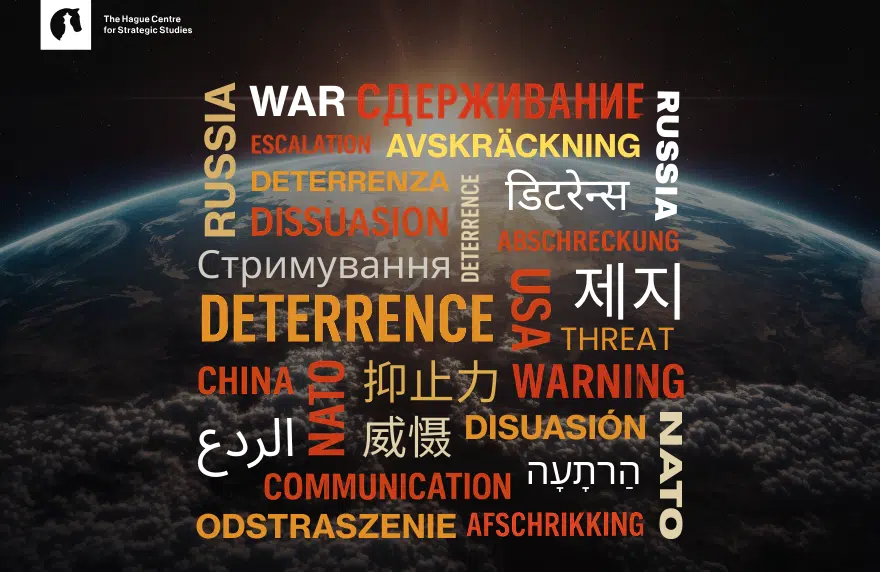
Why do deterrence efforts fail? Often, it’s not what is said, but how it’s said. In a new report, HCSS strategic advisor Dr. Jeffrey H. Michaels explores how the success or failure of deterrence often hinges not just on military threats, but on how warnings are communicated. With case studies from WWI to Ukraine, this report offers practical lessons for NATO’s current and future deterrence strategies.
11 Jun 2025
A new HCSS guest paper by Elsa B. Kania assesses China's evolving command capabilities and the implications for NATO with a particular focus on developments in C4ISR. It outlines the strategic importance of the PLA's advancements and highlights key lessons for NATO, emphasising resilience, adaptation and responsible innovation in future command capabilities.
26 May 2025
A new HCSS guest paper by Andrea Gilli and Mauro Gilli explores how NATO’s information backbone is under threat from electronic warfare, cyber vulnerabilities, and fragmentation. It outlines urgent reforms in AI-driven command, procurement, and investment alignment—vital ahead of the 2025 NATO Summit.
19 May 2025
In a new HCSS guest paper, Kateryna Bondar examines how Ukraine’s Armed Forces have transformed their battlefield coordination under pressure. Through rapid innovation and adaptation, Ukraine developed a more agile C4ISR system. The paper offers key lessons and five recommendations for NATO allies seeking to modernise their command structures.
12 May 2025
In a new HCSS guest paper, Antonio Calcara explores NATO’s cloud computing strategy and its implications for digital warfare. As cloud infrastructure becomes critical for AI-driven operations, NATO faces military and industrial challenges in implementation. The paper offers strategic insights on moving toward “cooperation by design” in future capabilities.
9 May 2025
Hybrid threats pose a complex and evolving challenge to Western governments. These threats span military and civilian domains, blending conventional and unconventional tactics, remaining below the threshold of armed conflict. Their ambiguity and unpredictability make them difficult to detect and counter. Our most recent research by Maarten Vonk and Tim Sweijs uses game-theoretic modelling to evaluate the effectiveness of various counter-measures—ranging from enhancing societal resilience and denying adversaries the means to act, to dissuasion through the threat of punishment.
7 May 2025
The fifth edition of the ‘Observer’, analysing the results of the HCSS Socio-Political Instability Survey, continues to monitor high levels of instability in Western Asia and Eastern Europe. Despite a Gaza ceasefire, tensions between Israel and Iran and the fallout from Syria’s regime collapse persist. Ukraine now tops the list of high-risk countries, likely due to war-related uncertainty. Notably, the U.S. has surged as the most influential country in global instability, rising from 15% to 60%, reflecting concerns over Trump’s second-term policies. Economic factors have overtaken military ones as the main drivers of instability, amid growing fears of trade wars.
29 Apr 2025
On March 27, HCSS and TNO, in close collaboration with the Ministries of Infrastructure and Water Management and Defence, organised the Seabed Security Seminar in The Hague. As part of the preparations, TNO in collaboration with HCSS and the Ministeries, drafted a position paper containing concrete recommendations for action, aimed at strengthening the debate and contributing to effective solutions for the strategic security of the seabed.
22 Apr 2025
How prepared is NATO’s European fuel infrastructure for war on its Eastern Flank? Fossil fuels are the backbone of modern militaries, a fact that is unlikely to change in the foreseeable future. This new report investigates the challenges to fuel logistics that NATO could face if forced into a large-scale conflict on its Eastern Flank. It finds that several core features of the European fuel supply system could emerge as serious constraints on military effectiveness and provides several recommendations to address these challenges.
16 Apr 2025
Beyond Western interpretations, how is Russia debating its own military future and stance towards NATO? A new HCSS report, part of the innovative multi-year research project RUBASE, sets out to improve our understanding of Russia’s multi-domain international behaviour, by providing insights derived directly from Russian-language sources on two crucial topics: Russia’s capacity for military regeneration and its potential intentions towards NATO. The research leverages an innovative analytical approach, combining deep domain expertise with AI assistance, to systematically process a scale of information previously unmanageable.
16 Apr 2025
Voortzettingsvermogen en weerbaarheid: Met de toenemende dreiging vanuit Rusland moet Nederland haar krijgsmacht voorbereiden op langdurige inzet. Dit nieuwe HCSS rapport door Frank Bekkers, Hans van der Louw, Otto van Wiggen, Björn de Heer, Pieter-Jan Vandoren, Michel Rademaker en Nino Malekovic analyseert hoe we ons voortzettingsvermogen kunnen versterken, van logistiek en voorraden tot personeelsstrategieën en industriële capaciteit. Lees meer over hoe Nederland haar defensie-inzet kan schalen en volhouden in een conflict.
9 Apr 2025
On March 27, HCSS and TNO, in close collaboration with the Ministries of Infrastructure and Water Management and Defence, organised the Seabed Security Seminar in The Hague. As part of the preparations, TNO in collaboration with HCSS and the Ministeries, drafted a position paper containing concrete recommendations for action, aimed at strengthening the debate and contributing to effective solutions for the strategic security of the seabed.
7 Apr 2025
What does the future hold for the Royal Netherlands Navy? The latest HCSS report by Davis Ellison, Pieter-Jan Vandoren and Frank Bekkers explores the future of Dutch maritime security in the 2040-2050 period. With climate change, shifting trade dynamics, and growing geopolitical instability, the RNLN must adapt to emerging threats. The report outlines key trends, four potential conflict scenarios, and critical capability recommendations.
31 Mar 2025
New HCSS guest paper by Alexander Lott explores legal solutions to safeguard critical underwater infrastructure from sabotage and accidental damage. Existing international law offers little protection beyond territorial waters, leaving submarine cables and pipelines vulnerable. This paper examines unconventional legal tools—ranging from piracy laws to safety zones—that could help coastal states take action. As recent incidents in the Baltic Sea and beyond have shown, securing these vital assets is more urgent than ever.
31 Mar 2025
Submarine cables are the lifeline of global digital communication, yet they remain vulnerable to geopolitical risks, cyber threats, and sabotage. Dr. Kenny Huang examines these security challenges and explores strategies to protect critical infrastructure in this new HCSS guest paper. From AI-powered monitoring to stronger international cooperation, the paper provides key recommendations for strengthening sea cable security in an era of rising global tensions.
31 Mar 2025
How can regional cooperation improve maritime security in the Baltic Sea? A new HCSS guest paper by Adriana Ávila-Zúñiga-Nordfjeld on securing critical seabed infrastructure in the Baltic Sea explores the feasibility of expanding the Helsinki Convention and HELCOM to include maritime security measures. It highlights the need for a regional agreement to counter undersea sabotage threats through standardized policies and cooperation.
27 Mar 2025
The latest HCSS report examines the precarious state of the international nuclear order and the challenges Europe faces as U.S. security guarantees become increasingly uncertain. With arms control agreements collapsing and the return of transactional U.S. alliances, European nations must explore alternative deterrence strategies. This report by Davis Ellison, Samuel Zilincik, and Tim Sweijs outlines six potential pathways for strengthening European security, from nuclear-sharing to strategic conventional weapons.

© The Hague Centre for Strategic Studies