
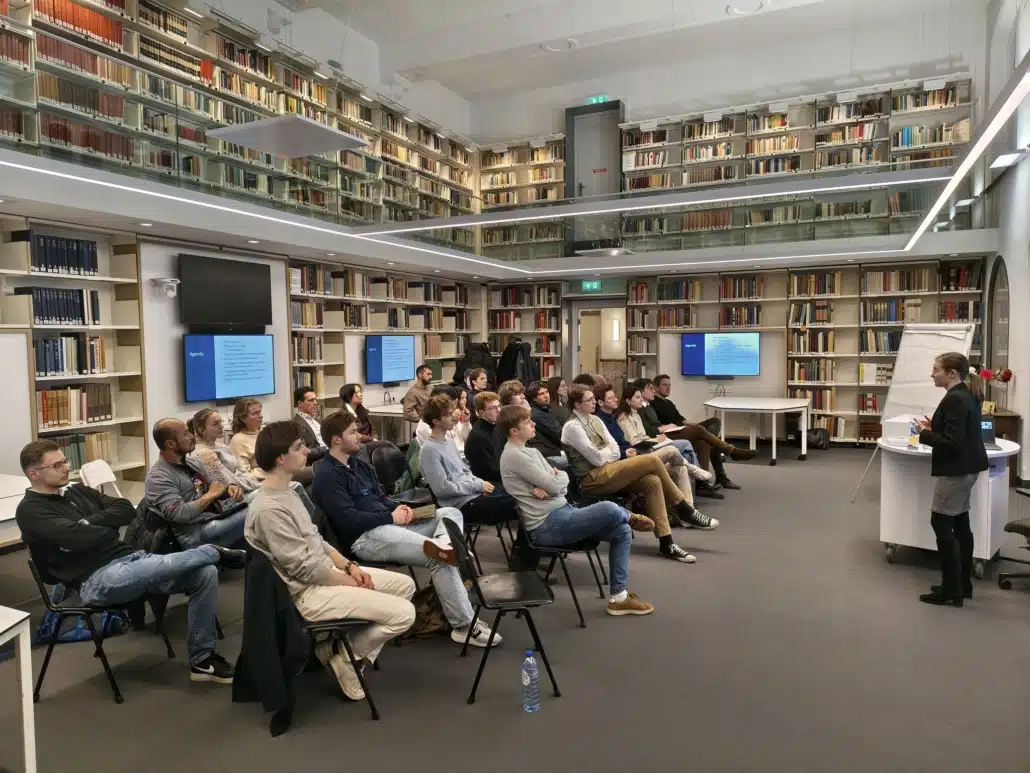
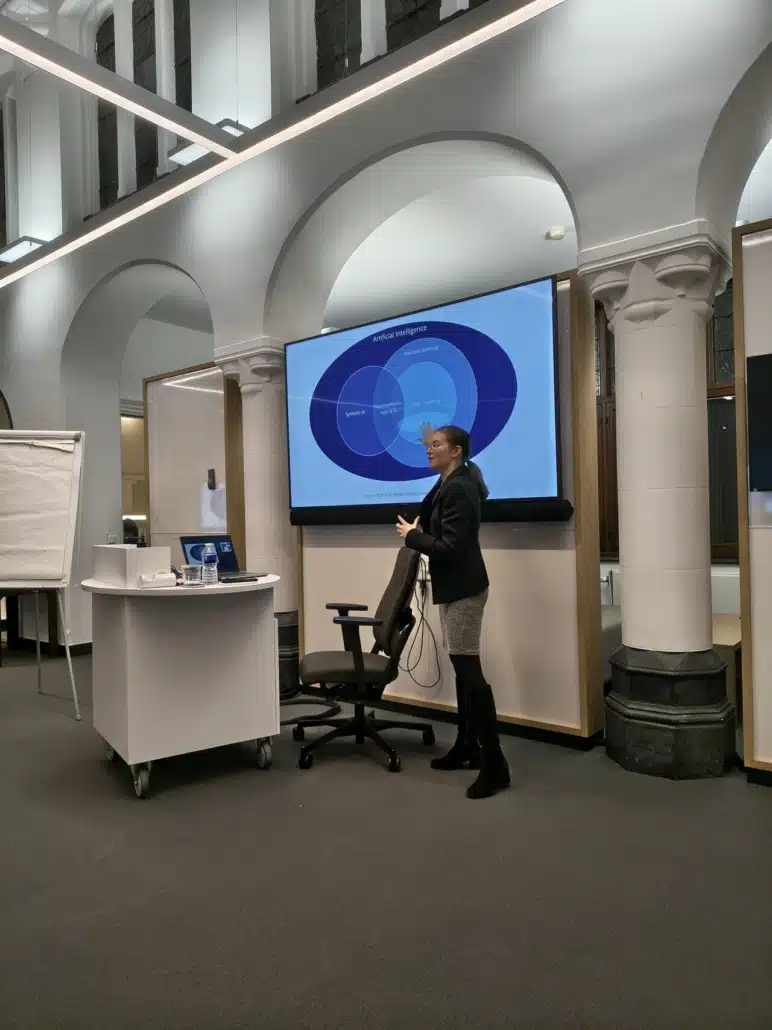
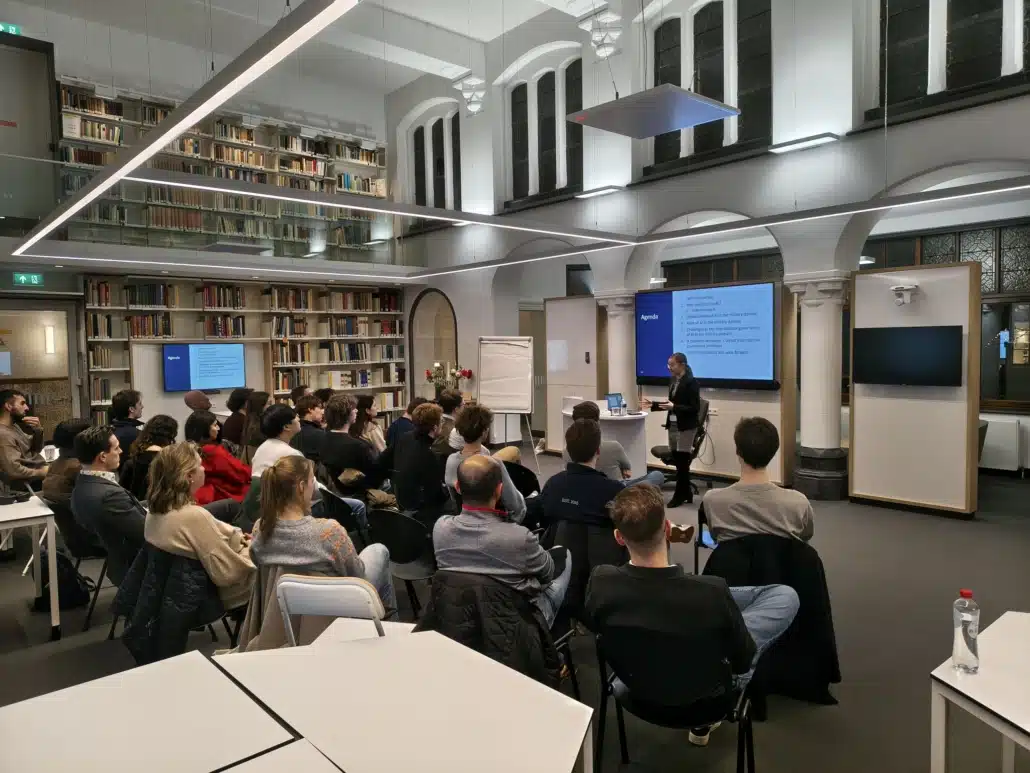
On Monday, the 9th of February, Sofia Romansky, Strategic Analyst at HCSS and Project Coordinator for GC REAIM, gave an expert talk at Utrecht University to examine the expanding role of AI in defense.
In this lecture, hosted by GA! Think Tank in Utrecht, Sofia Romansky gave a crash course on the intersection of artificial intelligence and the military domain, as well as the emerging challenges and opportunities. She emphasised that the fundamental obstacles to the effective and responsible integration of AI into security and defense are both technical and human; they require us to contend not only with complex socio-technical systems, but also create institutional safeguards to ensure that human users are able to interact with these systems in optimal ways. Findings the solutions to these problems in turn involves adopting an interdisciplinary mindset and a willingness to ask the difficult questions.
Sofia’s presentation started by outlining why AI has taken the centre stage in the last couple of years, attributing this primarily to four factors: advances in neural networks and specifically large language models, consistent hardware advances in semiconductors, ramping great power competition, and the demonstrated relevance of AI in real-world battlefields.
“Artificial intelligence plays a complex role in geopolitics, as it is both the subject and object of competition; states compete over AI capabilities and at the same time use AI as a signal of strength.”
Subsequently, she outlined the utility of AI for operations and the corresponding challenges, related to the preservation of human agency and responsibility. She concluded by highlighting some key global governance initiatives that aim to create common guidelines for states and militaries – as the challenges faced at this interface are necessarily trans-boundary. Despite certain pitfalls, global governance is a worthwhile pursuit for shared learning and the development of safe systems.
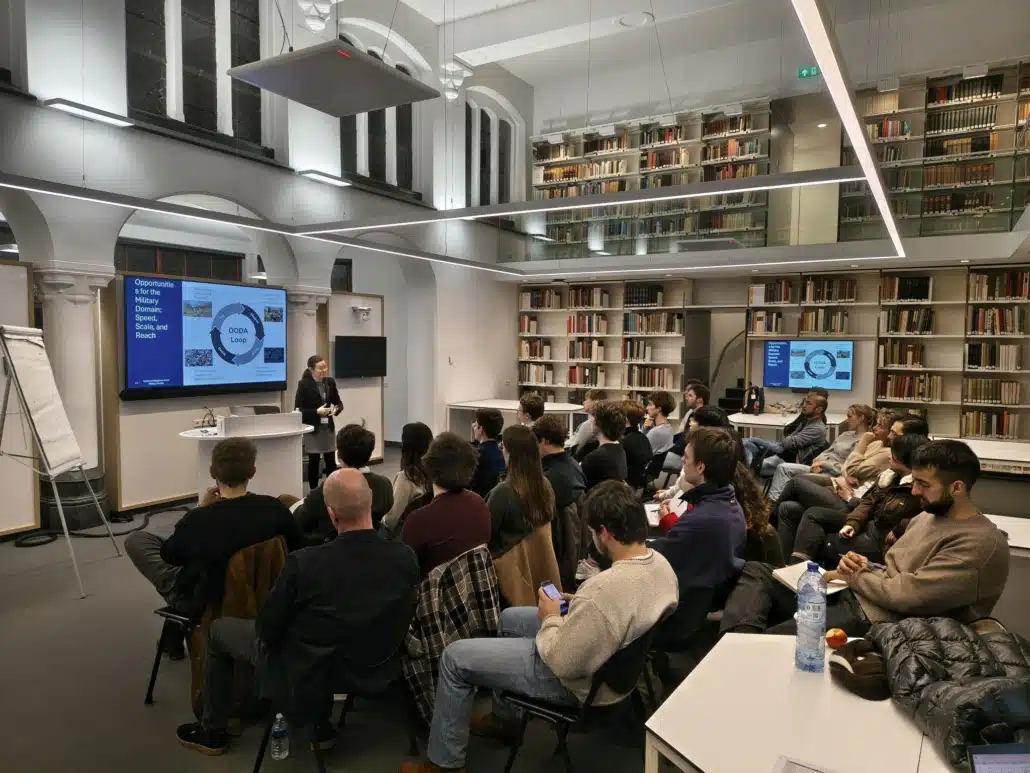
The fundamental appeal of AI as a category of technologies for the military domain lies in the fact that AI capabilities can accelerate processes throughout the operations loop: observation, orientation, decision-making and action.”
Read GA!’s event report here: GA! Think Tank
Experts

Related Content